Malerba I et al. (OCT 2002)
Toxicological sciences : an official journal of the Society of Toxicology 69 2 433--8
In vitro myelotoxicity of propanil and 3,4-dichloroaniline on murine and human CFU-E/BFU-E progenitors.
Because of the wide use of pesticides for domestic and industrial purposes,the evaluation of their potential effects is of major concern for public health. The myelotoxicity of the herbicide propanil (3,4-dichloroproprioanilide) and its metabolite 3,4-dichloroaniline (DCA) is well documented in mice,but evidence that pesticides may severely compromise hematopoiesis in humans is lacking. In this study,an interspecies comparison of in vitro toxicity of these two compounds on murine and human burst- and colony-forming unit-erythrocyte (BFU-E,CFU-E) and colony-forming unit-granulocyte/macrophage (CFU-GM) progenitors,has been carried out. Murine bone marrow progenitors and human cord blood cells were exposed to propanil or DCA in doses ranging from 10 micro M to 1000 micro M,and the toxic effect was detected by a clonogenic assay with continuous exposure to the compounds. The results on murine cells indicate that the erythrocytic lineage is the most sensitive target for propanil and DCA. On the other hand,human progenitors seem to be less sensitive to the toxic effects of both compounds than murine progenitors at the same concentrations (IC(50) values are 305.2 +/- 22.6 micro M [total erythroid colonies] and textgreater500 micro M [CFU-GM] for propanil). Propanil was significantly more toxic to human erythroid progenitors than to human CFU-GM progenitors,as was found for the murine cells,emphasizing the role of the heme pathway as the target for propanil. These data confirm the evidence that the compounds investigated interfere with erythroid colony formation at different stages of the differentiation pathway and have different effects according to the dose.
View Publication
产品类型:
产品号#:
04564
04534
04544
产品名:
入门套件MethoCult™H4534经典无EPO
MethoCult™H4534经典无EPO
MethoCult™H4534经典无EPO
von Vietinghoff S et al. (MAY 2007)
Blood 109 10 4487--93
NB1 mediates surface expression of the ANCA antigen proteinase 3 on human neutrophils.
Antineutrophil cytoplasmic antibodies (ANCAs) with specificity for proteinase 3 (PR3) are central to a form of ANCA-associated vasculitis. Membrane PR3 (mPR3) is expressed only on a subset of neutrophils. The aim of this study was to determine the mechanism of PR3 surface expression on human neutrophils. Neutrophils were isolated from patients and healthy controls,and hematopoietic stem cells from cord blood served as a model of neutrophil differentiation. Surface expression was analyzed by flow cytometry and confocal microscopy,and proteins were analyzed by Western blot experiments. Neutrophil subsets were separated by magnetic cell sorting. Transfection experiments were carried out in HEK293 and HL60 cell lines. Using neutrophils from healthy donors,patients with vasculitis,and neutrophilic differentiated stem cells we found that mPR3 display was restricted to cells expressing neutrophil glycoprotein NB1,a glycosylphosphatidylinositol (GPI)-linked surface receptor. mPR3 expression was decreased by enzymatic removal of GPI anchors from cell membranes and was absent in a patient with paroxysmal nocturnal hemoglobinuria. PR3 and NB1 coimmunoprecipitated from and colocalized on the neutrophil plasma membrane. Transfection with NB1 resulted in specific PR3 surface binding in different cell types. We conclude that PR3 membrane expression on neutrophils is mediated by the NB1 receptor.
View Publication
产品类型:
产品号#:
09600
09650
产品名:
StemSpan™ SFEM
StemSpan™ SFEM
Babiarz JE et al. (JUL 2012)
Stem cells and development 21 11 1956--1965
Determination of the human cardiomyocyte mRNA and miRNA differentiation network by fine-scale profiling.
To gain insight into the molecular regulation of human heart development,a detailed comparison of the mRNA and miRNA transcriptomes across differentiating human-induced pluripotent stem cell (hiPSC)-derived cardiomyocytes and biopsies from fetal,adult,and hypertensive human hearts was performed. Gene ontology analysis of the mRNA expression levels of the hiPSCs differentiating into cardiomyocytes revealed 3 distinct groups of genes: pluripotent specific,transitional cardiac specification,and mature cardiomyocyte specific. Hierarchical clustering of the mRNA data revealed that the transcriptome of hiPSC cardiomyocytes largely stabilizes 20 days after initiation of differentiation. Nevertheless,analysis of cells continuously cultured for 120 days indicated that the cardiomyocytes continued to mature toward a more adult-like gene expression pattern. Analysis of cardiomyocyte-specific miRNAs (miR-1,miR-133a/b,and miR-208a/b) revealed an miRNA pattern indicative of stem cell to cardiomyocyte specification. A biostatistitical approach integrated the miRNA and mRNA expression profiles revealing a cardiomyocyte differentiation miRNA network and identified putative mRNAs targeted by multiple miRNAs. Together,these data reveal the miRNA network in human heart development and support the notion that overlapping miRNA networks re-enforce transcriptional control during developmental specification.
View Publication
产品类型:
产品号#:
85850
85857
产品名:
mTeSR™1
mTeSR™1
Palmer JA et al. (AUG 2012)
Alcoholism,clinical and experimental research 36 8 1314--1324
Metabolic biomarkers of prenatal alcohol exposure in human embryonic stem cell-derived neural lineages.
BACKGROUND: Fetal alcohol spectrum disorders (FASD) are a leading cause of neurodevelopmental disability. The mechanisms underlying FASD are incompletely understood,and biomarkers to identify those at risk are lacking. Here,we perform metabolomic analysis of embryoid bodies and neural lineages derived from human embryonic stem (hES) cells to identify the neural secretome produced in response to ethanol (EtOH) exposure. METHODS: WA01 and WA09 hES cells were differentiated into embryoid bodies,neural progenitors,or neurons. Cells along this progression were cultured for 4 days with 0,0.1,or 0.3% EtOH. Supernatants were subjected to C18 chromatography followed by ESI-QTOF-MS. Features were annotated using public databases,and the identities of 4 putative biomarkers were confirmed with purified standards and comparative MS/MS. RESULTS: EtOH treatment induced statistically significant changes to metabolite abundance in human embryoid bodies (180 features),neural progenitors (76 features),and neurons (42 features). There were no shared significant features between different cell types. Fifteen features showed a dose-response to EtOH. Four chemical identities were confirmed: L-thyroxine,5'-methylthioadenosine,and the tryptophan metabolites,L-kynurenine and indoleacetaldehyde. One feature with a putative annotation of succinyladenosine was significantly increased in both EtOH treatments. Additional features were selective to EtOH treatment but were not annotated in public databases. CONCLUSIONS: EtOH exposure induces statistically significant changes to the metabolome profile of human embryoid bodies,neural progenitors,and neurons. Several of these metabolites are normally present in human serum,suggesting their usefulness as potential serum FASD biomarkers. These findings suggest the biochemical pathways that are affected by EtOH in the developing nervous system and delineate mechanisms of alcohol injury during human development.
View Publication
产品类型:
产品号#:
85850
85857
产品名:
mTeSR™1
mTeSR™1
Yang Y et al. (MAY 2015)
Proceedings of the National Academy of Sciences of the United States of America 112 18 E2337--------46
Heightened potency of human pluripotent stem cell lines created by transient BMP4 exposure
Human pluripotent stem cells (PSCs) show epiblast-type pluripotency that is maintained with ACTIVIN/FGF2 signaling. Here,we report the acquisition of a unique stem cell phenotype by both human ES cells (hESCs) and induced pluripotent stem cells (iPSCs) in response to transient (24-36 h) exposure to bone morphogenetic protein 4 (BMP4) plus inhibitors of ACTIVIN signaling (A83-01) and FGF2 (PD173074),followed by trypsin dissociation and recovery of colonies capable of growing on a gelatin substratum in standard medium for human PSCs at low but not high FGF2 concentrations. The self-renewing cell lines stain weakly for CDX2 and strongly for NANOG,can be propagated clonally on either Matrigel or gelatin,and are morphologically distinct from human PSC progenitors on either substratum but still meet standard in vitro criteria for pluripotency. They form well-differentiated teratomas in immune-compromised mice that secrete human chorionic gonadotropin (hCG) into the host mouse and include small areas of trophoblast-like cells. The cells have a distinct transcriptome profile from the human PSCs from which they were derived (including higher expression of NANOG,LEFTY1,and LEFTY2). In nonconditioned medium lacking FGF2,the colonies spontaneously differentiated along multiple lineages,including trophoblast. They responded to PD173074 in the absence of both FGF2 and BMP4 by conversion to trophoblast,and especially syncytiotrophoblast,whereas an A83-01/PD173074 combination favored increased expression of HLA-G,a marker of extravillous trophoblast. Together,these data suggest that the cell lines exhibit totipotent potential and that BMP4 can prime human PSCs to a self-renewing alternative state permissive for trophoblast development. The results may have implications for regulation of lineage decisions in the early embryo.
View Publication
产品类型:
产品号#:
07923
100-0485
100-1077
85850
85857
产品名:
Dispase (1 U/mL)
温和细胞解离试剂
ReLeSR™
mTeSR™1
mTeSR™1
Shetty DK and Inamdar MS (MAR 2016)
Stem Cell Research 16 2 290--292
Generation of human embryonic stem cell line expressing a red fluorescent protein: BJNhem20-pCAG-tdTomato
Human embryonic stem cell line BJNhem20-pCAG-tdTomato was generated using non-viral method. The construct pCAG-tdTomato was transfected using microporation procedure. This fluorescent hESC line can help to study heterogeneity within individual cells in hESC colonies by enabling live tracking of their growth,migration and differentiation properties. This cell line also serves as a resource for additional transgene introduction/knock-out/knock-in generation in a fluorescent background and allows ease of analysis in studies involving cell mixing.
View Publication
产品类型:
产品号#:
85850
85857
产品名:
mTeSR™1
mTeSR™1
Cantone I et al. (AUG 2016)
Nature communications 7 August 12354
Ordered chromatin changes and human X chromosome reactivation by cell fusion-mediated pluripotent reprogramming.
Erasure of epigenetic memory is required to convert somatic cells towards pluripotency. Reactivation of the inactive X chromosome (Xi) has been used to model epigenetic reprogramming in mouse,but human studies are hampered by Xi epigenetic instability and difficulties in tracking partially reprogrammed iPSCs. Here we use cell fusion to examine the earliest events in the reprogramming-induced Xi reactivation of human female fibroblasts. We show that a rapid and widespread loss of Xi-associated H3K27me3 and XIST occurs in fused cells and precedes the bi-allelic expression of selected Xi-genes by many heterokaryons (30-50%). After cell division,RNA-FISH and RNA-seq analyses confirm that Xi reactivation remains partial and that induction of human pluripotency-specific XACT transcripts is rare (1%). These data effectively separate pre- and post-mitotic events in reprogramming-induced Xi reactivation and reveal a complex hierarchy of epigenetic changes that are required to reactivate the genes on the human Xi chromosome.
View Publication
产品类型:
产品号#:
85850
85857
产品名:
mTeSR™1
mTeSR™1
Mazzotta S et al. (OCT 2016)
Stem cell reports 7 4 764--776
Distinctive Roles of Canonical and Noncanonical Wnt Signaling in Human Embryonic Cardiomyocyte Development.
Wnt signaling is a key regulator of vertebrate heart development; however,specific roles for human cardiomyocyte development remain uncertain. Here we use human embryonic stem cells (hESCs) to analyze systematically in human cardiomyocyte development the expression of endogenous Wnt signaling components,monitor pathway activity,and dissect stage-specific requirements for canonical and noncanonical Wnt signaling mechanisms using small-molecule inhibitors. Our analysis suggests that WNT3 and WNT8A,via FZD7 and canonical signaling,regulate BRACHYURY expression and mesoderm induction; that WNT5A/5B,via ROR2 and noncanonical signaling,regulate MESP1 expression and cardiovascular development; and that later in development WNT2,WNT5A/5B,and WNT11,via FZD4 and FZD6,regulate functional cardiomyocyte differentiation via noncanonical Wnt signaling. Our findings confirm in human development previously proposed roles for canonical Wnt signaling in sequential stages of vertebrate cardiomyogenesis,and identify more precise roles for noncanonical signaling and for individual Wnt signal and Wnt receptor genes in human cardiomyocyte development.
View Publication
产品类型:
产品号#:
85850
85857
产品名:
mTeSR™1
mTeSR™1
Wang G et al. (JAN 2017)
Nature protocols 12 1 88--103
Efficient, footprint-free human iPSC genome editing by consolidation of Cas9/CRISPR and piggyBac technologies.
Genome editing of human induced pluripotent stem cells (hiPSCs) offers unprecedented opportunities for in vitro disease modeling and personalized cell replacement therapy. The introduction of Cas9-directed genome editing has expanded adoption of this approach. However,marker-free genome editing using standard protocols remains inefficient,yielding desired targeted alleles at a rate of ∼1-5%. We developed a protocol based on a doxycycline-inducible Cas9 transgene carried on a piggyBac transposon to enable robust and highly efficient Cas9-directed genome editing,so that a parental line can be expeditiously engineered to harbor many separate mutations. Treatment with doxycycline and transfection with guide RNA (gRNA),donor DNA and piggyBac transposase resulted in efficient,targeted genome editing and concurrent scarless transgene excision. Using this approach,in 7 weeks it is possible to efficiently obtain genome-edited clones with minimal off-target mutagenesis and with indel mutation frequencies of 40-50% and homology-directed repair (HDR) frequencies of 10-20%.
View Publication
产品类型:
产品号#:
85850
85857
产品名:
mTeSR™1
mTeSR™1
Guo D et al. (NOV 2016)
Stem cell research 17 3 670--672
Generation of an Abcc8 heterozygous mutation human embryonic stem cell line using CRISPR/Cas9.
The gene of ATP-binding cassette subfamily C member 8 (Abcc8) is cytogenetically located at 11p15.1 and encodes the sulfonylurea receptor (SUR1). SUR1 is a subunit of ATP-sensitive potassium channel (KAPT) in the β-cell regulating insulin secretion. Mutations of ABCC8 are responsible for congenital hyperinsulinism (CHI). Here we reported that an Abcc8 heterozygous mutant cell line was generated by CRISPR/Cas9 technique with 1bp insertion resulting in abnormal splicing on human embryonic stem cell line H1. The phenotypic characteristics of this cell line reveal defective KATP channel and diazoxide-responsive that provides ideal model for molecular pathology research and drug screening for CHI.
View Publication
产品类型:
产品号#:
85850
85857
产品名:
mTeSR™1
mTeSR™1
Lippmann ES et al. (FEB 2014)
Scientific reports 4 February 2014 4160
A retinoic acid-enhanced, multicellular human blood-brain barrier model derived from stem cell sources.
Blood-brain barrier (BBB) models are often used to investigate BBB function and screen brain-penetrating therapeutics,but it has been difficult to construct a human model that possesses an optimal BBB phenotype and is readily scalable. To address this challenge,we developed a human in vitro BBB model comprising brain microvascular endothelial cells (BMECs),pericytes,astrocytes and neurons derived from renewable cell sources. First,retinoic acid (RA) was used to substantially enhance BBB phenotypes in human pluripotent stem cell (hPSC)-derived BMECs,particularly through adherens junction,tight junction,and multidrug resistance protein regulation. RA-treated hPSC-derived BMECs were subsequently co-cultured with primary human brain pericytes and human astrocytes and neurons derived from human neural progenitor cells (NPCs) to yield a fully human BBB model that possessed significant tightness as measured by transendothelial electrical resistance (˜5,000 $\$(2)). Overall,this scalable human BBB model may enable a wide range of neuroscience studies.
View Publication


 EasySep™小鼠TIL(CD45)正选试剂盒




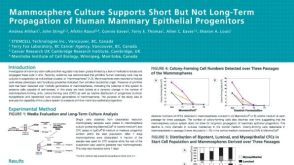 科学海报Mammosphere Culture Supports Short But Not Long-Term Propagation of Human Mammary Epithelial Progenitors
 沪公网安备31010102008431号