Lu S-J et al. (JUL 2013)
Regenerative medicine 8 4 413--424
3D microcarrier system for efficient differentiation of human pluripotent stem cells into hematopoietic cells without feeders and serum [corrected].
BACKGROUND Human embryonic stem cells (hESCs) have been derived and maintained on mouse embryonic fibroblast feeders to keep their undifferentiated status. To realize their clinical potential,a feeder-free and scalable system for large scale production of hESCs and their differentiated derivatives is required. MATERIALS & METHODS hESCs were cultured and passaged on serum/feeder-free 3D microcarriers for five passages. For embryoid body (EB) formation and hemangioblast differentiation,the medium for 3D microcarriers was directly switched to EB medium. RESULTS hESCs on 3D microcarriers maintained pluripotency and formed EBs,which were ten-times more efficient than hESCs cultured under 2D feeder-free conditions (0.11 ± 0.03 EB cells/hESC input 2D vs 1.19 ± 0.32 EB cells/hESC input 3D). After replating,EB cells from 3D culture readily developed into hemangioblasts with the potential to differentiate into hematopoietic and endothelial cells. Furthermore,this 3D system can also be adapted to human induced pluripotent stem cells,which generate functional hemangioblasts with high efficiency. CONCLUSION This 3D serum- and stromal-free microcarrier system is important for future clinical applications,with the potential of developing to a GMP-compatible scalable system.
View Publication
产品类型:
产品号#:
04436
05850
05857
05870
05875
85850
85857
85870
85875
产品名:
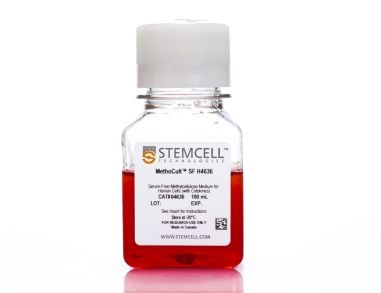
MethoCult™ SF H4436
mTeSR™1
mTeSR™1
Heckl D et al. (APR 2011)
Blood 117 14 3737--47
Lentiviral gene transfer regenerates hematopoietic stem cells in a mouse model for Mpl-deficient aplastic anemia.
Thpo/Mpl signaling plays an important role in the maintenance of hematopoietic stem cells (HSCs) in addition to its role in megakaryopoiesis. Patients with inactivating mutations in Mpl develop thrombocytopenia and aplastic anemia because of progressive loss of HSCs. Yet,it is unknown whether this loss of HSCs is an irreversible process. In this study,we used the Mpl knockout (Mpl(-/-)) mouse model and expressed Mpl from newly developed lentiviral vectors specifically in the physiologic Mpl target populations,namely,HSCs and megakaryocytes. After validating lineage-specific expression in vivo using lentiviral eGFP reporter vectors,we performed bone marrow transplantation of transduced Mpl(-/-) bone marrow cells into Mpl(-/-) mice. We show that restoration of Mpl expression from transcriptionally targeted vectors prevents lethal adverse reactions of ectopic Mpl expression,replenishes the HSC pool,restores stem cell properties,and corrects platelet production. In some mice,megakaryocyte counts were atypically high,accompanied by bone neo-formation and marrow fibrosis. Gene-corrected Mpl(-/-) cells had increased long-term repopulating potential,with a marked increase in lineage(-)Sca1(+)cKit(+) cells and early progenitor populations in reconstituted mice. Transcriptome analysis of lineage(-)Sca1(+)cKit(+) cells in Mpl-corrected mice showed functional adjustment of genes involved in HSC self-renewal.
View Publication
Lam AC et al. (DEC 2001)
Transfusion 41 12 1567--76
Preclinical ex vivo expansion of cord blood hematopoietic stem and progenitor cells: duration of culture; the media, serum supplements, and growth factors used; and engraftment in NOD/SCID mice.
BACKGROUND: Ex vivo expansion of cord blood (CB) hematopoietic stem and progenitor cells increases cell dose and may reduce the severity and duration of neutropenia and thrombocytopenia after transplantation. This study's purpose was to establish a clinically applicable culture system by investigating the use of cytokines,serum-free media,and autologous plasma for the expansion of CB cells and the engraftment of expanded product in nonobese diabetic/severe combined immunodeficient (NOD/SCID) mice. STUDY DESIGN AND METHODS: Enriched CB CD34+ cells were cultured in four media (Iscove's modified Dulbecco's medium with FCS,Gibco; X-Vivo-10,BioWhittaker; QBSF-60,Quality Biological; and StemSpan SFEM,Stem Cell Technologies) with four cytokine combinations (thrombopoietin [TPO],SCF,Flt-3 ligand [FL] with and without G-CSF,and/or IL-6). The effect of autologous CB plasma was also investigated. The read-out measures were evaluated on Days 8 and 12. After expansion at the optimized condition,cultured cells were transplanted into sublethally irradiated NOD/SCID mice. The engraftment of human CD45+ cells and subsets in the bone marrow,spleen,and peripheral blood was determined. RESULTS: QBSF-60 or StemSpan SFEM supported high yields of early progenitors (CD34+ cells,textlessor= 64.8-fold; CD34+CD38- cells,330-fold; CFU-granulocyte erythroid macrophage megakaryocyte [GEMM],248-fold) and CFUs of the myeloid (CFU-GM,407-fold) and erythroid (BFU/CFU-E,144-fold) lineages. The expansion of the megakaryocytic lineage was consistently higher in X-Vivo-10 (CFU-megakaryocyte,684-fold). Autologous plasma promoted colony formation but reduced CD34+ cells and CFU-GEMM. The addition of G-CSF or IL-6 improved cell yields; G-CSF was more effective for committed progenitors. Expansion products from cultures in QBSF-60 with the cytokines engrafted and differentiated into the myeloid and lymphoid lineages in NOD/SCID mice. CONCLUSION: The data supported the strategy of expansion. The optimized condition may be applicable to clinical expansion for the abrogation or reduction of posttransplant cytopenia.
View Publication
Seo J-H et al. (SEP 2010)
Cancer research 70 18 7325--35
A specific need for CRKL in p210BCR-ABL-induced transformation of mouse hematopoietic progenitors.
CRKL (CRK-like) is an adapter protein predominantly phosphorylated in cells that express the tyrosine kinase p210(BCR-ABL),the fusion product of a (9;22) chromosomal translocation causative for chronic myeloid leukemia. It has been unclear,however,whether CRKL plays a functional role in p210(BCR-ABL) transformation. Here,we show that CRKL is required for p210(BCR-ABL) to support interleukin-3-independent growth of myeloid progenitor cells and long-term outgrowth of B-lymphoid cells from fetal liver-derived hematopoietic progenitor cells. Furthermore,a synthetic phosphotyrosyl peptide that binds to the CRKL SH2 domain with high affinity blocks association of endogenous CRKL with the p210(BCR-ABL) complex and reduces c-MYC levels in K562 human leukemic cells as well as in mouse hematopoietic cells transformed by p210(BCR-ABL) or the imatinib-resistant mutant T315I. These results indicate that the function of CRKL as an adapter protein is essential for p210(BCR-ABL)-induced transformation.
View Publication
产品类型:
产品号#:
03234
产品名:
MethoCult™M3234
Ramadan A et al. (SEP 2010)
Genes to cells : devoted to molecular & cellular mechanisms 15 9 983--94
Cells with hematopoietic activity in the mouse placenta reside in side population.
The discovery of a major hematopoietic stem cell pool in midgestation mouse embryo has defined the placenta as an important hematopoietic anatomical site. In this study,we examined the flow cytometric pattern of mouse placenta cells on embryonic days (E) 10.5 to E15.5,in view of CD45 and c-Kit expression. We also determined which population of these cells shows differentiation potential toward multiple hematopoietic lineages by performing coculture with OP9 stromal cells and colony-forming assay in methylcellulose. Only CD45(+)c-Kit(+) population showed the ability to form hematopoietic colonies including multiple lineages. To distinguish which fraction of placenta cells have the hematopoietic activity,we used GFP transgenic mice in which the fetal part of the placenta is GFP positive and the maternal part is GFP negative. E11.5 and E13.5 CD45(+)c-Kit(+) placental cells that have ability to form hematopoietic colonies are the fetal GFP positive placental cells. E11.5 and E13.5 CD45(+)c-Kit(+) placental cells that have an ability to form hematopoietic colonies mainly reside in Hoechst dye-effluxing side population area (SP). Taken together,in the placenta of mouse embryo,we conclude that SP cells in the CD45(+)c-Kit(+) fetal placental cells have the ability to form hematopoietic colonies.
View Publication
产品类型:
产品号#:
03434
03444
产品名:
MethoCult™GF M3434
MethoCult™GF M3434
Pijuan-Galitó et al. (NOV 2014)
Journal of Biological Chemistry 289 48 33492--33502
Serum Inter-$\$-inhibitor activates the Yes tyrosine kinase and YAP/TEAD transcriptional complex in mouse embryonic stem cells.
We have previously demonstrated that the Src family kinase Yes,the Yes-associated protein (YAP) and TEA domain TEAD2 transcription factor pathway are activated by leukemia inhibitory factor (LIF) and contribute to mouse embryonic stem (mES) cell maintenance of pluripotency and self-renewal. In addition,we have shown that fetal bovine serum (FBS) induces Yes auto-phosphorylation and activation. In the present study we confirm that serum also activates TEAD-dependent transcription in a time- and dose-dependent manner and we identify Inter-α-inhibitor (IαI) as a component in serum capable of activating the Yes/YAP/TEAD pathway by inducing Yes auto-phosphorylation,YAP nuclear localization and TEAD-dependent transcription. The cleaved heavy chain 2 (HC2) sub-component of IαI,is demonstrated to be responsible for this effect. Moreover,IαI is also shown to efficiently increase expression of TEAD-downstream target genes including well-known stem cell factors Nanog and Oct 3/4. IαI is not produced by the ES cells per se but is added to the cells via the cell culture medium containing serum or serum-derived components such as bovine serum albumin (BSA). In conclusion,we describe a novel function of IαI in activating key pluripotency pathways associated with ES cell maintenance and self-renewal.
View Publication
Lin S and Talbot P (JAN 2011)
Methods in molecular biology (Clifton,N.J.) 690 31--56
Methods for culturing mouse and human embryonic stem cells
Mouse embryonic stem cells (mESCs) were first derived and cultured almost 30 years ago and ever since have been valuable tools for creating knockout mice and for studying early mammalian development. More recently (1998),human embryonic stem cells (hESCs) have been derived from blastocysts,and numerous methods have evolved to culture hESCs in vitro in both complex and defined media. hESCs are especially important at this time as they could potentially be used to treat degenerative diseases and to access the toxicity of new drugs and environmental chemicals. For both human and mouse ESCs,fibroblast feeder layers are often used at some phase in the culturing protocol. The feeders - often mouse embryonic fibroblasts (mEFs) - provide a substrate that increases plating efficiency,helps maintain pluripotency,and facilitates survival and growth of the stem cells. Various protocols for culturing embryonic stem cells from both species are available with newer trends moving toward feeder-free and serum-free culture. The purpose of this chapter is to provide basic protocol information on the isolation of mouse embryonic fibroblasts and establishment of feeder layers,the culture of mESCs on both mEFs and on gelatin in serum-containing medium,and the culture of hESCs in defined media on both mEFs (hESC culture medium) and Matrigel (mTeSR). These basic protocols are intended for researchers wanting to develop stem cell research in their labs. These protocols have been tested in our laboratory and work well. They can be modified and adapted for any relevant user's particular purpose.
View Publication