Wang Z et al. (APR 2012)
Cell stem cell 10 4 440--454
Distinct lineage specification roles for NANOG, OCT4, and SOX2 in human embryonic stem cells.
Nanog,Oct4,and Sox2 are the core regulators of mouse (m)ESC pluripotency. Although their basic importance in human (h)ESCs has been demonstrated,the mechanistic functions are not well defined. Here,we identify general and cell-line-specific requirements for NANOG,OCT4,and SOX2 in hESCs. We show that OCT4 regulates,and interacts with,the BMP4 pathway to specify four developmental fates. High levels of OCT4 enable self-renewal in the absence of BMP4 but specify mesendoderm in the presence of BMP4. Low levels of OCT4 induce embryonic ectoderm differentiation in the absence of BMP4 but specify extraembryonic lineages in the presence of BMP4. NANOG represses embryonic ectoderm differentiation but has little effect on other lineages,whereas SOX2 and SOX3 are redundant and repress mesendoderm differentiation. Thus,instead of being panrepressors of differentiation,each factor controls specific cell fates. Our study revises the view of how self-renewal is orchestrated in hESCs.
View Publication
产品类型:
产品号#:
05850
05857
05870
05875
85850
85857
85870
85875
产品名:
mTeSR™1
mTeSR™1
Du S-HH et al. (AUG 2015)
Journal of bioscience and bioengineering 120 2 210--217
Human iPS cell-derived fibroblast-like cells as feeder layers for iPS cell derivation and expansion
Mouse embryonic fibroblasts (MEFs) are commonly used as feeder cells for the generation of human induced pluripotent stem cells (hiPSCs). However,medical applications of cell derivatives of hiPSCs generated with a MEF feeder system run the risk of having xeno-factor contamination due to long-term cell culturing under an animal factor-containing environment. We developed a new method for the derivation of human fibroblast-like cells (FLCs) from a previously established hiPSC line in an FLC differentiation medium. The method was based on direct differentiation of hiPSCs seeded on Matrigel followed by expansion of differentiating cells on gelatin. Using inactivated FLCs as feeder layers,primary human foreskin fibroblasts were successfully reprogrammed into a state of pluripotency by Oct4,Sox2 Klf4,and c-Myc (OSKM) transcription factor genes,with a reprogramming efficiency under an optimized condition superior to that obtained on MEF feeder layers. Furthermore,the FLCs were more effective in supporting the growth of human pluripotent stem cells. The pluripotency and differentiation capability of the cells cultured on FLC feeder layers were well retained. Our results suggest that FLCs are a safe alternative to MEFs for hiPSC generation and expansion,especially in the clinical settings wherein hiPSC derivatives will be used for medical treatment.
View Publication
Pearce DJ and Bonnet D (SEP 2007)
Experimental hematology 35 9 1437--46
The combined use of Hoechst efflux ability and aldehyde dehydrogenase activity to identify murine and human hematopoietic stem cells.
OBJECTIVE: In murine hematopoietic tissue,direct repopulation experiments have demonstrated that the side population (SP) represents a remarkable enrichment of hematopoietic stem cells. Human SP has been phenotyped as negative for lineage antigens as well as CD34. However,in the 9 years since the original publication,no long-term hematopoietic reconstitution has been reported for the adult human SP/CD34(-) subset. Elevated levels of aldehyde dehydrogenase (ALDH) have been demonstrated in murine and human progenitor cells when compared to other hematopoietic cells. METHODS: Here,we report the phenotype of human cord blood SP cells. We established the technique of simultaneous phenotyping,Hoechst exclusion,and ALDH labeling on murine tissues. We then performed the simultaneous analysis of phenotype,SP,and ALDH activity on human cord blood and bone marrow cells. Finally,we analyzed the phenotype and functional potential of human cord blood ALDH(+) cells to determine whether Lin(-)/CD34(-) cells are identified via this technique. RESULTS: We demonstrate that human Lin(-)/CD34(-)/ALDH(+) cells are capable of long-term repopulation. Although the SP technique identifies cells that overlap with the ALDH(+) cell population,this is restricted to the CD34(+) cell subset. CONCLUSION: Hoechst exclusion ability does not seem to be the method of choice for the isolation of human hematopoietic stem cells.
View Publication
ErbB4 Activated p38$$ MAPK Isoform Mediates Early Cardiogenesis Through NKx2.5 in Human Pluripotent Stem Cells
Activation of ErbB4 receptor signaling is instrumental in heart development,lack of which results in embryonic lethality. However,mechanism governing its intracellular signaling remains elusive. Using human pluripotent stem cells,we show that ErbB4 is critical for cardiogenesis whereby its genetic knockdown results in loss of cardiomyocytes. Phospho-proteome profiling and Western blot studies attribute this loss to inactivation of p38$\$ isoform which physically interacts with NKx2.5 and GATA4 transcription factors. Post-cardiomyocyte formation p38$\$/NKx2.5 downregulation is followed by p38$\$/MEF2c upregulation suggesting stage-specific developmental roles of p38 MAPK isoforms. Knockdown of p38$\$ similarly disrupts cardiomyocyte formation in spite of the presence of NKx2.5. Cell fractionation and NKx2.5 phosphorylation studies suggest inhibition of ErbB4-p38$\$ hinders NKx2.5 nuclear translocation during early cardiogenesis. This study reveals a novel pathway that directly links ErbB4 and p38$\$ the transcriptional machinery of NKx2.5-GATA4 complex which is critical for cardiomyocyte formation during mammalian heart development.
View Publication
产品类型:
产品号#:
05850
05857
05870
05875
85850
85857
85870
85875
产品名:
mTeSR™1
mTeSR™1
Chen G et al. (AUG 2010)
Cell stem cell 7 2 240--8
Actin-myosin contractility is responsible for the reduced viability of dissociated human embryonic stem cells.
Human ESCs are the pluripotent precursor of the three embryonic germ layers. Human ESCs exhibit basal-apical polarity,junctional complexes,integrin-dependent matrix adhesion,and E-cadherin-dependent cell-cell adhesion,all characteristics shared by the epiblast epithelium of the intact mammalian embryo. After disruption of epithelial structures,programmed cell death is commonly observed. If individualized human ESCs are prevented from reattaching and forming colonies,their viability is significantly reduced. Here,we show that actin-myosin contraction is a critical effector of the cell death response to human ESC dissociation. Inhibition of myosin heavy chain ATPase,downregulation of myosin heavy chain,and downregulation of myosin light chain all increase survival and cloning efficiency of individualized human ESCs. ROCK inhibition decreases phosphorylation of myosin light chain,suggesting that inhibition of actin-myosin contraction is also the mechanism through which ROCK inhibitors increase cloning efficiency of human ESCs.
View Publication
产品类型:
产品号#:
05850
05857
05870
05875
72402
72404
85850
85857
85870
85875
产品名:
(-)-Blebbistatin
(-)-Blebbistatin
mTeSR™1
mTeSR™1
Zhang R et al. (JAN 2013)
Nature communications 4 1335
A thermoresponsive and chemically defined hydrogel for long-term culture of human embryonic stem cells
Cultures of human embryonic stem cell typically rely on protein matrices or feeder cells to support attachment and growth,while mechanical,enzymatic or chemical cell dissociation methods are used for cellular passaging. However,these methods are ill defined,thus introducing variability into the system,and may damage cells. They also exert selective pressures favouring cell aneuploidy and loss of differentiation potential. Here we report the identification of a family of chemically defined thermoresponsive synthetic hydrogels based on 2-(diethylamino)ethyl acrylate,which support long-term human embryonic stem cell growth and pluripotency over a period of 2-6 months. The hydrogels permitted gentle,reagent-free cell passaging by virtue of transient modulation of the ambient temperature from 37 to 15 °C for 30 min. These chemically defined alternatives to currently used,undefined biological substrates represent a flexible and scalable approach for improving the definition,efficacy and safety of human embryonic stem cell culture systems for research,industrial and clinical applications.
View Publication
产品类型:
产品号#:
05850
05857
05870
05875
85850
85857
85870
85875
产品名:
mTeSR™1
mTeSR™1
Carpentier A et al. (MAR 2016)
Stem Cell Research 16 3 640--650
Hepatic differentiation of human pluripotent stem cells in miniaturized format suitable for high-throughput screen
The establishment of protocols to differentiate human pluripotent stem cells (hPSCs) including embryonic (ESC) and induced pluripotent (iPSC) stem cells into functional hepatocyte-like cells (HLCs) creates new opportunities to study liver metabolism,genetic diseases and infection of hepatotropic viruses (hepatitis B and C viruses) in the context of specific genetic background. While supporting efficient differentiation to HLCs,the published protocols are limited in terms of differentiation into fully mature hepatocytes and in a smaller-well format. This limitation handicaps the application of these cells to high-throughput assays. Here we describe a protocol allowing efficient and consistent hepatic differentiation of hPSCs in 384-well plates into functional hepatocyte-like cells,which remain differentiated for more than 3 weeks. This protocol affords the unique opportunity to miniaturize the hPSC-based differentiation technology and facilitates screening for molecules in modulating liver differentiation,metabolism,genetic network,and response to infection or other external stimuli.
View Publication
产品类型:
产品号#:
05110
05850
05857
05870
05875
85850
85857
85870
85875
产品名:
STEMdiff™定型内胚层检测试剂盒
mTeSR™1
mTeSR™1
Dutt S et al. (MAR 2011)
Blood 117 9 2567--76
Haploinsufficiency for ribosomal protein genes causes selective activation of p53 in human erythroid progenitor cells.
Haploinsufficiency for ribosomal protein genes has been implicated in the pathophysiology of Diamond-Blackfan anemia (DBA) and the 5q-syndrome,a subtype of myelodysplastic syndrome. The p53 pathway is activated by ribosome dysfunction,but the molecular basis for selective impairment of the erythroid lineage in disorders of ribosome function has not been determined. We found that p53 accumulates selectively in the erythroid lineage in primary human hematopoietic progenitor cells after expression of shRNAs targeting RPS14,the ribosomal protein gene deleted in the 5q-syndrome,or RPS19,the most commonly mutated gene in DBA. Induction of p53 led to lineage-specific accumulation of p21 and consequent cell cycle arrest in erythroid progenitor cells. Pharmacologic inhibition of p53 rescued the erythroid defect,whereas nutlin-3,a compound that activates p53 through inhibition of HDM2,selectively impaired erythropoiesis. In bone marrow biopsies from patients with DBA or del(5q) myelodysplastic syndrome,we found an accumulation of nuclear p53 staining in erythroid progenitor cells that was not present in control samples. Our findings indicate that the erythroid lineage has a low threshold for the induction of p53,providing a basis for the failure of erythropoiesis in the 5q-syndrome,DBA,and perhaps other bone marrow failure syndromes.
View Publication
产品类型:
产品号#:
03334
03434
03444
产品名:
MethoCult™ M3334
MethoCult™ GF M3434
MethoCult™ GF M3434
Chen A et al. (JAN 2014)
Biomaterials 35 2 675--683
Integrated platform for functional monitoring of biomimetic heart sheets derived from human pluripotent stem cells
We present an integrated platform comprised of a biomimetic substrate and physiologically aligned human pluripotent stem cell-derived cardiomyocytes (CMs) with optical detection and algorithms to monitor subtle changes in cardiac properties under various conditions. In the native heart,anisotropic tissue structures facilitate important concerted mechanical contraction and electrical propagation. To recapitulate the architecture necessary for a physiologically accurate heart response,we have developed a simple way to create large areas of aligned CMs with improved functional properties using shrink-wrap film. Combined with simple bright field imaging,obviating the need for fluorescent labels or beads,we quantify and analyze key cardiac contractile parameters. To evaluate the performance capabilities of this platform,the effects of two drugs,E-4031 and isoprenaline,were examined. Cardiac cells supplemented with E-4031 exhibited an increase in contractile duration exclusively due to prolonged relaxation peak. Notably,cells aligned on the biomimetic platform responded detectably down to a dosage of 3nm E-4031,which is lower than the IC50 in the hERG channel assay. Cells supplemented with isoprenaline exhibited increased contractile frequency and acceleration. Interestingly,cells grown on the biomimetic substrate were more responsive to isoprenaline than those grown on the two control surfaces,suggesting topography may help induce more mature ion channel development. This simple and low-cost platform could thus be a powerful tool for longitudinal assays as well as an effective tool for drug screening and basic cardiac research. ?? 2013 Elsevier Ltd.
View Publication
产品类型:
产品号#:
05850
05857
05870
05875
85850
85857
85870
85875
产品名:
mTeSR™1
mTeSR™1
Sato N and Brivanlou A ( 2015)
1307 71--88
Microarray Approach to Identify the Signaling Network Responsible for Self-Renewal of Human Embryonic Stem Cells
Here we introduce the representative method to culture HESCs under the feeder and feeder-free conditions,the former of which is used to maintain or expand undifferentiated HESCs,and the latter can be used for the preparation of pure HESCs RNA samples,or for screening factors influential on self-renewal of HESCs. We also describe a protocol and tips for conducting gene chip analysis focusing on widely used Affymetrix Microarrays. These techniques will provide us unprecedented scale of biological information that would illuminate a key to decipher complex signaling networks controlling pluripotency.
View Publication
产品类型:
产品号#:
05854
05855
05860
05880
05850
05857
05870
05875
85850
85857
85870
85875
产品名:
mFreSR™
mFreSR™
mTeSR™1
mTeSR™1
Akopian V et al. (APR 2010)
In vitro cellular & developmental biology. Animal 46 3-4 247--258
Comparison of defined culture systems for feeder cell free propagation of human embryonic stem cells.
There are many reports of defined culture systems for the propagation of human embryonic stem cells in the absence of feeder cell support,but no previous study has undertaken a multi-laboratory comparison of these diverse methodologies. In this study,five separate laboratories,each with experience in human embryonic stem cell culture,used a panel of ten embryonic stem cell lines (including WA09 as an index cell line common to all laboratories) to assess eight cell culture methods,with propagation in the presence of Knockout Serum Replacer,FGF-2,and mouse embryonic fibroblast feeder cell layers serving as a positive control. The cultures were assessed for up to ten passages for attachment,death,and differentiated morphology by phase contrast microscopy,for growth by serial cell counts,and for maintenance of stem cell surface marker expression by flow cytometry. Of the eight culture systems,only the control and those based on two commercial media,mTeSR1 and STEMPRO,supported maintenance of most cell lines for ten passages. Cultures grown in the remaining media failed before this point due to lack of attachment,cell death,or overt cell differentiation. Possible explanations for relative success of the commercial formulations in this study,and the lack of success with other formulations from academic groups compared to previously published results,include: the complex combination of growth factors present in the commercial preparations; improved development,manufacture,and quality control in the commercial products; differences in epigenetic adaptation to culture in vitro between different ES cell lines grown in different laboratories.
View Publication


 EasySep™小鼠TIL(CD45)正选试剂盒




 31:39
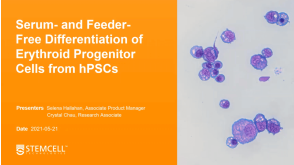
线上讲座Serum- and Feeder-Free Differentiation of Erythroid Progenitor Cells from hPSCs发布日期: 05/21/2021
31:39
线上讲座Serum- and Feeder-Free Differentiation of Erythroid Progenitor Cells from hPSCs发布日期: 05/21/2021
 沪公网安备31010102008431号