Self-renewal and differentiation of hematopoietic stem cells (HSCs) are balanced by the concerted activities of the fibroblast growth factor (FGF),Wnt,and Notch pathways,which are tuned by enzyme-mediated remodeling of heparan sulfate proteoglycans (HSPGs). Sulfatase modifying factor 1 (SUMF1) activates the Sulf1 and Sulf2 sulfatases that remodel the HSPGs,and is mutated in patients with multiple sulfatase deficiency. Here,we show that the FGF signaling pathway is constitutively activated in Sumf1(-/-) HSCs and hematopoietic stem progenitor cells (HSPCs). These cells show increased p-extracellular signal-regulated kinase levels,which in turn promote beta-catenin accumulation. Constitutive activation of FGF signaling results in a block in erythroid differentiation at the chromatophilic erythroblast stage,and of B lymphocyte differentiation at the pro-B cell stage. A reduction in mature myeloid cells and an aberrant development of T lymphocytes are also seen. These defects are rescued in vivo by blocking the FGF pathway in Sumf1(-/-) mice. Transplantation of Sumf1(-/-) HSPCs into wild-type mice reconstituted the phenotype of the donors,suggesting a cell autonomous defect. These data indicate that Sumf1 controls HSPC differentiation and hematopoietic lineage development through FGF and Wnt signaling.
View Publication
产品类型:
产品号#:
09600
09650
产品名:
StemSpan™ SFEM
StemSpan™ SFEM
Tripp A et al. (NOV 2005)
Journal of virology 79 22 14069--78
Induction of cell cycle arrest by human T-cell lymphotropic virus type 1 Tax in hematopoietic progenitor (CD34+) cells: modulation of p21cip1/waf1 and p27kip1 expression.
Human T-cell lymphotropic virus type 1 (HTLV-1) is the etiologic agent of adult T-cell leukemia,an aggressive CD4(+) malignancy. Although HTLV-2 is highly homologous to HTLV-1,infection with HTLV-2 has not been associated with lymphoproliferative disorders. Lentivirus-mediated transduction of CD34(+) cells with HTLV-1 Tax (Tax1) induced G(0)/G(1) cell cycle arrest and resulted in the concomitant suppression of multilineage hematopoiesis in vitro. Tax1 induced transcriptional upregulation of the cdk inhibitors p21(cip1/waf1) (p21) and p27(kip1) (p27),and marked suppression of hematopoiesis in immature (CD34(+)/CD38(-)) hematopoietic progenitor cells in comparison to CD34(+)/CD38(+) cells. HTLV-1 infection of CD34(+) cells also induced p21 and p27 expression. Tax1 also protected CD34(+) cells from serum withdrawal-mediated apoptosis. In contrast,HTLV-2 Tax (Tax2) did not detectably alter p21 or p27 gene expression,failed to induce cell cycle arrest,failed to suppress hematopoiesis in CD34(+) cells,and did not protect cells from programmed cell death. A Tax2/Tax1 chimera encoding the C-terminal 53 amino acids of Tax1 fused to Tax2 (Tax(221)) displayed a phenotype in CD34(+) cells similar to that of Tax1,suggesting that unique domains encoded within the C terminus of Tax1 may account for the phenotypes displayed in human hematopoietic progenitor cells. These remarkable differences in the activities of Tax1 and Tax2 in CD34(+) hematopoietic progenitor cells may underlie the sharp differences observed in the pathogenesis resulting from infection with HTLV-1 and HTLV-2.
View Publication
Nishimoto KP et al. (MAY 2011)
Regenerative medicine 6 3 303--18
Modification of human embryonic stem cell-derived dendritic cells with mRNA for efficient antigen presentation and enhanced potency.
AIM: Dendritic cell (DC)-based vaccines are designed to exploit the intrinsic capacity of these highly effective antigen presenting cells to prime and boost antigen-specific T-cell immune responses. Successful development of DC-based vaccines will be dependent on the ability to utilize and harness the full potential of these potent immune stimulatory cells. Recent advances to generate DCs derived from human embryonic stem cells (hESCs) that are suitable for clinical use represent an alternative strategy from conventional approaches of using patient-specific DCs. Although the differentiation of hESC-derived DCs in serum-free defined conditions has been established,the stimulatory potential of these hESC-derived DCs have not been fully evaluated. METHODS: hESC-derived DCs were differentiated in serum-free defined culture conditions. The delivery of antigen into hESC-derived DCs was investigated using mRNA transfection and replication-deficient adenoviral vector transduction. hESC-derived DCs modified with antigen were evaluated for their capacity to stimulate antigen-specific T-cell responses with known HLA matching. Since IL-12 is a key cytokine that drives T-cell function,further enhancement of DC potency was evaluated by transfecting mRNA encoding the IL-12p70 protein into hESC-derived DCs. RESULTS: The transfection of mRNA into hESC-derived DCs was effective for heterologous protein expression. The efficiency of adenoviral vector transduction into hESC-derived DCs was poor. These mRNA-transfected DCs were capable of stimulating human telomerase reverse transcriptase antigen-specific T cells composed of varying degrees of HLA matching. In addition,we observed the transfection of mRNA encoding IL-12p70 enhanced the T-cell stimulation potency of hESC-derived DCs. CONCLUSION: These data provide support for the development and modification of hESC-derived DCs with mRNA as a potential strategy for the induction of T-cell-mediated immunity.
View Publication
产品类型:
产品号#:
05850
05857
05870
05875
85850
85857
85870
85875
产品名:
mTeSR™1
mTeSR™1
Asuri P et al. (FEB 2012)
Molecular therapy : the journal of the American Society of Gene Therapy 20 2 329--38
Directed Evolution of Adeno-associated Virus for Enhanced Gene Delivery and Gene Targeting in Human Pluripotent Stem Cells
Efficient approaches for the precise genetic engineering of human pluripotent stem cells (hPSCs) can enhance both basic and applied stem cell research. Adeno- associated virus (AAV) vectors are of particular interest for their capacity to mediate efficient gene delivery to and gene targeting in various cells. However,natural AAV serotypes offer only modest transduction of human embryonic and induced pluripotent stem cells (hESCs and hiPSCs),which limits their utility for efficiently manipulating the hPSC genome. Directed evolution is a powerful means to generate viral vectors with novel capabilities,and we have applied this approach to create a novel AAV variant with high gene delivery efficiencies (˜50%) to hPSCs,which are importantly accompanied by a considerable increase in gene-targeting frequencies,up to 0.12%. While this level is likely sufficient for numerous applications,we also show that the gene-targeting efficiency mediated by an evolved AAV variant can be further enhanced (textgreater1%) in the presence of targeted double- stranded breaks (DSBs) generated by the co-delivery of artificial zinc finger nucleases (ZFNs). Thus,this study demonstrates that under appropriate selective pressures,AAV vectors can be created to mediate efficient gene targeting in hPSCs,alone or in the presence of ZFN- mediated double-stranded DNA breaks.
View Publication
产品类型:
产品号#:
05850
05857
05870
05875
85850
85857
85870
85875
产品名:
mTeSR™1
mTeSR™1
Lo SL et al. (MAY 2012)
Biochemical and biophysical research communications 421 3 616--620
A ??-sheet structure interacting peptide for intracellular protein delivery into human pluripotent stem cells and their derivatives
The advance in stem cell research relies largely on the efficiency and biocompatibility of technologies used to manipulate stem cells. In our previous study,we had designed an amphipathic peptide RV24 that can deliver proteins into cancer cell lines efficiently without significant side effects. Encouraged by this observation,we moved forward to test whether RV24 could be used to deliver proteins into human embryonic stem cells and human induced pluripotent stem cells. RV24 successfully mediated protein delivery into these pluripotent stem cells,as well as their derivatives including neural stem cells and dendritic cells. Based on NMR studies and particle surface charge measurements,we proposed that hydrophobic domain of RV24 interacts with ??-sheet structures of the proteins,followed by formation of peptide cage" to facilitate delivery across cellular membrane. These findings suggest the feasibility of using amphipathic peptide to deliver functional proteins intracellularly for stem cell research. ?? 2012 Elsevier Inc."
View Publication
产品类型:
产品号#:
05850
05857
05870
05875
85850
85857
85870
85875
产品名:
mTeSR™1
mTeSR™1
Fan Y et al. (NOV 2013)
Tissue Engineering Part A 20 3-4 131128071850006
Facile engineering of xeno-free microcarriers for the scalable cultivation of human pluripotent stem cells in stirred suspension.
A prerequisite for the realization of human pluripotent stem cell (hPSC) therapies is the development of bioprocesses for generating clinically relevant quantities of undifferentiated hPSCs and their derivatives under xeno-free conditions. Microcarrier stirred-suspension bioreactors are an appealing modality for the scalable expansion and directed differentiation of hPSCs. Comparative analyses of commercially available microcarriers clearly show the need for developing synthetic substrates supporting the adhesion and growth of hPSCs in three-dimensional cultures under agitation-induced shear. Moreover,the low seeding efficiencies during microcarrier loading with hPSC clusters poses a significant process bottleneck. To that end,a novel protocol was developed increasing hPSC seeding efficiency from 30% to over 80% and substantially shortening the duration of microcarrier loading. Importantly,this method was combined with the engineering of polystyrene microcarriers by surface conjugation of a vitronectin-derived peptide,which was previously shown to support the growth of human embryonic stem cells. Cells proliferated on peptide-conjugated beads in static culture but widespread detachment was observed after exposure to stirring. This prompted additional treatment of the microcarriers with a synthetic polymer commonly used to enhance cell adhesion. hPSCs were successfully cultivated on these microcarriers in stirred suspension vessels for multiple consecutive passages with attachment efficiencies close to 40%. Cultured cells exhibited on average a 24-fold increase in concentration per 6-day passage,over 85% viability,and maintained a normal karyotype and the expression of pluripotency markers such as Nanog,Oct4,and SSEA4. When subjected to spontaneous differentiation in embryoid body cultures or directed differentiation to the three embryonic germ layers,the cells adopted respective fates displaying relevant markers. Lastly,engineered microcarriers were successfully utilized for the expansion and differentiation of hPSCs to mesoderm progeny in stirred suspension vessels. Hence,we demonstrate a strategy for the facile engineering of xeno-free microcarriers for stirred-suspension cultivation of hPSCs. Our findings support the use of microcarrier bioreactors for the scalable,xeno-free propagation and differentiation of human stem cells intended for therapies.
View Publication
Enhanced CLIP Uncovers IMP Protein-RNA Targets in Human Pluripotent Stem Cells Important for Cell Adhesion and Survival
Human pluripotent stem cells (hPSCs) require precise control of post-transcriptional RNA networks to maintain proliferation and survival. Using enhanced UV crosslinking and immunoprecipitation (eCLIP),we identify RNA targets of the IMP/IGF2BP family of RNA-binding proteins in hPSCs. At the broad region and binding site levels,IMP1 and IMP2 show reproducible binding to a large and overlapping set of 3' UTR-enriched targets. RNA Bind-N-seq applied to recombinant full-length IMP1 and IMP2 reveals CA-rich motifs that are enriched in eCLIP-defined binding sites. We observe that IMP1 loss in hPSCs recapitulates IMP1 phenotypes,including a reduction in cell adhesion and increase in cell death. For cell adhesion,we find IMP1 maintains levels of integrin mRNA specifically regulating RNA stability of ITGB5 in hPSCs. Additionally,we show that IMP1 can be linked to hPSC survival via direct target BCL2. Thus,transcriptome-wide binding profiles identify hPSC targets modulating well-characterized IMP1 roles.
View Publication
产品类型:
产品号#:
05850
05857
05870
05875
85850
85857
85870
85875
产品名:
mTeSR™1
mTeSR™1
Li D et al. (MAY 2016)
Stem Cell Reports 6 5 717--728
Optimized Approaches for Generation of Integration-free iPSCs from Human Urine-Derived Cells with Small Molecules and Autologous Feeder
Generation of induced pluripotent stem cells (iPSCs) from human urine-derived cells (hUCs) provides a convenient and non-invasive way to obtain patient-specific iPSCs. However,many isolated hUCs exhibit very poor proliferation and are difficult to reprogram. In this study,we optimized reprogramming approaches for hUCs with very poor proliferation. We report here that a compound cocktail containing cyclic pifithrin-a (a P53 inhibitor),A-83-01,CHIR99021,thiazovivin,NaB,and PD0325901 significantly improves the reprogramming efficiency (170-fold more) for hUCs. In addition,we showed that replacement of Matrigel with autologous hUC feeders can overcome the reprogramming failure due to the massive cell death that occurs during delivery of reprogramming factors. In summary,we describe improved approaches to enable iPSC generation from hUCs that were otherwise difficult to reprogram,a valuable asset for banking patient-specific iPSCs.
View Publication
Porayette P et al. (DEC 2007)
Biochemical and biophysical research communications 364 3 522--527
Amyloid-?? precursor protein expression and modulation in human embryonic stem cells: A novel role for human chorionic gonadotropin
The amyloid-beta precursor protein (AbetaPP) is a ubiquitously expressed adhesion and neuritogenic protein whose processing has previously been shown to be regulated by reproductive hormones including the gonadotropin luteinizing hormone (LH) in human neuroblastoma cells. We report for the first time the expression of AbetaPP in human embryonic stem (hES) cells at the mRNA and protein levels. Using N- and C-terminal antibodies against AbetaPP,we detected both the mature and immature forms of AbetaPP as well as truncated variants ( approximately 53kDa,47kDa,and 29kDa) by immunoblot analyses. Expression of AbetaPP is regulated by both the stemness of the cells and pregnancy-associated hormones. Addition of human chorionic gonadotropin,the fetal equivalent of LH that is dramatically elevated during pregnancy,markedly increased the expression of all AbetaPP forms. These results indicate a critical molecular signaling link between the hormonal environment of pregnancy and the expression of AbetaPP in hES cells that is suggestive of an important function for this protein during early human embryogenesis prior to the formation of neural precursor cells.
View Publication


 EasySep™小鼠TIL(CD45)正选试剂盒




 产品手册Maximize Your Pluripotential with the TeSR™ Family of hPSC Culture Media
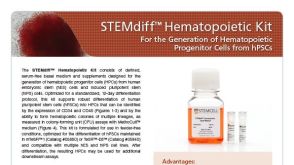 产品手册STEMdiff™ Hematopoietic Kit
 沪公网安备31010102008431号