Menon MP et al. (MAR 2006)
The Journal of clinical investigation 116 3 683--94
Signals for stress erythropoiesis are integrated via an erythropoietin receptor-phosphotyrosine-343-Stat5 axis.
Anemia due to chronic disease or chemotherapy often is ameliorated by erythropoietin (Epo). Present studies reveal that,unlike steady-state erythropoiesis,erythropoiesis during anemia depends sharply on an Epo receptor-phosphotyrosine-343-Stat5 signaling axis. In mice expressing a phosphotyrosine-null (PY-null) Epo receptor allele (EpoR-HM),severe and persistent anemia was induced by hemolysis or 5-fluorouracil. In short-term transplantation experiments,donor EpoR-HM bone marrow cells also failed to efficiently repopulate the erythroid compartment. In each context,stress erythropoiesis was rescued to WT levels upon the selective restoration of an EpoR PY343 Stat5-binding site (EpoR-H allele). As studied using a unique primary culture system,EpoR-HM erythroblasts exhibited marked stage-specific losses in Epo-dependent growth and survival. EpoR-H PY343 signals restored efficient erythroblast expansion,and the selective Epo induction of the Stat5 target genes proviral integration site-1 (Pim-1) and oncostatin-M. Bcl2-like 1 (Bcl-x),in contrast,was not significantly induced via WT-EpoR,EpoR-HM,or EpoR-H alleles. In Kit+ CD71+ erythroblasts,EpoR-PY343 signals furthermore enhanced SCF growth effects,and SCF modulation of Pim-1 kinase and oncostatin-M expression. In maturing Kit- CD71+ erythroblasts,oncostatin-M exerted antiapoptotic effects that likewise depended on EpoR PY343-mediated events. Stress erythropoiesis,therefore,requires stage-specific EpoR-PY343-Stat5 signals,some of which selectively bolster SCF and oncostatin-M action.
View Publication
Song W et al. (OCT 2016)
Journal of Biomedical Materials Research - Part A 104 3 678--687
Efficient generation of endothelial cells from human pluripotent stem cells and characterization of their functional properties
Although endothelial cells (ECs) have been derived from human pluripotent stem cells (hPSCs),large-scale generation of hPSC-ECs remains challenging and their functions are not well characterized. Here we report a simple and efficient three-stage method that allows generation of approximately 98 and 9500 ECs on day 16 and day 34,respectively,from each human embryonic stem cell (hESC) input. The functional properties of hESC-ECs derived in the presence and absence of a TGF$$-inhibitory molecule SB431542 were characterized and compared with those of human umbilical vein endothelial cells (HUVECs). Confluent monolayers formed by SB431542(+) hESC-ECs,SB431542(-) hESC-ECs,and HUVECs showed similar permeability to 10,000 Da dextran,but these cells exhibited striking differences in forming tube-like structures in 3D fibrin gels. The SB431542(+) hESC-ECs were most potent in forming tube-like structures regardless of whether VEGF and bFGF were present in the medium; less potent SB431542(-) hESC-ECs and HUVECs responded differently to VEGF and bFGF,which significantly enhanced the ability of HUVECs to form tube-like structures but had little impact on SB431542(-) hESC-ECs. This study offers an efficient approach to large-scale hPSC-EC production and suggests that the phenotypes and functions of hPSC-ECs derived under different conditions need to be thoroughly examined before their use in technology development. This article is protected by copyright. All rights reserved.
View Publication
产品类型:
产品号#:
07923
27215
27216
27217
27250
27260
27270
36254
85850
85857
产品名:
Dispase (1 U/mL)
37µm可逆滤筛,小 (15 mL)
70µm可逆滤筛,小 (15 mL)
100µm可逆滤筛,小 (15 mL)
37µm可逆滤筛,大 (50 mL)
70µm可逆滤筛,大 (50 mL)
100µm可逆滤筛,大 (50 mL)
DMEM/F-12 with 15 mM HEPES
mTeSR™1
mTeSR™1
Tenedini E et al. ( 2010)
Cell Death & Disease 1 e28
Integrated analysis of microRNA and mRNA expression profiles in physiological myelopoiesis: role of hsa-mir-299-5p in CD34+ progenitor cells commitment
Hematopoiesis entails a series of hierarchically organized events that proceed throughout cell specification and terminates with cell differentiation. Commitment needs the transcription factors' effort,which,in concert with microRNAs,drives cell fate and responds to promiscuous patterns of gene expression by turning on lineage-specific genes and repressing alternate lineage transcripts. We obtained microRNA profiles from human CD34+ hematopoietic progenitor cells and in vitro differentiated erythroblasts,megakaryoblasts,monoblasts and myeloblast precursors that we analyzed together with their gene expression profiles. The integrated analysis of microRNA-mRNA expression levels highlighted an inverse correlation between microRNAs specifically upregulated in one single-cell progeny and their putative target genes,which resulted in downregulation. Among the upregulated lineage-enriched microRNAs,hsa-miR-299-5p emerged as having a role in controlling CD34+ progenitor fate,grown in multilineage culture conditions. Gain- and loss-of-function experiments revealed that hsa-miR-299-5p participates in the regulation of hematopoietic progenitor fate,modulating megakaryocytic-granulocytic versus erythroid-monocytic differentiation.
View Publication


 EasySep™小鼠TIL(CD45)正选试剂盒




 EasySep™人CD45去除试剂盒II 免疫磁珠法去除人CD45+细胞
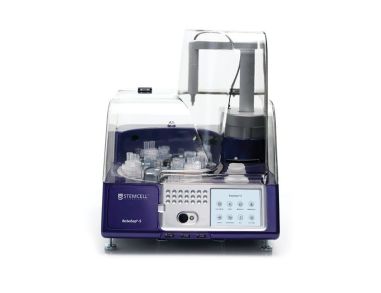 RoboSep™- S 全自动细胞分选仪器
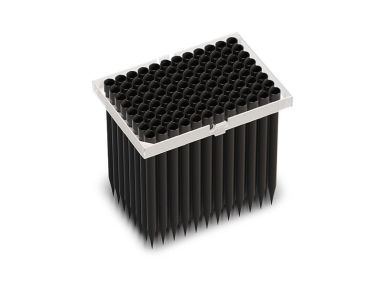 RoboSep™-16导电滤芯吸头 RoboSep™-16导电滤芯吸头
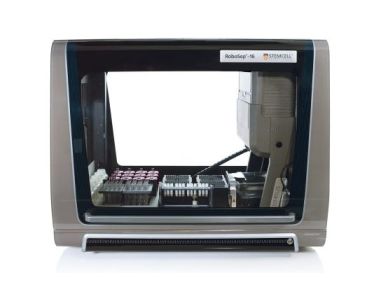 RoboSep™-16 全自动细胞分选仪器适用于多达16个样本
 RoboSep™-16垃圾袋 RoboSep™-16垃圾袋
 RoboSep™分选管套装 RoboSep™分选管套装(9个塑料管)




 沪公网安备31010102008431号