Jankowska AM et al. (JUN 2009)
Blood 113 25 6403--10
Loss of heterozygosity 4q24 and TET2 mutations associated with myelodysplastic/myeloproliferative neoplasms.
Chromosomal abnormalities are frequent in myeloid malignancies,but in most cases of myelodysplasia (MDS) and myeloproliferative neoplasms (MPN),underlying pathogenic molecular lesions are unknown. We identified recurrent areas of somatic copy number-neutral loss of heterozygosity (LOH) and deletions of chromosome 4q24 in a large cohort of patients with myeloid malignancies including MDS and related mixed MDS/MPN syndromes using single nucleotide polymorphism arrays. We then investigated genes in the commonly affected area for mutations. When we sequenced TET2,we found homozygous and hemizygous mutations. Heterozygous and compound heterozygous mutations were found in patients with similar clinical phenotypes without LOH4q24. Clinical analysis showed most TET2 mutations were present in patients with MDS/MPN (58%),including CMML (6/17) or sAML (32%) evolved from MDS/MPN and typical MDS (10%),suggesting they may play a ubiquitous role in malignant evolution. TET2 mutations affected conserved domains and the N terminus. TET2 is widely expressed in hematopoietic cells but its function is unknown,and it lacks homology to other known genes. The frequency of mutations in this candidate myeloid regulatory gene suggests an important role in the pathogenesis of poor prognosis MDS/MPN and sAML and may act as a disease gene marker for these often cytogenetically normal disorders.
View Publication
产品类型:
产品号#:
21000
20119
20155
19752
19752RF
产品名:
RoboSep™- S
RoboSep™ 吸头组件抛光剂
RoboSep™分选管套装(9个塑料管)
Vetter ML and D'Aquila RT (SEP 2009)
Journal of virology 83 17 8646--54
Cytoplasmic APOBEC3G restricts incoming Vif-positive human immunodeficiency virus type 1 and increases two-long terminal repeat circle formation in activated T-helper-subtype cells.
Cytoplasmic APOBEC3G has been reported to block wild-type human immunodeficiency virus type 1 (HIV-1) infection in some primary cells. It is not known whether cytoplasmic APOBEC3G has residual activity in activated T cells,even though virion-packaged APOBEC3G does restrict HIV-1 in activated T cells. Because we found that APOBEC3G expression is greater in activated CD4(+) T-helper type 1 (Th1) lymphocytes than in T-helper type 2 (Th2) lymphocytes,we hypothesized that residual target cell restriction of incoming Vif-positive virions that lack APOBEC3G,if present,would be greater in Th1 than Th2 lymphocytes. Infection of activated Th1 cells with APOBEC3-negative virions did result in decreased amounts of early and late reverse transcription products and integrated virus relative to infection of activated Th2 cells. Two-long terminal repeat (2-LTR) circles,which are formed in the nucleus when reverse transcripts do not integrate,were increased after APOBEC3-negative virus infection of activated Th1 cells relative to infection of activated Th2 cells. In contrast,2-LTR circle forms were decreased after infection of APOBEC3G-negative cells with APOBEC3G-containing virions relative to APOBEC3G-negative virions and with Th1 cell-produced virions relative to Th2 cell-produced virions. Increasing APOBEC3G in Th2 cells and decreasing APOBEC3G in Th1 cells modulated the target cell phenotypes,indicating causation by APOBEC3G. The comparison between activated Th1 and Th2 cells indicates that cytoplasmic APOBEC3G in activated Th1 cells partially restricts reverse transcription and integration of incoming Vif-positive,APOBEC3G-negative HIV-1. The differing effects of cytoplasmic and virion-packaged APOBEC3G on 2-LTR circle formation indicate a difference in their antiviral mechanisms.
View Publication
产品类型:
产品号#:
19052
19052RF
21000
20119
20155
产品名:
EasySep™人CD4+ T细胞富集试剂盒
RoboSep™ 人CD4+ T细胞富集试剂盒含滤芯吸头
RoboSep™- S
RoboSep™ 吸头组件抛光剂
RoboSep™分选管套装(9个塑料管)
Allan LL et al. (SEP 2009)
Blood 114 12 2411--6
Apolipoprotein-mediated lipid antigen presentation in B cells provides a pathway for innate help by NKT cells.
Natural killer T (NKT) cells are innate-like lymphocytes that recognize lipid antigens and have been shown to enhance B-cell activation and antibody production. B cells typically recruit T-cell help by presenting internalized antigens recognized by their surface antigen receptor. Here,we demonstrate a highly efficient means whereby human B cells present lipid antigens to NKT cells,capturing the antigen using apolipoprotein E (apoE) and the low-density lipoprotein receptor (LDL-R). ApoE dramatically enhances B-cell presentation of alpha-galactosylceramide (alphaGalCer),an exogenous CD1d presented antigen,inducing activation of NKT cells and the subsequent activation of B cells. B cells express the LDL-R on activation,and the activation of NKT cells by B cells is completely LDL-R dependent,as shown by blocking experiments and the complete lack of presentation when using apoE2,an isoform of apoE incapable of LDL-R binding. The dependence on apoE and the LDL-R is much more pronounced in B cells than we had previously seen in dendritic cells,which can apparently use alternate pathways of lipid antigen uptake. Thus,B cells use an apolipoprotein-mediated pathway of lipid antigen presentation,which constitutes a form of innate help for B cells by NKT cells.
View Publication
产品类型:
产品号#:
19054
19054RF
产品名:
EasySep™人B细胞富集试剂盒
RoboSep™ 人B细胞富集试剂盒含滤芯吸头
Jiang S et al. (JAN 2018)
Cell metabolism
Let-7 Suppresses B Cell Activation through Restricting the Availability of Necessary Nutrients.
The control of uptake and utilization of necessary extracellular nutrients-glucose and glutamine-is an important aspect of B cell activation. Let-7 is a family of microRNAs known to be involved in metabolic control. Here,we employed several engineered mouse models,including B cell-specific overexpression of Lin28a or the let-7a-1/let-7d/let-7f-1 cluster (let-7adf) and knockout of individual let-7 clusters to show that let-7adf specifically inhibits T cell-independent (TI) antigen-induced immunoglobulin (Ig)M antibody production. Both overexpression and deletion of let-7 in this cluster leads to altered TI-IgM production. Mechanistically,let-7adf suppresses the acquisition and utilization of key nutrients,including glucose and glutamine,through directly targeting hexokinase 2 (Hk2) and by repressing a glutamine transporter Slc1a5 and a key degradation enzyme,glutaminase (Gls),a mechanism mediated by regulation of c-Myc. Our results suggest a novel role of let-7adf as a metabolic brake" on B cell antibody production."
View Publication
BiHC, a T-Cell-Engaging Bispecific Recombinant Antibody, Has Potent Cytotoxic Activity Against Her2 Tumor Cells.
Among different cancer immunotherapy approaches,bispecific antibodies (BsAbs) are of great interest due to their ability to recruit immune cells to kill tumor cells directly. Various BsAbs against Her2 tumor cells have been proposed with potent cytotoxic activities. However,most of these formats require extensive processing to obtain heterodimeric bispecific antibodies. In this study,we describe a bispecific antibody,BiHC (bispecific Her2-CD3 antibody),constructed with a single-domain anti-Her2 and a single-chain Fv (variable fragment) of anti-CD3 in an IgG-like format. In contrast to most IgG-like BsAbs,the two arms in BiHC have different molecular weights,making it easier to separate hetero- or homodimers. BiHC can be expressed in Escherichia coli and purified via Protein A affinity chromatography. The purified BiHC can recruit T cells and induce specific cytotoxicity of Her2-expressing tumor cells in vitro. The BiHC can also efficiently inhibit the tumor growth in vivo. Thus,BiHC is a promising candidate for the treatment of Her2-positive cancers.
View Publication
产品类型:
产品号#:
17851
17851RF
100-0692
产品名:
EasySep™人CD3正选试剂盒II
RoboSep™ 人CD3正选试剂盒II
EasySep™人CD3正选试剂盒II
Dewhurst JA et al. (AUG 2017)
Scientific reports 7 1 7143
Characterisation of lung macrophage subpopulations in COPD patients and controls.
Lung macrophage subpopulations have been identified based on size. We investigated characteristics of small and large macrophages in the alveolar spaces and lung interstitium of COPD patients and controls. Alveolar and interstitial cells were isolated from lung resection tissue from 88 patients. Macrophage subpopulation cell-surface expression of immunological markers and phagocytic ability were assessed by flow cytometry. Inflammatory related gene expression was measured. Alveolar and interstitial macrophages had subpopulations of small and large macrophages based on size and granularity. Alveolar macrophages had similar numbers of small and large cells; interstitial macrophages were mainly small. Small macrophages expressed significantly higher cell surface HLA-DR,CD14,CD38 and CD36 and lower CD206 compared to large macrophages. Large alveolar macrophages showed lower marker expression in COPD current compared to ex-smokers. Small interstitial macrophages had the highest pro-inflammatory gene expression levels,while large alveolar macrophages had the lowest. Small alveolar macrophages had the highest phagocytic ability. Small alveolar macrophage CD206 expression was lower in COPD patients compared to smokers. COPD lung macrophages include distinct subpopulations; Small interstitial and small alveolar macrophages with more pro-inflammatory and phagocytic function respectively,and large alveolar macrophages with low pro-inflammatory and phagocytic ability.
View Publication
Direct interaction of whole-inactivated influenza A and pneumococcal vaccines enhances influenza-specific immunity.
The upper respiratory tract is continuously exposed to a vast array of potentially pathogenic viruses and bacteria. Influenza A virus (IAV) has particular synergism with the commensal bacterium Streptococcus pneumoniae in this niche,and co-infection exacerbates pathogenicity and causes significant mortality. However,it is not known whether this synergism is associated with a direct interaction between the two pathogens. We have previously reported that co-administration of a whole-inactivated IAV vaccine (gamma-Flu) with a whole-inactivated pneumococcal vaccine (gamma-PN) enhances pneumococcal-specific responses. In this study,we show that mucosal co-administration of gamma-Flu and gamma-PN similarly augments IAV-specific immunity,particularly tissue-resident memory cell responses in the lung. In addition,our in vitro analysis revealed that S. pneumoniae directly interacts with both gamma-Flu and with live IAV,facilitating increased uptake by macrophages as well as increased infection of epithelial cells by IAV. These observations provide an additional explanation for the synergistic pathogenicity of IAV and S. pneumoniae,as well as heralding the prospect of exploiting the phenomenon to develop better vaccine strategies for both pathogens.
View Publication
产品类型:
产品号#:
19858
19858RF
产品名:
EasySep™ 小鼠Naïve CD8+ T细胞分选试剂盒
RoboSep™ 小鼠Naïve CD8+ T细胞分选试剂盒
E. Giuliani et al. (mar 2019)
Scientific reports 9 1 4373
Hexamethylene bisacetamide impairs NK cell-mediated clearance of acute T lymphoblastic leukemia cells and HIV-1-infected T cells that exit viral latency.
The hexamethylene bisacetamide (HMBA) anticancer drug was dismissed due to limited efficacy in leukemic patients but it may re-enter into the clinics in HIV-1 eradication strategies because of its recently disclosed capacity to reactivate latent virus. Here,we investigated the impact of HMBA on the cytotoxicity of natural killer (NK) cells against acute T lymphoblastic leukemia (T-ALL) cells or HIV-1-infected T cells that exit from latency. We show that in T-ALL cells HMBA upmodulated MICB and ULBP2 ligands for the NKG2D activating receptor. In a primary CD4+ T cell-based latency model,HMBA did not reactivate HIV-1,yet enhanced ULBP2 expression on cells harboring virus reactivated by prostratin (PRO). However,HMBA reduced the expression of NKG2D and its DAP10 adaptor in NK cells,hence impairing NKG2D-mediated cytotoxicity and DAP10-dependent response to IL-15 stimulation. Alongside,HMBA dampened killing of T-ALL targets by IL-15-activated NK cells and impaired NK cell-mediated clearance of PRO-reactivated HIV-1+ cells. Overall,our results demonstrate a dominant detrimental effect of HMBA on the NKG2D pathway that crucially controls NK cell-mediated killing of tumors and virus-infected cells,providing one possible explanation for poor clinical outcome in HMBA-treated cancer patients and raising concerns for future therapeutic application of this drug.
View Publication
产品类型:
产品号#:
19052
19052RF
产品名:
EasySep™人CD4+ T细胞富集试剂盒
RoboSep™ 人CD4+ T细胞富集试剂盒含滤芯吸头
J. Jung et al. (apr 2019)
Cell host microbe 25 4 513--525.e6
Cleaved Cochlin Sequesters Pseudomonas aeruginosa and Activates Innate Immunity in the Inner Ear.
In the inner ear,endolymph fluid surrounds the organ of Corti,which is important for auditory function; notably,even slight environmental changes mediated by trauma or infection can have significant consequences. However,it is unclear how the immune response is modulated in these tissues. Here,we report the local immune surveillance role of cleaved cochlin LCCL (Limulus factor C,Cochlin,and Lgl1) during Pseudomonas aeruginosa infection in the cochlea. Upon infection,the LCCL domain is cleaved from cochlin and secreted into the perilymph. This cleaved fragment sequesters infiltrating bacteria in the scala tympani and subsequently recruits resident immune cells to eliminate the bacteria. Importantly,hearing loss in a cochlin knockout mouse model is remedied by treatment with a cochlin LCCL peptide. These findings suggest cleaved cochlin LCCL constitutes a critical factor in innate immunity and auditory function and may be a potential therapeutic target to treat chronic otitis media-induced hearing loss.
View Publication
产品类型:
产品号#:
19762
19762RF
产品名:
EasySep™小鼠中性粒细胞富集试剂盒
RoboSep™ 小鼠中性粒细胞富集试剂盒含滤芯吸头
N. Kuroda et al. (jun 2019)
Scientific reports 9 1 8568
Infiltrating CCR2+ monocytes and their progenies, fibrocytes, contribute to colon fibrosis by inhibiting collagen degradation through the production of TIMP-1.
Intestinal fibrosis is a serious complication in inflammatory bowel disease (IBD). Despite the remarkable success of recent anti-inflammatory therapies for IBD,incidence of intestinal fibrosis and need for bowel resection have not significantly changed. To clarify the contribution of haematopoietic-derived cells in intestinal fibrosis,we prepared bone marrow (BM) chimeric mice (chimeras),which were reconstituted with BM cells derived from enhanced green fluorescent protein (EGFP)-transgenic mice or CC chemokine receptor 2 (CCR2)-deficient mice. After 2 months of transplantation,BM chimeras were treated with azoxymethane/dextran sodium sulphate. During chronic inflammation,CCR2+ BM-derived monocyte and fibrocyte infiltration into the colon and CC chemokine ligand 2 production increased,leading to colon fibrosis in EGFP BM chimeras. In CCR2-deficient BM chimeras,monocyte and fibrocyte numbers in the colonic lamina propria significantly decreased,and colon fibrosis was attenuated. In colon tissue,mRNA expression of tissue inhibitor of metalloproteinase (TIMP)-1 but not of collagen I,transforming growth factor-beta1 or matrix metalloproteinases was significantly different between the two chimeras. CCR2+ monocytes and fibrocytes showed high Timp1 mRNA expression. Our results suggest that infiltrating CCR2+ monocytes and their progenies,fibrocytes,promote colon fibrosis by inhibiting collagen degradation through TIMP-1 production.
View Publication


 EasySep™小鼠TIL(CD45)正选试剂盒




 产品手册从全血中直接分离单个核细胞
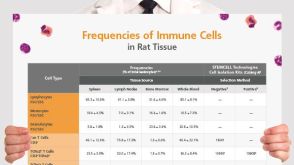 挂图Frequencies of Immune Cells in Rat Tissue Lists the estimated frequencies of more than 15 immune cell types in Sprague Dawley rats
 沪公网安备31010102008431号