Ichikawa S et al. (MAY 2011)
Journal of immunology (Baltimore,Md. : 1950) 186 10 5549--55
Hepatic stellate cells function as regulatory bystanders.
Regulatory T cells (Tregs) contribute significantly to the tolerogenic nature of the liver. The mechanisms,however,underlying liver-associated Treg induction are still elusive. We recently identified the vitamin A metabolite,retinoic acid (RA),as a key controller that promotes TGF-β-dependent Foxp3(+) Treg induction but inhibits TGF-β-driven Th17 differentiation. To investigate whether the RA producing hepatic stellate cells (HSC) are part of the liver tolerance mechanism,we investigated the ability of HSC to function as regulatory APC. Different from previous reports,we found that highly purified HSC did not express costimulatory molecules and only upregulated MHC class II after in vitro culture in the presence of exogenous IFN-γ. Consistent with an insufficient APC function,HSC failed to stimulate naive OT-II TCR transgenic CD4(+) T cells and only moderately stimulated α-galactosylceramide-primed invariant NKT cells. In contrast,HSC functioned as regulatory bystanders and promoted enhanced Foxp3 induction by OT-II TCR transgenic T cells primed by spleen dendritic cells,whereas they greatly inhibited the Th17 differentiation. Furthermore,the regulatory bystander capacity of the HSC was completely dependent on their ability to produce RA. Our data thus suggest that HSC can function as regulatory bystanders,and therefore,by promoting Tregs and suppressing Th17 differentiation,they might represent key players in the mechanism that drives liver-induced tolerance.
View Publication
Hicar MD et al. (JUL 2010)
Journal of acquired immune deficiency syndromes (1999) 54 3 223--35
Pseudovirion particles bearing native HIV envelope trimers facilitate a novel method for generating human neutralizing monoclonal antibodies against HIV.
Monomeric HIV envelope vaccines fail to elicit broadly neutralizing antibodies or to protect against infection. Neutralizing antibodies against HIV bind to native functionally active Env trimers on the virion surface. Gag-Env pseudovirions recapitulate the native trimer and could serve as an effective epitope presentation platform for study of the neutralizing antibody response in HIV-infected individuals. To address if pseudovirions can recapitulate native HIV virion epitope structures,we carefully characterized these particles,concentrating on the antigenic structure of the coreceptor binding site. By blue native gel shift assays,Gag-Env pseudovirions were shown to contain native trimers that were competent for binding to neutralizing monoclonal antibodies. In enzyme-linked immunosorbent assay,pseudovirions exhibited increased binding of known CD4-induced antibodies after addition of CD4. Using flow cytometric analysis,fluorescently labeled pseudovirions specifically identified a subset of antigen-specific B cells in HIV-infected subjects. Interestingly,the sequence of one of these novel human antibodies,identified during cloning of single HIV-specific B cells and designated 2C6,exhibited homology to mAb 47e,a known anti-CD4-induced coreceptor binding site antibody. The secreted monoclonal antibody 2C6 did not bind monomeric gp120,but specifically bound envelope on pseudovirions. A recombinant form of the antibody 2C6 acted as a CD4-induced epitope-specific antibody in neutralization assays,yet did not bind monomeric gp120. These findings imply specificity against a quaternary epitope presented on the pseudovirion envelope spike. These data demonstrate that Gag-Env pseudovirions recapitulate CD4 and coreceptor binding pocket antigenic structures and can facilitate identification of B-cell clones that secrete neutralizing antibodies.
View Publication
产品类型:
产品号#:
18054
18054RF
产品名:
Nguyen KD et al. (NOV 2009)
American journal of respiratory and critical care medicine 180 9 823--33
Impaired IL-10-dependent induction of tolerogenic dendritic cells by CD4+CD25hiCD127lo/- natural regulatory T cells in human allergic asthma.
RATIONALE: Tolerogenic dendritic cells and natural regulatory T cells have been implicated in the process of infectious tolerance in human allergic asthma. However,the significance of the influence of natural regulatory T cells on tolerogenic dendritic cells in the disease has not been investigated. OBJECTIVES: We aimed to characterize the mechanism of induction of the tolerogenic phenotype in circulating blood dendritic cells by allergic asthmatic natural regulatory T cells. METHODS: The study was performed in a cohort of 21 subjects with allergic asthma,21 healthy control subjects,and 21 subjects with nonallergic asthma. We cultured blood dendritic cells with natural regulatory T cells to study the induction of tolerogenic dendritic cells. Flow cytometry and proliferation assays were employed to analyze phenotype and function of dendritic cells as well as IL-10 production from natural regulatory T cells. MEASUREMENTS AND MAIN RESULTS: Dendritic cells cultured with natural regulatory T cells up-regulated IL-10,down-regulated costimulatory molecules,and stimulated the proliferation of CD4(+)CD25(-) effector T cells less potently. Allergic asthmatic natural regulatory T cells were significantly less efficient in inducing this tolerogenic phenotype of dendritic cells compared with healthy control and nonallergic asthmatic counterparts. Furthermore,this defective function of natural regulatory T cells was associated with their decreased IL-10 expression,disease severity,and could be reversed by oral corticosteroid therapy. CONCLUSIONS: These results provided the first evidences of impaired induction of tolerogenic dendritic cells mediated by natural regulatory T cells in human allergic asthma.
View Publication
产品类型:
产品号#:
15022
15062
产品名:
RosetteSep™人CD4+ T细胞富集抗体混合物
RosetteSep™人CD4+ T细胞富集抗体混合物
Norman JM et al. (OCT 2011)
Nature immunology 12 10 975--83
The antiviral factor APOBEC3G enhances the recognition of HIV-infected primary T cells by natural killer cells.
APOBEC3G (A3G) is an intrinsic antiviral factor that inhibits the replication of human immunodeficiency virus (HIV) by deaminating cytidine residues to uridine. This causes guanosine-to-adenosine hypermutation in the opposite strand and results in inactivation of the virus. HIV counteracts A3G through the activity of viral infectivity factor (Vif),which promotes degradation of A3G. We report that viral protein R (Vpr),which interacts with a uracil glycosylase,also counteracted A3G by diminishing the incorporation of uridine. However,this process resulted in activation of the DNA-damage–response pathway and the expression of natural killer (NK) cell–activating ligands. Our results show that pathogen-induced deamination of cytidine and the DNA-damage response to virus-mediated repair of the incorporation of uridine enhance the recognition of HIV-infected cells by NK cells.
View Publication
产品类型:
产品号#:
17755
产品名:
Frazer-Abel AA et al. (NOV 2004)
The Journal of pharmacology and experimental therapeutics 311 2 758--69
Nicotine activates nuclear factor of activated T cells c2 (NFATc2) and prevents cell cycle entry in T cells.
We used primary peripheral blood T cells,a population that exists in G(0) and can be stimulated to enter the cell cycle synchronously,to define more precisely the effects of nicotine on pathways that control cell cycle entry and progression. Our data show that nicotine decreased the ability of T cells to transit through the G(0)/G(1) boundary (acquire competence) and respond to progression signals. These effects were due to nuclear factor of activated T cells c2 (NFATc2)-dependent repression of cyclin-dependent kinase 4 (CDK4) expression. Growth arrest at the G(0)/G(1) boundary was further enforced by inhibition of cyclin D2 expression and by increased expression and stabilization of p27Kip1. Intriguingly,T cells from habitual users of tobacco products and from NFATc2-deficient mice constitutively expressed CDK4 and were resistant to the antiproliferative effects of nicotine. These results indicate that nicotine impairs T cell cycle entry through NFATc2-dependent mechanisms and suggest that,in the face of chronic nicotine exposure,selection may favor cells that can evade these effects. We postulate that cross talk between nicotinic acetylcholine receptors and growth factor receptor-activated pathways offers a novel mechanism by which nicotine may directly impinge on cell cycle progression. This offers insight into possible reasons that underlie the unique effects of nicotine on distinct cell types and identifies new targets that may be useful control tobacco-related diseases.
View Publication
产品类型:
产品号#:
19751
19751RF
产品名:
Milush JM et al. (NOV 2009)
Blood 114 23 4823--31
Functionally distinct subsets of human NK cells and monocyte/DC-like cells identified by coexpression of CD56, CD7, and CD4.
The lack of natural killer (NK) cell-specific markers,as well as the overlap among several common surface antigens and functional properties,has obscured the delineation between NK cells and dendritic cells. Here,novel subsets of peripheral blood CD3/14/19(neg) NK cells and monocyte/dendritic cell (DC)-like cells were identified on the basis of CD7 and CD4 expression. Coexpression of CD7 and CD56 differentiates NK cells from CD56+ monocyte/DC-like cells,which lack CD7. In contrast to CD7+CD56+ NK cells,CD7(neg)CD56+ cells lack expression of NK cell-associated markers,but share commonalities in their expression of various monocyte/DC-associated markers. Using CD7,we observed approximately 60% of CD4+CD56+ cells were CD7(neg) cells,indicating the actual frequency of activated CD4+ NK cells is much lower in the blood than previously recognized. Functionally,only CD7+ NK cells secrete gamma interferon (IFNgamma) and degranulate after interleukin-12 (IL-12) plus IL-18 or K562 target cell stimulation. Furthermore,using CD7 to separate CD56+ NK cells and CD56+ myeloid cells,we demonstrate that unlike resting CD7+CD56+ NK cells,the CD7(neg)CD56+ myeloid cells stimulate a potent allogeneic response. Our data indicate that CD7 and CD56 coexpression discriminates NK cells from CD7(neg)CD56+ monocyte/DC-like cells,thereby improving our ability to study the intricacies of NK-cell subset phenotypes and functions in vivo.
View Publication
Human blood IgM memory" B cells are circulating splenic marginal zone B cells harboring a prediversified immunoglobulin repertoire."
The human peripheral B-cell compartment displays a large population of immunoglobulin M-positive,immunoglobulin D-positive CD27(+) (IgM(+)IgD(+)CD27(+)) memory" B cells carrying a mutated immunoglobulin receptor. By means of phenotypic analysis�
View Publication


 EasySep™小鼠TIL(CD45)正选试剂盒




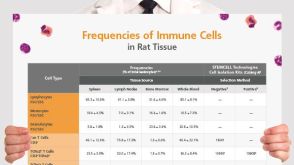 挂图Frequencies of Immune Cells in Rat Tissue Lists the estimated frequencies of more than 15 immune cell types in Sprague Dawley rats


 沪公网安备31010102008431号