Reichert AJ et al. (DEC 2015)
Protein Engineering Design and Selection 28 12 553--65
Optimisation of a system for the co-translational incorporation of a keto amino acid and its application to a tumour-specific Anticalin
The bioorthogonal keto group has attracted interest for the site-specific chemical conjugation of recombinant proteins under mild conditions,e.g. with aminooxy-functionalised fluorescent probes,radiometal chelates,toxins or polymers. However,the cotranslational incorporation of the corresponding non-canonical amino acid p-acetyl-L-phenylalanine (Apa) into proteins expressed in Escherichia coli by means of amber suppression using a previously described system with a mutated tRNA and an engineered tyrosyl-tRNA synthetase from Methanococcus jannaschii shows limited efficiency and considerable promiscuity towards endogenous amino acids. Employing a one-plasmid system that encodes all three components required for selection,i.e. the modified aminoacyl-tRNA synthetase (aaRS),the cognate amber suppressor tRNA and the enhanced green fluorescent protein equipped with an amber stop codon and serving as reporter,we have generated an Apa-specific aaRS&tRNA pair with considerably improved efficiency (17-fold increased expression) and also fidelity (6-fold). To this end,both the aaRS and the tRNA were subjected to doped random mutagenesis and selection in altogether four evolutionary cycles using fluorescence-activated bacterial cell sorting as well as automated screening of microcultures. The resulting aaRS&tRNA pair was applied to the functionalisation of an Anticalin with specificity towards oncofetal fibronectin by introducing a keto group at a permissible site for subsequent conjugation with a fluorescent dye,thus allowing visualisation of this tumour target under the microscope.
View Publication
Geldanamycin and herbimycin A induce apoptotic killing of B chronic lymphocytic leukemia cells and augment the cells' sensitivity to cytotoxic drugs.
We studied the actions of geldanamycin (GA) and herbimycin A (HMA),inhibitors of the chaperone proteins Hsp90 and GRP94,on B chronic lymphocytic leukemia (CLL) cells in vitro. Both drugs induced apoptosis of the majority of CLL isolates studied. Whereas exposure to 4-hour pulses of 30 to 100 nM GA killed normal B lymphocytes and CLL cells with similar dose responses,T lymphocytes from healthy donors as well as those present in the CLL isolates were relatively resistant. GA,but not HMA,showed a modest cytoprotective effect toward CD34+ hematopoietic progenitors from normal bone marrow. The ability of bone marrow progenitors to form hematopoietic colonies was unaffected by pulse exposures to GA. Both GA and HMA synergized with chlorambucil and fludarabine in killing a subset of CLL isolates. GA- and HMA-induced apoptosis was preceded by the up-regulation of the stress-responsive chaperones Hsp70 and BiP. Both ansamycins also resulted in down-regulation of Akt protein kinase,a modulator of cell survival. The relative resistance of T lymphocytes and of CD34+ bone marrow progenitors to GA coupled with its ability to induce apoptosis following brief exposures and to synergize with cytotoxic drugs warrant further investigation of ansamycins as potential therapeutic agents in CLL.
View Publication
产品类型:
产品号#:
04434
04444
产品名:
MethoCult™ H4434 Classic
MethoCult™ H4434 Classic
Sapparapu G et al. (NOV 2016)
Nature
Neutralizing human antibodies prevent Zika virus replication and fetal disease in mice.
Zika virus (ZIKV) is an emerging mosquito-transmitted flavivirus that can cause severe disease,including congenital birth defects during pregnancy(1). To develop candidate therapeutic agents against ZIKV,we isolated a panel of human monoclonal antibodies (mAbs) from subjects with prior ZIKV infection. A subset of mAbs recognized diverse epitopes on the envelope (E) protein and exhibited potently neutralizing activity. One of the most inhibitory mAbs,ZIKV-117,broadly neutralized infection of ZIKV strains corresponding to African,Asian,and American lineages. Epitope mapping studies revealed that ZIKV-117 recognized a unique quaternary epitope on the E protein dimer-dimer interface. We evaluated the therapeutic efficacy of ZIKV-117 in pregnant and non-pregnant mice. mAb treatment markedly reduced tissue pathology,placental and fetal infection,and mortality in mice. Thus,neutralizing human mAbs can protect against maternal-fetal transmission,infection and disease,and reveal important determinants for structure-based rational vaccine design efforts.
View Publication
Yuki N et al. (AUG 2004)
Proceedings of the National Academy of Sciences 101 31 11404--09
Carbohydrate mimicry between human ganglioside GM1 and Campylobacter jejuni lipooligosaccharide causes Guillain-Barre syndrome
Molecular mimicry between microbial and self-components is postulated as the mechanism that accounts for the antigen and tissue specificity of immune responses in postinfectious autoimmune diseases. Little direct evidence exists,and research in this area has focused principally on T cell-mediated,antipeptide responses,rather than on humoral responses to carbohydrate structures. Guillain-Barré syndrome,the most frequent cause of acute neuromuscular paralysis,occurs 1-2 wk after various infections,in particular,Campylobacter jejuni enteritis. Carbohydrate mimicry [Galbeta1-3GalNAcbeta1-4(NeuAcalpha2-3)Galbeta1-] between the bacterial lipooligosaccharide and human GM1 ganglioside is seen as having relevance to the pathogenesis of Guillain-Barré syndrome,and conclusive evidence is reported here. On sensitization with C. jejuni lipooligosaccharide,rabbits developed anti-GM1 IgG antibody and flaccid limb weakness. Paralyzed rabbits had pathological changes in their peripheral nerves identical with those present in Guillain-Barré syndrome. Immunization of mice with the lipooligosaccharide generated a mAb that reacted with GM1 and bound to human peripheral nerves. The mAb and anti-GM1 IgG from patients with Guillain-Barré syndrome did not induce paralysis but blocked muscle action potentials in a muscle-spinal cord coculture,indicating that anti-GM1 antibody can cause muscle weakness. These findings show that carbohydrate mimicry is an important cause of autoimmune neuropathy.
View Publication
Imatinib mesylate has shown remarkable efficacy in the treatment of patients in the chronic phase of chronic myeloid leukemia. However,despite an overall significant hematological and cytogenetic response,imatinib therapy may favor the emergence of drug-resistant clones,ultimately leading to relapse. Some imatinib resistance mechanisms had not been fully elucidated yet. In this study we used sensitive and resistant sublines from a Bcr-Abl positive cell line to investigate the putative involvement of telomerase in the promotion of imatinib resistance. We showed that sensitivity to imatinib can be partly restored in imatinib-resistant cells by targeting telomerase expression,either by the introduction of a dominant-negative form of the catalytic protein subunit of the telomerase (hTERT) or by the treatment with all-trans-retinoic acid,a clinically used drug. Furthermore,we showed that hTERT overexpression favors the development of imatinib resistance through both its antiapoptotic and telomere maintenance functions. Therefore,combining antitelomerase strategies to imatinib treatment at the beginning of the treatment should be promoted to reduce the risk of imatinib resistance development and increase the probability of eradicating the disease.
View Publication
产品类型:
产品号#:
04230
产品名:
MethoCult™ H4230
Coffman KT et al. (NOV 2003)
Cancer Research 63 22 7907--12
Differential EphA2 epitope display on normal versus malignant cells.
The EphA2 receptor tyrosine kinase is overexpressed in many different types of human cancers where it functions as a powerful oncoprotein. Dramatic changes in the subcellular localization and function of EphA2 have also been linked with cancer,and in particular,unstable cancer cell-cell contacts prevent EphA2 from stably binding its ligand on the surface of adjoining cells. This change is important in light of evidence that ligand binding causes EphA2 to transmit signals that negatively regulate tumor cell growth and invasiveness and also induce EphA2 degradation. On the basis of these properties,we have begun to target EphA2 on tumor cells using agonistic antibodies,which mimic the consequences of ligand binding. In our present study,we show that a subset of agonistic EphA2 antibodies selectively bind epitopes on malignant cells,which are not available on nontransformed epithelial cells. We also show that such epitopes arise from differential cell-cell adhesions and that the stable intercellular junctions of nontransformed epithelial cells occlude the binding site for ligand,as well as this subset of EphA2 antibodies. Finally,we demonstrate that antibody targeting of EphA2 decreases tumor cell growth as measured using xenograft tumor models and found that the mechanism of antibody action relates to EphA2 protein degradation in vivo. Taken together,these results suggest new opportunities for therapeutic targeting of the large number of different cancers that express EphA2 in a manner that could minimize potential toxicities to normal cells.
View Publication
Callahan KP et al. (OCT 2014)
Leukemia 28 10 1960--8
Flavaglines target primitive leukemia cells and enhance anti-leukemia drug activity.
Identification of agents that target human leukemia stem cells is an important consideration for the development of new therapies. The present study demonstrates that rocaglamide and silvestrol,closely related natural products from the flavagline class of compounds,are able to preferentially kill functionally defined leukemia stem cells,while sparing normal stem and progenitor cells. In addition to efficacy as single agents,flavaglines sensitize leukemia cells to several anticancer compounds,including front-line chemotherapeutic drugs used to treat leukemia patients. Mechanistic studies indicate that flavaglines strongly inhibit protein synthesis,leading to the reduction of short-lived antiapoptotic proteins. Notably though,treatment with flavaglines,alone or in combination with other drugs,yields a much stronger cytotoxic activity toward leukemia cells than the translational inhibitor temsirolimus. These results indicate that the underlying cell death mechanism of flavaglines is more complex than simply inhibiting general protein translation. Global gene expression profiling and cell biological assays identified Myc inhibition and the disruption of mitochondrial integrity to be features of flavaglines,which we propose contribute to their efficacy in targeting leukemia cells. Taken together,these findings indicate that rocaglamide and silvestrol are distinct from clinically available translational inhibitors and represent promising candidates for the treatment of leukemia.
View Publication


 EasySep™小鼠TIL(CD45)正选试剂盒




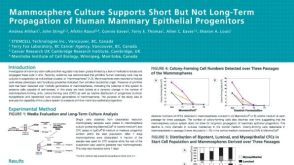 科学海报Mammosphere Culture Supports Short But Not Long-Term Propagation of Human Mammary Epithelial Progenitors


 沪公网安备31010102008431号