Pirson L et al. (JUL 2006)
Stem cells (Dayton,Ohio) 24 7 1814--21
Despite inhibition of hematopoietic progenitor cell growth in vitro, the tyrosine kinase inhibitor imatinib does not impair engraftment of human CD133+ cells into NOD/SCIDbeta2mNull mice.
There is potential interest for combining allogeneic hematopoietic cell transplantation (HCT),and particularly allogeneic HCT with a nonmyeloablative regimen,to the tyrosine kinase inhibitor imatinib (Glivec; Novartis,Basel,Switzerland,http://www.novartis.com) in order to maximize anti-leukemic activity against Philadelphia chromosome-positive leukemias. However,because imatinib inhibits c-kit,the stem cell factor receptor,it could interfere with bone marrow engraftment. In this study,we examined the impact of imatinib on normal progenitor cell function. Imatinib decreased the colony-forming capacity of mobilized peripheral blood human CD133(+) cells but not that of long-term culture-initiating cells. Imatinib also decreased the proliferation of cytokine-stimulated CD133(+) cells but did not induce apoptosis of these cells. Expression of very late antigen (VLA)-4,VLA-5,and CXCR4 of CD133(+) cells was not modified by imatinib,but imatinib decreased the ability of CD133(+) cells to migrate. Finally,imatinib did not decrease engraftment of CD133(+) cells into irradiated nonobese diabetic/severe combined immunodeficient/beta2m(null) mice conditioned with 3 or 1 Gy total body irradiation. In summary,our results suggest that,despite inhibition of hematopoietic progenitor cell growth in vitro,imatinib does not interfere with hematopoietic stem cell engraftment.
View Publication
Eckardt S et al. (FEB 2007)
Genes & development 21 4 409--19
Hematopoietic reconstitution with androgenetic and gynogenetic stem cells.
Parthenogenetic embryonic stem (ES) cells with two oocyte-derived genomes (uniparental) have been proposed as a source of autologous tissue for transplantation. The therapeutic applicability of any uniparental cell type is uncertain due to the consequences of genomic imprinting that in mammalian uniparental tissues causes unbalanced expression of imprinted genes. We transplanted uniparental fetal liver cells into lethally irradiated adult mice to test their capacity to replace adult hematopoietic tissue. Both maternal (gynogenetic) and paternal (androgenetic) derived cells conveyed long-term,multilineage reconstitution of hematopoiesis in recipients,with no associated pathologies. We also establish that uniparental ES cells can differentiate into transplantable hematopoietic progenitors in vitro that contribute to long-term hematopoiesis in recipients. Hematopoietic tissue in recipients maintained fidelity of parent-of-origin methylation marks at the Igf2/H19 locus; however,variability occurred in the maintenance of parental-specific methylation marks at other loci. In summary,despite genomic imprinting and its consequences on development that are particularly evident in the androgenetic phenotype,uniparental cells of both parental origins can form adult-transplantable stem cells and can repopulate an adult organ.
View Publication
产品类型:
产品号#:
03434
03444
产品名:
MethoCult™GF M3434
MethoCult™GF M3434
Camargo FD et al. (JAN 2006)
Blood 107 2 501--7
Hematopoietic stem cells do not engraft with absolute efficiencies.
Hematopoietic stem cells (HSCs) can be isolated from murine bone marrow by their ability to efflux the Hoechst 33342 dye. This method defines an extremely small and hematopoietically potent subset of cells known as the side population (SP). Recent studies suggest that transplanted single SP cells are capable of lymphohematopoietic repopulation at near absolute efficiencies. Here,we carefully reevaluate the hematopoietic potential of individual SP cells and find substantially lower rates of reconstitution. Our strategy involved the cotransplantation of single SP cells along with different populations of competitor cells that varied in their self-renewal capacity. Even with minimized HSC competition,SP cells were only able to reconstitute up to 35% of recipient mice. Furthermore,through immunophenotyping and clonal in vitro assays we find that SP cells are virtually homogeneous. Isolation of HSCs on the basis of Hoechst exclusion and a single cell-surface marker allows enrichment levels similar to that obtained with complex multicolor strategies. Altogether,our results indicate that even an extremely homogeneous HSC population,based on phenotype and dye efflux,cannot reconstitute mice at absolute efficiencies.
View Publication
产品类型:
产品号#:
03434
03444
产品名:
MethoCult™GF M3434
MethoCult™GF M3434
Lioznov MV et al. (MAY 2005)
Bone marrow transplantation 35 9 909--14
Aldehyde dehydrogenase activity as a marker for the quality of hematopoietic stem cell transplants.
Taking advantage of fluorescent substrates for their metabolic marker aldehyde dehydrogenase (ALDH),hematopoietic stem cells (HSC) were defined as SSC(lo)ALDH(br) - reflecting their low orthogonal light scattering and bright fluorescence intensity in flow cytometry. Based thereon,we investigated the usefulness of ALDH activity for characterizing HSC graft quality,particularly under stress conditions. We first compared the expression of ALDH vs CD34 in bone marrow and peripheral blood stem cell (PBSC) samples over 7 days. We noted that (i) only ALDH activity but not CD34 expression strongly reflected colony-forming ability over time,and that (ii) PBSC grafts stored at room temperature lost most of their progenitor cells within just 48 h. We then retrospectively related ALDH and CD34 expression as well as granulocyte-macrophage colony-forming units (CFU-GM) potential for 19 cryopreserved allogeneic PBSC grafts to engraftment data. Strikingly,in all six patients who received markedly decreased numbers of SSC(lo)ALDH(br) cells,this was associated not only with almost complete loss of CFU-GM potential but also with delayed establishment/permanent absence of full hematopoietic donor cell chimerism,whereas all other patients showed early complete donor chimerism. In conclusion,we suggest to measure ALDH activity as a surrogate marker for HSC activity,and to transport and store PBSC under controlled cooling conditions.
View Publication
Tchernychev B et al. (DEC 2010)
Proceedings of the National Academy of Sciences of the United States of America 107 51 22255--9
Discovery of a CXCR4 agonist pepducin that mobilizes bone marrow hematopoietic cells.
The G protein-coupled receptor (GPCR),chemokine CXC-type receptor 4 (CXCR4),and its ligand,CXCL12,mediate the retention of polymorphonuclear neutrophils (PMNs) and hematopoietic stem and progenitor cells (HSPCs) in the bone marrow. Agents that disrupt CXCL12-mediated chemoattraction of CXCR4-expressing cells mobilize PMNs and HSPCs into the peripheral circulation and are therapeutically useful for HSPC collection before autologous bone marrow transplantation (ABMT). Our aim was to develop unique CXCR4-targeted therapeutics using lipopeptide GPCR modulators called pepducins. A pepducin is a synthetic molecule composed of a peptide derived from the amino acid sequence of one of the intracellular (IC) loops of a target GPCR coupled to a lipid tether. We prepared and screened a small CXCR4-targeted pepducin library and identified several pepducins with in vitro agonist activity,including ATI-2341,whose peptide sequence derives from the first IC loop. ATI-2341 induced CXCR4- and G protein-dependent signaling,receptor internalization,and chemotaxis in CXCR4-expressing cells. It also induced dose-dependent peritoneal recruitment of PMNs when administered i.p. to mice. However,when administered systemically by i.v. bolus,ATI-2341 acted as a functional antagonist and dose-dependently mediated release of PMNs from the bone marrow of both mice and cynomolgus monkeys. ATI-2341-mediated release of granulocyte/macrophage progenitor cells from the bone marrow was confirmed by colony-forming assays. We conclude that ATI-2341 is a potent and efficacious mobilizer of bone marrow PMNs and HSPCs and could represent a previously undescribed therapeutic approach for the recruitment of HSPCs before ABMT.
View Publication
产品类型:
产品号#:
03534
产品名:
MethoCult™GF M3534
Liang Y et al. (AUG 2005)
Blood 106 4 1479--87
Effects of aging on the homing and engraftment of murine hematopoietic stem and progenitor cells.
To test the hypothesis that aging has negative effects on stem-cell homing and engraftment,young or old C57BL/6 bone marrow (BM) cells were injected,using a limiting-dilution,competitive transplantation method,into old or young Ly5 congenic mice. Numbers of hematopoietic stem cells (HSCs) and progenitor cells (HPCs) recovered from BM or spleen were measured and compared with the numbers initially transplanted. Although the frequency of marrow competitive repopulation units (CRUs) increased approximately 2-fold from 2 months to 2 years of age,the BM homing efficiency of old CRUs was approximately 3-fold lower than that of young CRUs. Surprisingly,the overall size of individual stem-cell clones generated in recipients receiving a single CRU was not affected by donor age. However,the increased ages of HSC donors and HSC transplant recipients caused marked skewing of the pattern of engraftment toward the myeloid lineage,indicating that HSC-intrinsic and HSC-extrinsic (microenvironmental) age-related changes favor myelopoiesis. This correlated with changes after transplantation in the rate of recovery of circulating leukocytes,erythrocytes,and platelets. Recovery of the latter was especially blunted in aged recipients. Collectively,these findings may have implications for clinical HSC transplantation in which older persons increasingly serve as donors for elderly patients.
View Publication


 EasySep™小鼠TIL(CD45)正选试剂盒




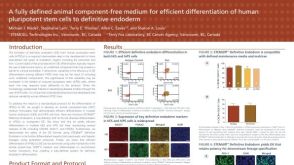 科学海报A Fully Defined Animal Component Free Medium for Efficient Differentiation of Human Pluripotent Stem Cells to Definitive Endoderm



 沪公网安备31010102008431号