Bö et al. (DEC 2005)
Journal of Immunological Methods 307 1-2 13--23
Establishment of a strategy for the rapid generation of a monoclonal antibody against the human protein SNEV (hNMP200) by flow-cytometric cell sorting
The screening for antigen-specific hybridoma cells with adequate production rates is still a time-,labour- and money-consuming procedure. A reduction in cell culture testing by specifically selecting those fused cells that produce antibody could therefore make hybridoma technology more attractive,even for small research groups or for newly discovered proteins at an early stage of research. Additional problems,such as the requirement to produce sufficient amounts of the unknown protein at a purity that allows specific immunisation of mice and testing of the resulting hybridoma clones,also need to be overcome. Here we present a new strategy to isolate rapidly and efficiently monoclonal antibodies against new proteins,for which only sequence information at the DNA level is known. The strategy consists of fusion of the protein to a hexa-His-tag to allow easy purification,production in yeast and insect cells to reduce background immunisation with host cell proteins and the selection of IgG-producing hybridoma cells by flow-cytometric cell sorting using the affinity matrix secretion assay technique. ?? 2005 Elsevier B.V. All rights reserved.
View Publication
产品类型:
产品号#:
03800
03801
03802
03803
03804
03805
03806
产品名:
ClonaCell™-HY杂交瘤试剂盒
ClonaCell™-HY培养基A
ClonaCell™-HY 培养基 B
ClonaCell™-HY 培养基 C
ClonaCell™-HY 培养基 D
ClonaCell™-HY 培养基 E
ClonaCell™-HY PEG
Darabi R and Perlingeiro RCR ( 2016)
1357 423--439
Derivation of Skeletal Myogenic Precursors from Human Pluripotent Stem Cells Using Conditional Expression of PAX7.
Cell-based therapies are considered as one of the most promising approaches for the treatment of degenerating pathologies including muscle disorders and dystrophies. Advances in the approach of reprogramming somatic cells into induced pluripotent stem (iPS) cells allow for the possibility of using the patient's own pluripotent cells to generate specific tissues for autologous transplantation. In addition,patient-specific tissue derivatives have been shown to represent valuable material for disease modeling and drug discovery. Nevertheless,directed differentiation of pluripotent stem cells into a specific lineage is not a trivial task especially in the case of skeletal myogenesis,which is generally poorly recapitulated during the in vitro differentiation of pluripotent stem cells.Here,we describe a practical and efficient method for the derivation of skeletal myogenic precursors from differentiating human pluripotent stem cells using controlled expression of PAX7. Flow cytometry (FACS) purified myogenic precursors can be expanded exponentially and differentiated in vitro into myotubes,enabling researchers to use these cells for disease modeling as well as therapeutic purposes.
View Publication
产品类型:
产品号#:
05850
05857
05870
05875
85850
85857
85870
85875
产品名:
mTeSR™1
mTeSR™1
Fuerstenau-Sharp M et al. (MAY 2015)
PloS one 10 5 e0126596
Generation of highly purified human cardiomyocytes from peripheral blood mononuclear cell-derived induced pluripotent stem cells.
Induced pluripotent stem (iPS) cells have an enormous potential for physiological studies. A novel protocol was developed combining the derivation of iPS from peripheral blood with an optimized directed differentiation to cardiomyocytes and a subsequent metabolic selection. The human iPS cells were retrovirally dedifferentiated from activated T cells. The subsequent optimized directed differentiation protocol yielded 30-45% cardiomyocytes at day 16 of differentiation. The derived cardiomyocytes expressed appropriate structural markers like cardiac troponin T,$\$-actinin and myosin light chain 2 (MLC2V). In a subsequent metabolic selection with lactate,the cardiomyocytes content could be increased to more than 90%. Loss of cardiomyocytes during metabolic selection were less than 50%,whereas alternative surface antibody-based selection procedures resulted in loss of up to 80% of cardiomyocytes. Electrophysiological characterization confirmed the typical cardiac features and the presence of ventricular,atrial and nodal-like action potentials within the derived cardiomyocyte population. Our combined and optimized protocol is highly robust and applicable for scalable cardiac differentiation. It provides a simple and cost-efficient method without expensive equipment for generating large numbers of highly purified,functional cardiomyocytes. It will further enhance the applicability of iPS cell-derived cardiomyocytes for disease modeling,drug discovery,and regenerative medicine.
View Publication
产品类型:
产品号#:
05850
05857
05870
05875
85850
85857
85870
85875
产品名:
mTeSR™1
mTeSR™1
Durruthy-Durruthy J et al. (APR 2014)
PLoS ONE 9 4 e94231
Rapid and efficient conversion of integration-free human induced pluripotent stem cells to GMP-grade culture conditions
Data suggest that clinical applications of human induced pluripotent stem cells (hiPSCs) will be realized. Nonetheless,clinical applications will require hiPSCs that are free of exogenous DNA and that can be manufactured through Good Manufacturing Practice (GMP). Optimally,derivation of hiPSCs should be rapid and efficient in order to minimize manipulations,reduce potential for accumulation of mutations and minimize financial costs. Previous studies reported the use of modified synthetic mRNAs to reprogram fibroblasts to a pluripotent state. Here,we provide an optimized,fully chemically defined and feeder-free protocol for the derivation of hiPSCs using synthetic mRNAs. The protocol results in derivation of fully reprogrammed hiPSC lines from adult dermal fibroblasts in less than two weeks. The hiPSC lines were successfully tested for their identity,purity,stability and safety at a GMP facility and cryopreserved. To our knowledge,as a proof of principle,these are the first integration-free iPSCs lines that were reproducibly generated through synthetic mRNA reprogramming that could be putatively used for clinical purposes.
View Publication
产品类型:
产品号#:
05860
05880
05850
05857
05870
05875
07923
07909
85850
85857
85870
85875
27845
27945
27840
27865
27940
27965
产品名:
Dispase (1 U/mL)
IV型胶原酶(1mg /mL)
mTeSR™1
mTeSR™1
Zhang P-WW et al. (JAN 2016)
Glia 64 1 63--75
Generation of GFAP::GFP astrocyte reporter lines from human adult fibroblast-derived iPS cells using zinc-finger nuclease technology.
Astrocytes are instrumental to major brain functions,including metabolic support,extracellular ion regulation,the shaping of excitatory signaling events and maintenance of synaptic glutamate homeostasis. Astrocyte dysfunction contributes to numerous developmental,psychiatric and neurodegenerative disorders. The generation of adult human fibroblast-derived induced pluripotent stem cells (iPSCs) has provided novel opportunities to study mechanisms of astrocyte dysfunction in human-derived cells. To overcome the difficulties of cell type heterogeneity during the differentiation process from iPSCs to astroglial cells (iPS astrocytes),we generated homogenous populations of iPS astrocytes using zinc-finger nuclease (ZFN) technology. Enhanced green fluorescent protein (eGFP) driven by the astrocyte-specific glial fibrillary acidic protein (GFAP) promoter was inserted into the safe harbor adeno-associated virus integration site 1 (AAVS1) locus in disease and control-derived iPSCs. Astrocyte populations were enriched using Fluorescence Activated Cell Sorting (FACS) and after enrichment more than 99% of iPS astrocytes expressed mature astrocyte markers including GFAP,S100$\$,NFIA and ALDH1L1. In addition,mature pure GFP-iPS astrocytes exhibited a well-described functional astrocytic activity in vitro characterized by neuron-dependent regulation of glutamate transporters to regulate extracellular glutamate concentrations. Engraftment of GFP-iPS astrocytes into rat spinal cord grey matter confirmed in vivo cell survival and continued astrocytic maturation. In conclusion,the generation of GFAP::GFP-iPS astrocytes provides a powerful in vitro and in vivo tool for studying astrocyte biology and astrocyte-driven disease pathogenesis and therapy.
View Publication
产品类型:
产品号#:
05850
05857
05870
05875
85850
85857
85870
85875
05835
05839
08581
08582
产品名:
mTeSR™1
mTeSR™1
STEMdiff™ 神经诱导培养基
STEMdiff™ 神经诱导培养基
STEMdiff™SMADi神经诱导试剂盒
STEMdiff™SMADi神经诱导试剂盒,2套
Young J et al. (SEP 2015)
Journal of Immunological Methods 424 91--99
A novel immunoassay to measure total serum lymphotoxin�?α levels in the presence of an anti-LTα therapeutic antibody
During drug development,measurement of suitable pharmacodynamic biomarkers is key to establishing in vivo drug activity. Binding of monoclonal antibody (mAb) therapeutics to soluble target proteins often results in elevated serum levels of their target antigen,and measuring total (free and bound) concentration of the target antigen can be an important means of demonstrating that the mAb has reached its specific target. However,accurately measuring soluble circulating antigen in preclinical or clinical samples in the presence of a therapeutic mAb presents a bioanalytical challenge. Particularly in the case of low molecular weight and/or multimeric targets,epitopes for capture and detection of the target by reagent antibodies can be obscured by bound therapeutic mAb. Lymphotoxin-alpha (LTα) is a cytokine in the TNF superfamily that has been implicated in the pathophysiology of autoimmune disease,and is a therapeutic target for neutralizing mAb. During preclinical safety studies in cynomolgus macaques,we encountered difficulties in measuring total LTα in serum of dosed animals. When serum LTα trimer was saturated with the anti-LTα mAb,binding of two reagent antibodies,as required for a classic sandwich ELISA,was not feasible,and dissociation methods were also found to be unsuitable. We therefore developed an approach in which excess anti-LTα mAb was added to the in vitro assay system to fully saturate all binding sites,and an anti-idiotypic antibody was used to detect bound therapeutic antibody. Using this method,total LTα could be accurately measured in cynomolgus macaque serum,and was observed to increase with increasing anti-LTα therapeutic mAb dose. Additional in vitro studies demonstrated that the method worked equally well in human serum. This assay strategy will be useful for quantifying total concentrations of other small and/or multimeric target proteins in the presence of a therapeutic antibody.
View Publication
产品类型:
产品号#:
产品名:
Shimada H et al. (JAN 2012)
Biochemical and Biophysical Research Communications 417 2 659--664
Accelerated generation of human induced pluripotent stem cells with retroviral transduction and chemical inhibitors under physiological hypoxia
Induced pluripotent stem (iPS) cells are generated from somatic cells by the forced expression of a defined set of pluripotency-associated transcription factors. Human iPS cells can be propagated indefinitely,while maintaining the capacity to differentiate into all cell types in the body except for extra-embryonic tissues. This technology not only represents a new way to use individual-specific stem cells for regenerative medicine but also constitutes a novel method to obtain large amounts of disease-specific cells for biomedical research. Despite their great potential,the long reprogramming process (up to 1. month) remains one of the most significant challenges facing standard virus-mediated methodology. In this study,we report the accelerated generation of human iPS cells from adipose-derived stem (ADS) cells,using a new combination of chemical inhibitors under a setting of physiological hypoxia in conjunction with retroviral transduction of Oct4,Sox2,Klf4,and L-Myc. Under optimized conditions,we observed human embryonic stem (ES)-like cells as early as 6. days after the initial retroviral transduction. This was followed by the emergence of fully reprogrammed cells bearing Tra-1-81-positive and DsRed transgene-silencing properties on day 10. The resulting cell lines resembled human ES cells in many respects including proliferation rate,morphology,pluripotency-associated markers,global gene expression patterns,genome-wide DNA methylation states,and the ability to differentiate into all three of the germ layers,both in vitro and in vivo. Our method,when combined with chemical inhibitors under conditions of physiological hypoxia,offers a powerful tool for rapidly generating bona fide human iPS cells and facilitates the application of iPS cell technology to biomedical research. textcopyright 2011 Elsevier Inc.
View Publication
产品类型:
产品号#:
05850
05857
05870
05875
85850
85857
85870
85875
产品名:
mTeSR™1
mTeSR™1
Lou Y-R et al. (FEB 2014)
Stem Cells and Development 23 4 380--392
The Use of Nanofibrillar Cellulose Hydrogel As a Flexible Three-Dimensional Model to Culture Human Pluripotent Stem Cells
Human embryonic stem cells and induced pluripotent stem cells have great potential in research and thera-pies. The current in vitro culture systems for human pluripotent stem cells (hPSCs) do not mimic the three-dimensional (3D) in vivo stem cell niche that transiently supports stem cell proliferation and is subject to changes which facilitate subsequent differentiation during development. Here,we demonstrate,for the first time,that a novel plant-derived nanofibrillar cellulose (NFC) hydrogel creates a flexible 3D environment for hPSC culture. The pluripotency of hPSCs cultured in the NFC hydrogel was maintained for 26 days as evidenced by the expression of OCT4,NANOG,and SSEA-4,in vitro embryoid body formation and in vivo teratoma formation. The use of a cellulose enzyme,cellulase,enables easy cell propagation in 3D culture as well as a shift between 3D and two-dimensional cultures. More importantly,the removal of the NFC hydrogel facilitates differentiation while retaining 3D cell organization. Thus,the NFC hydrogel represents a flexible,xeno-free 3D culture system that supports pluripotency and will be useful in hPSC-based drug research and regenerative medicine.
View Publication
产品类型:
产品号#:
05850
05857
05870
05875
07923
85850
85857
85870
85875
产品名:
Dispase (1 U/mL)
mTeSR™1
mTeSR™1
Greene WA et al. (JUN 2014)
Journal of visualized experiments : JoVE 88 e51589
MicroRNA expression profiles of human iPS cells, retinal pigment epithelium derived from iPS, and fetal retinal pigment epithelium.
The objective of this report is to describe the protocols for comparing the microRNA (miRNA) profiles of human induced-pluripotent stem (iPS) cells,retinal pigment epithelium (RPE) derived from human iPS cells (iPS-RPE),and fetal RPE. The protocols include collection of RNA for analysis by microarray,and the analysis of microarray data to identify miRNAs that are differentially expressed among three cell types. The methods for culture of iPS cells and fetal RPE are explained. The protocol used for differentiation of RPE from human iPS is also described. The RNA extraction technique we describe was selected to allow maximal recovery of very small RNA for use in a miRNA microarray. Finally,cellular pathway and network analysis of microarray data is explained. These techniques will facilitate the comparison of the miRNA profiles of three different cell types.
View Publication
产品类型:
产品号#:
05850
05857
05870
05875
85850
85857
85870
85875
产品名:
mTeSR™1
mTeSR™1
Lee J et al. (AUG 2015)
FASEB journal : official publication of the Federation of American Societies for Experimental Biology 29 8 3399--3410
Early induction of a prechondrogenic population allows efficient generation of stable chondrocytes from human induced pluripotent stem cells.
Regeneration of human cartilage is inherently inefficient; an abundant autologous source,such as human induced pluripotent stem cells (hiPSCs),is therefore attractive for engineering cartilage. We report a growth factor-based protocol for differentiating hiPSCs into articular-like chondrocytes (hiChondrocytes) within 2 weeks,with an overall efficiency textgreater90%. The hiChondrocytes are stable and comparable to adult articular chondrocytes in global gene expression,extracellular matrix production,and ability to generate cartilage tissue in vitro and in immune-deficient mice. Molecular characterization identified an early SRY (sex-determining region Y) box (Sox)9(low) cluster of differentiation (CD)44(low)CD140(low) prechondrogenic population during hiPSC differentiation. In addition,2 distinct Sox9-regulated gene networks were identified in the Sox9(low) and Sox9(high) populations providing novel molecular insights into chondrogenic fate commitment and differentiation. Our findings present a favorable method for generating hiPSC-derived articular-like chondrocytes. The hiChondrocytes are an attractive cell source for cartilage engineering because of their abundance,autologous nature,and potential to generate articular-like cartilage rather than fibrocartilage. In addition,hiChondrocytes can be excellent tools for modeling human musculoskeletal diseases in a dish and for rapid drug screening.
View Publication
Varela I et al. (DEC 2014)
Cellular reprogramming 16 6 447--455
Generation of human $\$-thalassemia induced pluripotent cell lines by reprogramming of bone marrow-derived mesenchymal stromal cells using modified mRNA.
Synthetic modified mRNA molecules encoding pluripotency transcription factors have been used successfully in reprogramming human fibroblasts to induced pluripotent stem cells (iPSCs). We have applied this method on bone marrow-derived mesenchymal stromal cells (BM-MSCs) obtained from a patient with $$-thalassemia ($$-thal) with the aim to generate trangene-free $$-thal-iPSCs. Transfection of 10(4) BM-MSCs by lipofection with mRNA encoding the reprogramming factors Oct4,Klf4,Sox2,cMyc,and Lin28 resulted in formation of five iPSC colonies,from which three were picked up and expanded in $$-thal-iPSC lines. After 10 serial passages in vitro,$$-thal-iPSCs maintain genetic stability as shown by array comparative genomic hybridization (aCGH) and are capable of forming embryoid bodies in vitro and teratomas in vivo. Their gene expression profile compared to human embryonic stem cells (ESCs) and BM-MSCs seems to be similar to that of ESCs,whereas it differs from the profile of the parental BM-MSCs. Differentiation cultures toward a hematopoietic lineage showed the generation of CD34(+) progenitors up to 10%,but with a decreased hematopoietic colony-forming capability. In conclusion,we report herein the generation of transgene-free $$-thal-iPSCs that could be widely used for disease modeling and gene therapy applications. Moreover,it was demonstrated that the mRNA-based reprogramming method,used mainly in fibroblasts,is also suitable for reprogramming of human BM-MSCs.
View Publication


 EasySep™小鼠TIL(CD45)正选试剂盒




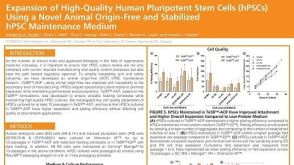 科学海报Expansion of High-Quality Human Pluripotent Stem Cells (hPSCs) Using a Novel Animal Origin-Free and Stabilized hPSC Maintenance Medium
 沪公网安备31010102008431号