Lambert AW et al. (JAN 2016)
Molecular cancer research : MCR 14 1 103--113
Tumor Cell-Derived Periostin Regulates Cytokines That Maintain Breast Cancer Stem Cells.
UNLABELLED Basal-like breast cancer (BLBC) is an aggressive subtype of breast cancer which is often enriched with cancer stem cells (CSC),but the underlying molecular basis for this connection remains elusive. We hypothesized that BLBC cells are able to establish a niche permissive to the maintenance of CSCs and found that tumor cell-derived periostin (POSTN),a component of the extracellular matrix,as well as a corresponding cognate receptor,integrin $$(v)$$(3),are highly expressed in a subset of BLBC cell lines as well as in CSC-enriched populations. Furthermore,we demonstrated that an intact periostin-integrin $$3 signaling axis is required for the maintenance of breast CSCs. POSTN activates the ERK signaling pathway and regulates NF-$$B-mediated transcription of key cytokines,namely IL6 and IL8,which in turn control downstream activation of STAT3. In summary,these findings suggest that BLBC cells have an innate ability to establish a microenvironmental niche supportive of CSCs. IMPLICATIONS The findings reported here indicate that POSTN produced by CSCs acts to reinforce the stem cell state through the activation of integrin receptors and the production of key cytokines.
View Publication
产品类型:
产品号#:
05620
产品名:
MammoCult™ 人源培养基套装
Nefedova Y et al. (JAN 2004)
Journal of immunology (Baltimore,Md. : 1950) 172 1 464--74
Hyperactivation of STAT3 is involved in abnormal differentiation of dendritic cells in cancer.
Abnormal differentiation of myeloid cells is one of the hallmarks of cancer. However,the molecular mechanisms of this process remain elusive. In this study,we investigated the effect of tumor-derived factors on Janus kinase (Jak)/STAT signaling in myeloid cells during their differentiation into dendritic cells. Tumor cell conditioned medium induced activation of Jak2 and STAT3,which was associated with an accumulation of immature myeloid cells. Jak2/STAT3 activity was localized primarily in these myeloid cells,which prevented the differentiation of immature myeloid cells into mature dendritic cells. This differentiation was restored after removal of tumor-derived factors. Inhibition of STAT3 abrogated the negative effects of these factors on myeloid cell differentiation,and overexpression of STAT3 reproduced the effects of tumor-derived factors. Thus,this is a first demonstration that tumor-derived factors may affect myeloid cell differentiation in cancer via constitutive activation of Jak2/STAT3.
View Publication
产品类型:
产品号#:
03534
产品名:
MethoCult™ GF M3534
Giuntoli S et al. (MAY 2007)
Stem cells (Dayton,Ohio) 25 5 1119--25
Severe hypoxia defines heterogeneity and selects highly immature progenitors within clonal erythroleukemia cells.
We showed that resistance to severe hypoxia defines hierarchical levels within normal hematopoietic populations and that hypoxia modulates the balance between generation of progenitors and maintenance of hematopoietic stem cells (HSC) in favor of the latter. This study deals with the effects of hypoxia (0.1% oxygen) in vitro on Friend's murine erythroleukemia (MEL) cells,addressing the question of whether a clonal leukemia cell population comprise functionally different cell subsets characterized by different hypoxia resistance. To identify leukemia stem cells (LSC),we used the Culture Repopulating Ability (CRA) assay we developed to quantify in vitro stem cells capable of short-term reconstitution (STR). Hypoxia strongly inhibited the overall growth of MEL cell population,which,despite its clonality,comprised progenitors characterized by markedly different hypoxia-resistance. These included hypoxia-sensitive colony-forming cells and hypoxia-resistant STR-type LSC,capable of repopulating secondary liquid cultures of CRA assays,confirming what was previously shown for normal hematopoiesis. STR-type LSC were found capable not only of surviving in hypoxia but also of being mostly in cycle,in contrast with the fact that almost all hypoxia-surviving cells were growth-arrested and with what we previously found for HSC. However,quiescent LSC were also detected,capable of delayed culture repopulation with the same efficiency as STR-like LSC. The fact that even quiescent LSC,believed to sustain minimal residual disease in vivo,were found within the MEL cells indicates that all main components of leukemia cell populations may be present within clonal cell lines,which are therefore suitable to study the sensitivity of individual components to treatments. Disclosure of potential conflicts of interest is found at the end of this article.
View Publication
产品类型:
产品号#:
04230
产品名:
MethoCult™ H4230
Karp JE et al. (MAY 2009)
Blood 113 20 4841--52
Active oral regimen for elderly adults with newly diagnosed acute myelogenous leukemia: a preclinical and phase 1 trial of the farnesyltransferase inhibitor tipifarnib (R115777, Zarnestra) combined with etoposide.
The farnesyltransferase inhibitor tipifarnib exhibits modest activity against acute myelogenous leukemia. To build on these results,we examined the effect of combining tipifarnib with other agents. Tipifarnib inhibited signaling downstream of the farnesylated small G protein Rheb and synergistically enhanced etoposide-induced antiproliferative effects in lymphohematopoietic cell lines and acute myelogenous leukemia isolates. We subsequently conducted a phase 1 trial of tipifarnib plus etoposide in adults over 70 years of age who were not candidates for conventional therapy. A total of 84 patients (median age,77 years) received 224 cycles of oral tipifarnib (300-600 mg twice daily for 14 or 21 days) plus oral etoposide (100-200 mg daily on days 1-3 and 8-10). Dose-limiting toxicities occurred with 21-day tipifarnib. Complete remissions were achieved in 16 of 54 (30%) receiving 14-day tipifarnib versus 5 of 30 (17%) receiving 21-day tipifarnib. Complete remissions occurred in 50% of two 14-day tipifarnib cohorts: 3A (tipifarnib 600,etoposide 100) and 8A (tipifarnib 400,etoposide 200). In vivo,tipifarnib plus etoposide decreased ribosomal S6 protein phosphorylation and increased histone H2AX phosphorylation and apoptosis. Tipifarnib plus etoposide is a promising orally bioavailable regimen that warrants further evaluation in elderly adults who are not candidates for conventional induction chemotherapy. These clinical studies are registered at www.clinicaltrials.gov as NCT00112853.
View Publication
产品类型:
产品号#:
04434
04444
产品名:
MethoCult™ H4434 Classic
MethoCult™ H4434 Classic
Navarro F et al. (SEP 2009)
Blood 114 10 2181--92
miR-34a contributes to megakaryocytic differentiation of K562 cells independently of p53.
The role of miRNAs in regulating megakaryocyte differentiation was examined using bipotent K562 human leukemia cells. miR-34a is strongly up-regulated during phorbol ester-induced megakaryocyte differentiation,but not during hemin-induced erythrocyte differentiation. Enforced expression of miR-34a in K562 cells inhibits cell proliferation,induces cell-cycle arrest in G(1) phase,and promotes megakaryocyte differentiation as measured by CD41 induction. miR-34a expression is also up-regulated during thrombopoietin-induced differentiation of CD34(+) hematopoietic precursors,and its enforced expression in these cells significantly increases the number of megakaryocyte colonies. miR-34a directly regulates expression of MYB,facilitating megakaryocyte differentiation,and of CDK4 and CDK6,to inhibit the G(1)/S transition. However,these miR-34a target genes are down-regulated rapidly after inducing megakaryocyte differentiation before miR-34a is induced. This suggests that miR-34a is not responsible for the initial down-regulation but may contribute to maintaining their suppression later on. Previous studies have implicated miR-34a as a tumor suppressor gene whose transcription is activated by p53. However,in p53-null K562 cells,phorbol esters induce miR-34a expression independently of p53 by activating an alternative phorbol ester-responsive promoter to produce a longer pri-miR-34a transcript.
View Publication
Association of reactive oxygen species levels and radioresistance in cancer stem cells.
The metabolism of oxygen,although central to life,produces reactive oxygen species (ROS) that have been implicated in processes as diverse as cancer,cardiovascular disease and ageing. It has recently been shown that central nervous system stem cells and haematopoietic stem cells and early progenitors contain lower levels of ROS than their more mature progeny,and that these differences are critical for maintaining stem cell function. We proposed that epithelial tissue stem cells and their cancer stem cell (CSC) counterparts may also share this property. Here we show that normal mammary epithelial stem cells contain lower concentrations of ROS than their more mature progeny cells. Notably,subsets of CSCs in some human and murine breast tumours contain lower ROS levels than corresponding non-tumorigenic cells (NTCs). Consistent with ROS being critical mediators of ionizing-radiation-induced cell killing,CSCs in these tumours develop less DNA damage and are preferentially spared after irradiation compared to NTCs. Lower ROS levels in CSCs are associated with increased expression of free radical scavenging systems. Pharmacological depletion of ROS scavengers in CSCs markedly decreases their clonogenicity and results in radiosensitization. These results indicate that,similar to normal tissue stem cells,subsets of CSCs in some tumours contain lower ROS levels and enhanced ROS defences compared to their non-tumorigenic progeny,which may contribute to tumour radioresistance.
View Publication
产品类型:
产品号#:
05601
产品名:
EpiCult™-B 人培养基
Kakarala M et al. (AUG 2010)
Breast cancer research and treatment 122 3 777--85
Targeting breast stem cells with the cancer preventive compounds curcumin and piperine.
The cancer stem cell hypothesis asserts that malignancies arise in tissue stem and/or progenitor cells through the dysregulation or acquisition of self-renewal. In order to determine whether the dietary polyphenols,curcumin,and piperine are able to modulate the self-renewal of normal and malignant breast stem cells,we examined the effects of these compounds on mammosphere formation,expression of the breast stem cell marker aldehyde dehydrogenase (ALDH),and Wnt signaling. Mammosphere formation assays were performed after curcumin,piperine,and control treatment in unsorted normal breast epithelial cells and normal stem and early progenitor cells,selected by ALDH positivity. Wnt signaling was examined using a Topflash assay. Both curcumin and piperine inhibited mammosphere formation,serial passaging,and percent of ALDH+ cells by 50% at 5 microM and completely at 10 microM concentration in normal and malignant breast cells. There was no effect on cellular differentiation. Wnt signaling was inhibited by both curcumin and piperine by 50% at 5 microM and completely at 10 microM. Curcumin and piperine separately,and in combination,inhibit breast stem cell self-renewal but do not cause toxicity to differentiated cells. These compounds could be potential cancer preventive agents. Mammosphere formation assays may be a quantifiable biomarker to assess cancer preventive agent efficacy and Wnt signaling assessment can be a mechanistic biomarker for use in human clinical trials.
View Publication
产品类型:
产品号#:
01700
01705
01701
01702
产品名:
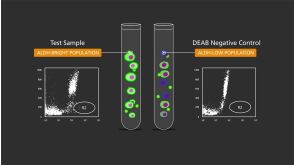
ALDEFLUOR™ 试剂盒
ALDEFLUOR™ DEAB试剂, 1.5 mM, 1 mL
ALDEFLUOR™检测缓冲液
Rasper M et al. (OCT 2010)
Neuro-oncology 12 10 1024--33
Glioblastoma (GBM) is the most aggressive primary brain tumor and is resistant to all therapeutic regimens. Relapse occurs regularly and might be caused by a poorly characterized tumor stem cell (TSC) subpopulation escaping therapy. We suggest aldehyde dehydrogenase 1 (ALDH1) as a novel stem cell marker in human GBM. Using the neurosphere formation assay as a functional method to identify brain TSCs,we show that high protein levels of ALDH1 facilitate neurosphere formation in established GBM cell lines. Even single ALDH1 positive cells give rise to colonies and neurospheres. Consequently,the inhibition of ALDH1 in vitro decreases both the number of neurospheres and their size. Cell lines without expression of ALDH1 do not form tumor spheroids under the same culturing conditions. High levels of ALDH1 seem to keep tumor cells in an undifferentiated,stem cell-like state indicated by the low expression of beta-III-tubulin. In contrast,ALDH1 inhibition induces premature cellular differentiation and reduces clonogenic capacity. Primary cell cultures obtained from fresh tumor samples approve the established GBM cell line results.
View Publication
Houtenbos I et al. (MAR 2006)
Haematologica 91 3 348--55
Leukemia-derived dendritic cells: towards clinical vaccination protocols in acute myeloid leukemia.
The ability of acute myeloid leukemic (AML) blasts to differentiate into leukemic dendritic cells (DC) thus acquiring the potential to present known and unknown leukemic antigens efficiently,holds promise as a possible new treatment for AML patients with minimal residual disease. Recent advances in culture methods have made the clinical use of leukemic DC feasible. However,additional measures appear to be essential in order to potentiate vaccines and to overcome the intrinsic tolerant state of the patients immune system. This review describes ways to improve AML-DC vaccines and discusses critical aspects concerning the development of clinical vaccination protocols.
View Publication
产品类型:
产品号#:
09600
09650
产品名:
StemSpan™ SFEM
StemSpan™ SFEM
Gallia GL et al. (FEB 2009)
Molecular cancer therapeutics 8 2 386--93
Inhibition of Akt inhibits growth of glioblastoma and glioblastoma stem-like cells.
A commonly activated signaling cascade in many human malignancies,including glioblastoma multiforme,is the Akt pathway. This pathway can be activated via numerous upstream alterations including genomic amplification of epidermal growth factor receptor,PTEN deletion,or PIK3CA mutations. In this study,we screened phosphatidylinositol 3-kinase/Akt small-molecule inhibitors in an isogenic cell culture system with an activated Akt pathway secondary to a PIK3CA mutation. One small molecule,A-443654,showed the greatest selective inhibition of cells with the mutant phenotype. Based on these findings,this inhibitor was screened in vitro against a panel of glioblastoma multiforme cell lines. All cell lines tested were sensitive to A-443654 with a mean IC(50) of approximately 150 nmol/L. An analogue of A-443654,methylated at a region that blocks Akt binding,was on average 36-fold less active. Caspase assays and dual flow cytometric analysis showed an apoptotic mechanism of cell death. A-443654 was further tested in a rat intracranial model of glioblastoma multiforme. Animals treated intracranially with polymers containing A-443654 had significantly extended survival compared with control animals; animals survived 79% and 43% longer than controls when A-443654-containing polymers were implanted simultaneously or in a delayed fashion,respectively. This small molecule also inhibited glioblastoma multiforme stem-like cells with similar efficacy compared with traditionally cultured glioblastoma multiforme cell lines. These results suggest that local delivery of an Akt small-molecule inhibitor is effective against experimental intracranial glioma,with no observed resistance to glioblastoma multiforme cells grown in stem cell conditions.
View Publication


 EasySep™小鼠TIL(CD45)正选试剂盒






 沪公网安备31010102008431号