Contribution of Hfe expression in macrophages to the regulation of hepatic hepcidin levels and iron loading.
Hereditary hemochromatosis (HH),an iron overload disease associated with mutations in the HFE gene,is characterized by increased intestinal iron absorption and consequent deposition of excess iron,primarily in the liver. Patients with HH and Hfe-deficient (Hfe-/-) mice manifest inappropriate expression of the iron absorption regulator hepcidin,a peptide hormone produced by the liver in response to iron loading. In this study,we investigated the contribution of Hfe expression in macrophages to the regulation of liver hepcidin levels and iron loading. We used bone marrow transplantation to generate wild-type (wt) and Hfe-/- mice chimeric for macrophage Hfe gene expression. Reconstitution of Hfe-deficient mice with wt bone marrow resulted in augmented capacity of the spleen to store iron and in significantly decreased liver iron loading,accompanied by a significant increase of hepatic hepcidin mRNA levels. Conversely,wt mice reconstituted with Hfe-deficient bone marrow had a diminished capacity to store iron in the spleen but no significant alterations of liver iron stores or hepcidin mRNA levels. Our results suggest that macrophage Hfe participates in the regulation of splenic and liver iron concentrations and liver hepcidin expression.
View Publication
产品类型:
产品号#:
18755
18755RF
产品名:
EasySep™小鼠CD49b正选试剂盒
RoboSep™ 小鼠CD49b正选试剂盒含滤芯吸头
Fusi A et al. (MAR 2011)
The Journal of investigative dermatology 131 2 487--94
Expression of the stem cell markers nestin and CD133 on circulating melanoma cells.
Different molecular markers have been identified for melanoma-initiating cells including CD133 and nestin. Assuming that metastasis requires a dissemination of tumor-initiating cells,presence of circulating tumor-initiating cells should be associated with worse patient outcome. In this study,20 ml blood was collected from 32 consecutive patients affected by metastatic melanoma and blood was enriched for circulating melanoma cells (CMCs) by CD45 depletion of the non-melanoma cell fraction. Multiparameter cytometry was carried out to co-stain with combinations of CD133 and nestin (NES). Six tissue samples from metastatic lesions of six different patients were stained with the same antibodies by immunohistochemistry. Percentage of NES-positive CMCs correlated with tumor burden and number of metastatic sites. Cox regression analysis revealed levels of lactate dehydrogenase (LDH; hazard ratio: 12.8 (1.35-121.5); P=0.02),number of metastatic sites (hazard ratio 3.87 (1.66-9.03); P=0.02),tumor burden (hazard ratio 5.72 (1.57-20.9); P=0.01),and percentage of NES-expressing CMCs ≥ 35% (hazard ratio 5.73 (1.66-19.7); P=0.006) to be factors related to shorter overall survival. CD133- and NES-expression profiles on CMCs were similar to matched metastatic tissue. These findings show that CMCs expressed stem cell-associated markers NES and CD133. Higher expression of NES on CMCs might represent an index of poor prognosis.
View Publication
产品类型:
产品号#:
18259
18259RF
产品名:
Jeselsohn R et al. (JAN 2010)
Cancer cell 17 1 65--76
Cyclin D1 kinase activity is required for the self-renewal of mammary stem and progenitor cells that are targets of MMTV-ErbB2 tumorigenesis.
Transplantation studies have demonstrated the existence of mammary progenitor cells with the ability to self-renew and regenerate a functional mammary gland. Although these progenitors are the likely targets for oncogenic transformation,correlating progenitor populations with certain oncogenic stimuli has been difficult. Cyclin D1 is required for lobuloalveolar development during pregnancy and lactation as well as MMTV-ErbB2- but not MMTV-Wnt1-mediated tumorigenesis. Using a kinase-deficient cyclin D1 mouse,we identified two functional mammary progenitor cell populations,one of which is the target of MMTV-ErbB2. Moreover,cyclin D1 activity is required for the self-renewal and differentiation of mammary progenitors because its abrogation leads to a failure to maintain the mammary epithelial regenerative potential and also results in defects in luminal lineage differentiation.
View Publication
产品类型:
产品号#:
19757
产品名:
Carlsten M et al. (OCT 2009)
Journal of immunology (Baltimore,Md. : 1950) 183 8 4921--30
Primary human tumor cells expressing CD155 impair tumor targeting by down-regulating DNAM-1 on NK cells.
The activating NK cell receptor DNAX accessory molecule-1 (DNAM-1) contributes to tumor immune surveillance and plays a crucial role in NK cell-mediated recognition of several types of human tumors,including ovarian carcinoma. Here,we have analyzed the receptor repertoire and functional integrity of NK cells in peritoneal effusions from patients with ovarian carcinoma. Relative to autologous peripheral blood NK cells,tumor-associated NK cells expressed reduced levels of the DNAM-1,2B4,and CD16 receptors and were hyporesponsive to HLA class I-deficient K562 cells and to coactivation via DNAM-1 and 2B4. Moreover,tumor-associated NK cells were also refractory to CD16 receptor stimulation,resulting in diminished Ab-dependent cellular cytotoxicity against autologous tumor cells. Coincubation of NK cells with ovarian carcinoma cells expressing the DNAM-1 ligand CD155 led to reduction of DNAM-1 expression. Therefore,NK cell-mediated rejection of ovarian carcinoma may be limited by perturbed DNAM-1 expression on tumor-associated NK cells induced by chronic ligand exposure. Thus,these data support the notion that tumor-induced alterations of activating NK cell receptor expression may hamper immune surveillance and promote tumor progression.
View Publication
产品类型:
产品号#:
18259
18259RF
18289
18289RF
18551
18551RF
18561
产品名:
Regala RP et al. (OCT 2009)
Cancer research 69 19 7603--11
Atypical protein kinase Ciota is required for bronchioalveolar stem cell expansion and lung tumorigenesis.
Protein kinase Ciota (PKCiota) is an oncogene required for maintenance of the transformed phenotype of non-small cell lung cancer cells. However,the role of PKCiota in lung tumor development has not been investigated. To address this question,we established a mouse model in which oncogenic Kras(G12D) is activated by Cre-mediated recombination in the lung with or without simultaneous genetic loss of the mouse PKCiota gene,Prkci. Genetic loss of Prkci dramatically inhibits Kras-initiated hyperplasia and subsequent lung tumor formation in vivo. This effect correlates with a defect in the ability of Prkci-deficient bronchioalveolar stem cells to undergo Kras-mediated expansion and morphologic transformation in vitro and in vivo. Furthermore,the small molecule PKCiota inhibitor aurothiomalate inhibits Kras-mediated bronchioalveolar stem cell expansion and lung tumor growth in vivo. Thus,Prkci is required for oncogene-induced expansion and transformation of tumor-initiating lung stem cells. Furthermore,aurothiomalate is an effective antitumor agent that targets the tumor-initiating stem cell niche in vivo. These data have important implications for PKCiota as a therapeutic target and for the clinical use of aurothiomalate for lung cancer treatment.
View Publication
产品类型:
产品号#:
18555
18555RF
18554
18554RF
18564
18564RF
产品名:
Yang L et al. (FEB 2009)
Biotechnology and bioengineering 102 2 521--34
Optimization of an enrichment process for circulating tumor cells from the blood of head and neck cancer patients through depletion of normal cells.
The optimization of a purely negative depletion,enrichment process for circulating tumor cells (CTCs) in the peripheral blood of head and neck cancer patients is presented. The enrichment process uses a red cell lysis step followed by immunomagnetic labeling,and subsequent depletion,of CD45 positive cells. A number of relevant variables are quantified,or attempted to be quantified,which control the performance of the enrichment process. Six different immunomagnetic labeling combinations were evaluated as well as the significant difference in performance with respect to the blood source: buffy coats purchased from the Red Cross,fresh,peripheral blood from normal donors,and fresh peripheral blood from human cancer patients. After optimization,the process is able to reduce the number of normal blood cells in a cancer patient's blood from 4.05 x 10(9) to 8.04 x 10(3) cells/mL and still recover,on average,2.32 CTC per mL of blood. For all of the cancer patient blood samples tested in which CTC were detected (20 out of 26 patients) the average recovery of CTCs was 21.7 per mL of blood,with a range of 282 to 0.53 CTC. Since the initial number of CTC in a patient's blood is unknown,and most probably varies from patient to patient,the recovery of the CTC is unknown. However,spiking studies of a cancer cell line into normal blood,and subsequent enrichment using the optimized protocol indicated an average recovery of approximately 83%. Unlike a majority of other published studies,this study focused on quantifying as many factors as possible to facilitate both the optimization of the process as well as provide information for current and future performance comparisons. The authors are not aware any other reported study which has achieved the performance reported here (a 5.66 log(10)) in a purely negative enrichment mode of operation. Such a mode of operation of an enrichment process provides significant flexibility in that it has no bias with respect to what attributes define a CTC; thereby allowing the researcher or clinician to use any maker they choose to define whether the final,enrich product contains CTCs or other cell type relevant to the specific question (i.e.,does the CTC have predominantly epithelial or mesenchymal characteristics?).
View Publication
Jankowska AM et al. (JUN 2009)
Blood 113 25 6403--10
Loss of heterozygosity 4q24 and TET2 mutations associated with myelodysplastic/myeloproliferative neoplasms.
Chromosomal abnormalities are frequent in myeloid malignancies,but in most cases of myelodysplasia (MDS) and myeloproliferative neoplasms (MPN),underlying pathogenic molecular lesions are unknown. We identified recurrent areas of somatic copy number-neutral loss of heterozygosity (LOH) and deletions of chromosome 4q24 in a large cohort of patients with myeloid malignancies including MDS and related mixed MDS/MPN syndromes using single nucleotide polymorphism arrays. We then investigated genes in the commonly affected area for mutations. When we sequenced TET2,we found homozygous and hemizygous mutations. Heterozygous and compound heterozygous mutations were found in patients with similar clinical phenotypes without LOH4q24. Clinical analysis showed most TET2 mutations were present in patients with MDS/MPN (58%),including CMML (6/17) or sAML (32%) evolved from MDS/MPN and typical MDS (10%),suggesting they may play a ubiquitous role in malignant evolution. TET2 mutations affected conserved domains and the N terminus. TET2 is widely expressed in hematopoietic cells but its function is unknown,and it lacks homology to other known genes. The frequency of mutations in this candidate myeloid regulatory gene suggests an important role in the pathogenesis of poor prognosis MDS/MPN and sAML and may act as a disease gene marker for these often cytogenetically normal disorders.
View Publication


 EasySep™小鼠TIL(CD45)正选试剂盒




 技术窍门组织解离方法指南
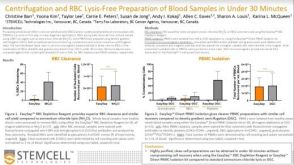 科学海报Centrifugation and RBC Lysis-Free Preparation of Blood Samples in Under 30 Minutes
 30:07
线上讲座Online Immunology Journal Club: New Strategies to Target Macrophages in Cancer发布日期: 08/10/2020
30:07
线上讲座Online Immunology Journal Club: New Strategies to Target Macrophages in Cancer发布日期: 08/10/2020

 沪公网安备31010102008431号