Susceptibility of human fetal mesenchymal stem cells to Kaposi sarcoma-associated herpesvirus.
Recent reports link Kaposi sarcoma-associated herpesvirus (KSHV) infection of bone marrow cells to bone marrow failure and lymphoproliferative syndromes. The identity of the infected marrow cells,however,remains unclear. Other work has demonstrated that circulating mononuclear cells can harbor KSHV where its detection predicts the onset and severity of Kaposi sarcoma. In either setting,bone marrow precursors may serve as viral reservoirs. Since mesenchymal stem cells (MSCs) in human bone marrow regulate the differentiation and proliferation of adjacent hematopoietic precursors,we investigated their potential role in KSHV infection. Our results indicate that primary MSCs are susceptible to both cell-free and cell-associated KSHV in culture. Moreover,infection persisted within nearly half of the cells for up to 6 weeks. Thus,MSCs possess a clear capacity to support KSHV infection and warrant further exploration into their potential role in KSHV-related human disease.
View Publication
产品类型:
产品号#:
15027
15067
产品名:
RosetteSep™人骨髓祖细胞预富集抗体混合物
RosetteSep™人骨髓祖细胞预富集抗体混合物
Sarugaser R et al. ( 2009)
Methods in molecular biology (Clifton,N.J.) 482 269--79
Isolation, propagation, and characterization of human umbilical cord perivascular cells (HUCPVCs).
Current sources of mesenchymal cells,including bone marrow,fat and muscle,all require invasive procurement procedures,and provide relatively low frequencies of progenitors. Here,we describe the non-invasive isolation,and characterization,of a rich source of mesenchymal progenitor cells,which we call human umbilical cord perivascular cells (HUCPVCs). HUCPVCs show a similar immunological phenotype to bone marrow-derived mesenchymal stromal cells (BM-MSCs),since they are non-alloreactive,exhibit immunosuppression,and significantly reduce lymphocyte activation,in vitro. They present a non-hematopoietic myofibroblastic mesenchymal phenotype (CD45-,CD34-,CD105+,CD73+,CD90+,CD44+,CD106+,3G5+,CD146+); with a 1:300 frequency at harvest,a short-doubling time,and a clonogenic frequency of textgreater1:3 in culture. Furthermore,in addition to robust quinti-potential differentiation capacity in vitro,HUCPVCs have been shown to contribute to both musculo-skeletal and dermal wound healing in vivo.
View Publication
产品类型:
产品号#:
07930
07931
07940
07952
07955
07959
100-1061
产品名:
CryoStor® CS10
CryoStor® CS10
CryoStor® CS10
CryoStor® CS10
CryoStor® CS10
CryoStor® CS10
CryoStor® CS10
Xu Y et al. (DEC 2015)
Cryobiology 71 3 486--492
Sensitivity of human embryonic stem cells to different conditions during cryopreservation
Low cell recovery rate of human embryonic stem cells (hESCs) resulting from cryopreservation damages leads to the difficulty in their successful commercialization of clinical applications. Hence in this study,sensitivity of human embryonic stem cells (hESCs) to different cooling rates,ice seeding and cryoprotective agent (CPA) types was compared and cell viability and recovery after cryopreservation under different cooling conditions were assessed. Both extracellular and intracellular ice formation were observed. Reactive oxidative species (ROS) accumulation of hESCs was determined. Cryopreservation of hESCs at 1 °C/min with the ice seeding and at the theoretically predicted optimal cooling rate (TPOCR) led to lower level of intracellular ROS,and prevented irregular and big ice clump formation compared with cryopreservation at 1 °C/min. This strategy further resulted in a significant increase in the hESC recovery when glycerol and 1,2-propanediol were used as the CPAs,but no increase for Me2SO. hESCs after cryopreservation under all the tested conditions still maintained their pluripotency. Our results provide guidance for improving the hESC cryopreservation recovery through the combination of CPA type,cooling rate and ice seeding.
View Publication
产品类型:
产品号#:
05835
05839
产品名:
STEMdiff™ 神经诱导培养基
STEMdiff™ 神经诱导培养基
Gazdhar A et al. ( 2017)
Frontiers in immunology 8 April 447
Human Bronchial Epithelial Cells Induce CD141/CD123/DC-SIGN/FLT3Monocytes That Promote Allogeneic Th17 Differentiation.
Little is known about monocyte differentiation in the lung mucosal environment and about how the epithelium shapes monocyte function. We studied the role of the soluble component of bronchial epithelial cells (BECs) obtained under basal culture conditions in innate and adaptive monocyte responses. Monocytes cultured in bronchial epithelial cell-conditioned media (BEC-CM) specifically upregulate CD141,CD123,and DC-SIGN surface levels andFLT3expression,as well as the release of IL-1β,IL-6,and IL-10. BEC-conditioned monocytes stimulate naive T cells to produce IL-17 through IL-1β mechanism and also trigger IL-10 production by memory T cells. Furthermore,monocytes cultured in an inflammatory environment induced by the cytokines IL-6,IL-8,IL-1β,IL-15,TNF-α,and GM-CSF also upregulate CD123 and DC-SIGN expression. However,only inflammatory cytokines in the epithelial environment boost the expression of CD141. Interestingly,we identified a CD141/CD123/DC-SIGN triple positive population in the bronchoalveolar lavage fluid (BALF) from patients with different inflammatory conditions,demonstrating that this monocyte population existsin vivo. The frequency of this monocyte population was significantly increased in patients with sarcoidosis,suggesting a role in inflammatory mechanisms. Overall,these data highlight the specific role that the epithelium plays in shaping monocyte responses. Therefore,the unraveling of these mechanisms contributes to the understanding of the function that the epithelium may playin vivo.
View Publication
产品类型:
产品号#:
05001
05021
05022
产品名:
PneumaCult™-ALI 培养基
PneumaCult™-ALI 培养基含12 mm Transwell®插件
PneumaCult™-ALI 培养基含6.5 mm Transwell®插件
Gilpin SE et al. ( 2016)
Biomaterials 108 111--119
Regenerative potential of human airway stem cells in lung epithelial engineering
Bio-engineered organs for transplantation may ultimately provide a personalized solution for end-stage organ failure,without the risk of rejection. Building upon the process of whole organ perfusion decellularization,we aimed to develop novel,translational methods for the recellularization and regeneration of transplantable lung constructs. We first isolated a proliferative KRT5+TP63+ basal epithelial stem cell population from human lung tissue and demonstrated expansion capacity in conventional 2D culture. We then repopulated acellular rat scaffolds in ex vivo whole organ culture and observed continued cell proliferation,in combination with primary pulmonary endothelial cells. To show clinical scalability,and to test the regenerative capacity of the basal cell population in a human context,we then recellularized and cultured isolated human lung scaffolds under biomimetic conditions. Analysis of the regenerated tissue constructs confirmed cell viability and sustained metabolic activity over 7 days of culture. Tissue analysis revealed extensive recellularization with organized tissue architecture and morphology,and preserved basal epithelial cell phenotype. The recellularized lung constructs displayed dynamic compliance and rudimentary gas exchange capacity. Our results underline the regenerative potential of patient-derived human airway stem cells in lung tissue engineering. We anticipate these advances to have clinically relevant implications for whole lung bioengineering and ex vivo organ repair.
View Publication
产品类型:
产品号#:
05001
05021
05022
产品名:
PneumaCult™-ALI 培养基
PneumaCult™-ALI 培养基含12 mm Transwell®插件
PneumaCult™-ALI 培养基含6.5 mm Transwell®插件
Kim YY et al. (SEP 2016)
PLOS ONE 11 9 e0163812
Alcohol-Induced Molecular Dysregulation in Human Embryonic Stem Cell-Derived Neural Precursor Cells
Adverse effect of alcohol on neural function has been well documented. Especially,the teratogenic effect of alcohol on neurodevelopment during embryogenesis has been demonstrated in various models,which could be a pathologic basis for fetal alcohol spectrum disorders (FASDs). While the developmental defects from alcohol abuse during gestation have been described,the specific mechanisms by which alcohol mediates these injuries have yet to be determined. Recent studies have shown that alcohol has significant effect on molecular and cellular regulatory mechanisms in embryonic stem cell (ESC) differentiation including genes involved in neural development. To test our hypothesis that alcohol induces molecular alterations during neural differentiation we have derived neural precursor cells from pluripotent human ESCs in the presence or absence of ethanol treatment. Genome-wide transcriptomic profiling identified molecular alterations induced by ethanol exposure during neural differentiation of hESCs into neural rosettes and neural precursor cell populations. The Database for Annotation,Visualization and Integrated Discovery (DAVID) functional analysis on significantly altered genes showed potential ethanol's effect on JAK-STAT signaling pathway,neuroactive ligand-receptor interaction,Toll-like receptor (TLR) signaling pathway,cytokine-cytokine receptor interaction and regulation of autophagy. We have further quantitatively verified ethanol-induced alterations of selected candidate genes. Among verified genes we further examined the expression of P2RX3,which is associated with nociception,a peripheral pain response. We found ethanol significantly reduced the level of P2RX3 in undifferentiated hESCs,but induced the level of P2RX3 mRNA and protein in hESC-derived NPCs. Our result suggests ethanol-induced dysregulation of P2RX3 along with alterations in molecules involved in neural activity such as neuroactive ligand-receptor interaction may be a molecular event associated with alcohol-related peripheral neuropathy of an enhanced nociceptive response.
View Publication
产品类型:
产品号#:
05835
05839
85850
85857
产品名:
STEMdiff™ 神经诱导培养基
STEMdiff™ 神经诱导培养基
mTeSR™1
mTeSR™1
Kunisato A et al. (JAN 2011)
Stem cells and development 20 1 159--168
Direct generation of induced pluripotent stem cells from human nonmobilized blood.
The use of induced pluripotent stem cells (iPSCs) is an exciting frontier in the study and treatment of human diseases through the generation of specific cell types. Here we show the derivation of iPSCs from human nonmobilized peripheral blood (PB) and bone marrow (BM) mononuclear cells (MNCs) by retroviral transduction of OCT3/4,SOX2,KLF4,and c-MYC. The PB- and BM-derived iPSCs were quite similar to human embryonic stem cells with regard to morphology,expression of surface antigens and pluripotency-associated transcription factors,global gene expression profiles,and differentiation potential in vitro and in vivo. Infected PB and BM MNCs gave rise to iPSCs in the presence of several cytokines,although transduction efficiencies were not high. We found that 5 × 10(5) PB MNCs,which corresponds to less than 1 mL of PB,was enough for the generation of several iPSC colonies. Generation of iPSCs from MNCs of nonmobilized PB,with its relative efficiency and ease of harvesting,could enable the therapeutic use of patient-specific pluripotent stem cells.
View Publication
产品类型:
产品号#:
85850
85857
产品名:
mTeSR™1
mTeSR™1
Lange C et al. (JAN 2011)
Neuroscience letters 488 1 36--40
Small molecule GSK-3 inhibitors increase neurogenesis of human neural progenitor cells.
Human neural progenitor cells provide a source for cell replacement therapy to treat neurodegenerative diseases. Therefore,there is great interest in mechanisms and tools to direct the fate of multipotent progenitor cells during their differentiation to increase the yield of a desired cell type. We tested small molecule inhibitors of glycogen synthase kinase-3 (GSK-3) for their functionality and their influence on neurogenesis using the human neural progenitor cell line ReNcell VM. Here we report the enhancement of neurogenesis of human neural progenitor cells by treatment with GSK-3 inhibitors. We tested different small molecule inhibitors of GSK-3 i.e. LiCl,sodium-valproate,kenpaullone,indirubin-3-monoxime and SB-216763 for their ability to inhibit GSK-3 in human neural progenitor cells. The highest in situ GSK-3 inhibitory effect of the drugs was found for kenpaullone and SB-216763. Accordingly,kenpaullone and SB-216763 were the only drugs tested in this study to stimulate the Wnt/β-catenin pathway that is antagonized by GSK-3. Analysis of human neural progenitor differentiation revealed an augmentation of neurogenesis by SB-216763 and kenpaullone,without changing cell cycle exit or cell survival. Small molecule inhibitors of GSK-3 enhance neurogenesis of human neural progenitor cells and may be used to direct the differentiation of neural stem and progenitor cells in therapeutic applications.
View Publication
产品类型:
产品号#:
72782
72872
产品名:
Kenpaullone
SB216763
Olmer R et al. (OCT 2012)
Tissue engineering. Part C,Methods 18 10 772--784
Suspension culture of human pluripotent stem cells in controlled, stirred bioreactors
Therapeutic and industrial applications of pluripotent stem cells and their derivatives require large cell quantities generated in defined conditions. To this end,we have translated single cell-inoculated suspension cultures of human pluripotent stem cells (hPSCs; including human induced pluripotent stem cells [hiPS] and human embryonic stem cells [hESC]) to stirred tank bioreactors. These systems that are widely used in biopharmaceutical industry allow straightforward scale up and detailed online monitoring of key process parameters. To ensure minimum medium consumption,but in parallel functional integration of all probes mandatory for process monitoring,that is,for pO₂ and pH,experiments were performed in 100 mL culture volume in a mini reactor platform" consisting of four independently controlled vessels. By establishing defined parameters for tightly controlled cell inoculation and aggregate formation up to 2×10�?� hiPSCs/100 mL were generated in a single process run in 7 days. Expression of pluripotency markers and ability of cells to differentiate into derivates of all three germ layers in vitro was maintained�
View Publication
产品类型:
产品号#:
85850
85857
产品名:
mTeSR™1
mTeSR™1
Deng F et al. ( 2012)
Molecular vision 18 2871
Generation of induced pluripotent stem cells from human Tenon's capsule fibroblasts.
PURPOSE This study aimed to develop a feasible and efficient method for generating embryonic stem cell (ESC)-like induced pluripotent stem (iPS) cells from human Tenon's capsule fibroblasts (HTFs) through the expression of a defined set of transcription factors,which will have significant application value for ophthalmic personalized regenerative medicine. METHODS HTFs were harvested from fresh samples,and reprogramming was induced by the exogenous expression of the four classic transcription factors,OCT-3/4,SOX-2,KLF-4,and C-MYC. The HTF-derived iPS (TiPS) cells were analyzed with phase contrast microscopy,real-time PCR,immunofluorescence,FACS analysis,alkaline phosphatase activity analysis,and a teratoma formation assay. Human ESC colonies were used as the positive control. RESULTS The resulting HTF-derived iPS cell colonies were indistinguishable from human ESC colonies regarding morphology,gene expression levels,pluripotent gene expression,alkaline phosphatase activity,and the ability to generate all three embryonic germ layers. CONCLUSIONS This study presents a simple,efficient,practical procedure for generating patient-tailored iPS cells from HTFs. These cells will serve as a valuable and preferred candidate donor cell population for ophthalmological regenerative medicine.
View Publication


 EasySep™小鼠TIL(CD45)正选试剂盒




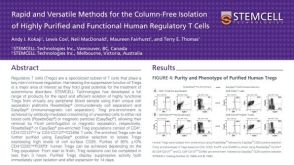 科学海报Column-Free Isolation of Highly Purified and Functional Human Regulatory T Cells

 沪公网安备31010102008431号