Chromatin interaction maps of human arterioles reveal mechanisms for the genetic regulation of blood pressure
Arterioles are small blood vessels located just upstream of capillaries in nearly all tissues. Despite the broad and essential role of arterioles in physiology and disease,current knowledge of the functional genomics of arterioles is largely absent. Here,we report extensive maps of chromatin interactions,single-cell expression,and other molecular features in human arterioles and uncover mechanisms linking human genetic variants to gene expression in vascular cells and the development of hypertension. Compared to large arteries,arterioles exhibited a higher proportion of pericytes which were enriched for blood pressure (BP)-associated genes. BP-associated single nucleotide polymorphisms (SNPs) were enriched in chromatin interaction regions in arterioles. We linked BP-associated noncoding SNP rs1882961 to gene expression through long-range chromatin contacts and revealed remarkable effects of a 4-bp noncoding genomic segment on hypertension in vivo. We anticipate that our data and findings will advance the study of the numerous diseases involving arterioles. Liu et al.,report extensive maps of chromatin interactions,single-cell expression,and other molecular features in human arterioles and uncover mechanisms linking noncoding genetic variants to gene expression and the development of hypertension.
View Publication
产品类型:
产品号#:
100-0276
100-1130
产品名:
mTeSR™ Plus
mTeSR™ Plus
(May 2025)
Biotechnology Reports 47 9
Scale-down optimization of a robust, parallelizable human induced pluripotent stem cell bioprocess for high-throughput research
Highlights•Preformation of aggregates tuned by cell density enable cultivation of hiPSCs in scale-down shear environments.•Scale-down systems utilizing preformation protocols achieve comparable fold expansion with commercial systems.•Expression of pluripotency markers and functional differentiation capacity is maintained following passage in scale-down culture.•Successful application of hiPSC protocols at < 20 mL scales enable rapid and cost-effective research into cell phenotype under dynamic conditions. Human induced pluripotent stem cell (hiPSC) derived therapeutics require clinically relevant quantities of high-quality cell populations for applications in regenerative medicine. The lack of efficacy exhibited across clinical trials suggests deeper understanding of the networks governing phenotype is needed. Further,costs limit study throughput in characterizing the artificial niche relative to outcomes. We present herein an optimized strategy to enable high-throughput hiPSC expansion at <20 mL research scale. We assessed viability of single cell inoculation and aggregate preformation to facilitate proliferation. We modeled aggregate characteristics against agitation rate. Our results demonstrate tunable control with fold expansion comparable to commercial systems. Marker quantification and teratoma assay confirm functional pluripotency. This approach constitutes a scalable protocol to accelerate hiPSC research,and a significant step in advancing the rate of progress in elucidating links to derivative functionality. This work will enable statistically rigorous studies targeting hiPSC and downstream phenotype for clinical manufacturing. Graphical abstractImplementation of adapted protocols enable scale-down systems as a tool for high-throughput iPSC biomanufacturing research,in platforms conducive to scale-up for clinical manufacturing.Image,graphical abstract
View Publication
产品类型:
产品号#:
85850
85857
产品名:
mTeSR™1
mTeSR™1
O. Contreras et al. (Aug 2025)
iScience 28 9
OpenEMMU: A versatile, open-source EdU multiplexing methodology for studying DNA replication and cell cycle dynamics
5-Ethynyl-2′-deoxyuridine (EdU) has revolutionized DNA replication and cell cycle analyses through fast,efficient click chemistry detection. However,commercial EdU kits suffer from high costs,proprietary formulations,limited antibody multiplexing capabilities,and difficulties with larger biological specimens. Here,we present OpenEMMU (Open-source EdU Multiplexing Methodology for Understanding DNA replication dynamics),an optimized,affordable,and user-friendly click chemistry platform utilizing off-the-shelf reagents. OpenEMMU enhances efficiency,brightness,and multiplexing capabilities of EdU staining with both non-conjugated and conjugated antibodies across diverse cell types,including T cell activation and proliferation assays. We validated its effectiveness for the fluorescent imaging of nascent DNA synthesis in developing embryos and organs,including embryonic heart,forelimbs,and 3D hiPSC-derived cardiac organoids. OpenEMMU also enabled the deep-tissue 3D imaging of DNA synthesis in zebrafish larvae and under replication stress in embryos at high spatial resolution. This approach opens new avenues for understanding organismal development,cell proliferation,and DNA replication dynamics with unprecedented precision and flexibility. Subject areas: Biochemistry,Cell biology,Developmental biology,Computational bioinformatics
View Publication
产品类型:
产品号#:
100-0483
100-0484
100-0276
100-1130
产品名:
Hausser Scientificᵀᴹ 明线血球计数板
ReLeSR™
mTeSR™ Plus
mTeSR™ Plus
S. Tamiya et al. (Dec 2024)
Open Forum Infectious Diseases 12 1
H and B Blood Antigens Are Essential for In Vitro Replication of GII.2 Human Norovirus
Human norovirus (HuNoV) is a major cause of enteric infectious gastroenteritis and is classified into several genotypes based on its capsid protein amino acid sequence and nucleotide sequence of the polymerase gene. Among these,GII.4 is the major genotype worldwide. Epidemiological studies have highlighted the prevalence of GII.2. Although recent advances using human tissue– and induced pluripotent stem cell (iPSC)–derived intestinal epithelial cells (IECs) have enabled in vitro replication of multiple HuNoV genotypes,GII.2 HuNoV could replicate only in tissue-derived IECs and not in iPSC-derived IECs. We investigated the factors influencing GII.2 HuNoV replication in IECs,focusing on histo-blood group antigens. We also assessed the immunogenicity of GII.2 virus-like particles (VLPs) and their ability to induce neutralizing antibodies. Antibody cross-reactivity was tested to determine whether GII.2 VLPs could neutralize other HuNoV genotypes,including GII.4,GII.3,GII.6,and GII.17. Our findings indicated that GII.2 HuNoV replication in vitro requires the presence of both H and B antigens. Moreover,GII.2 VLPs generated neutralizing antibodies effective against both GII.2 and GII.4 but not against GII.3,GII.6,or GII.17. Comparatively,GII.2 and GII.17 VLPs induced broader neutralizing responses than GII.4 VLPs. The findings of this study suggests that GII.2 and GII.17 VLPs may be advantageous as HuNoV vaccine candidates because they elicit neutralizing antibodies against the predominant GII.4 genotype,which could be particularly beneficial for infants without prior HuNoV exposure. These insights will contribute to the development of effective HuNoV vaccines.
View Publication
产品类型:
产品号#:
05140
产品名:
STEMdiff™肠道类器官试剂盒
B. L. Khoo et al. ( 2019)
NPJ precision oncology 3 30
Liquid biopsy for minimal residual disease detection in leukemia using a portable blast cell biochip.
Long-term management for leukemia is challenging due to the painful and invasive procedure of bone marrow (BM) biopsy. At present,non-invasive liquid (blood) biopsy is not utilized for leukemia,due to lower counts of leukemia blast cells in the blood. Here,we described a robust system for the simultaneous detection and enrichment of rare blast cells. Enrichment of blast cells was achieved from blood with a one-step microfluidic blast cell biochip (BCB) sorting system,without specific targeting of proteins by antibodies. Non-target cells encountered a differential net force as compared to stiffer blast cells and were removed. The efficiency of the BCB promotes high detection sensitivity (1 in 106 cells) even from patients with minimal residual disease. The procedure was validated using actual blast cells from patients with various types of leukemia. Outcomes were compared to current evaluation standards,such as flow cytometry,using BM aspirates. Blast cell detection efficiency was higher in 55.6{\%} of the patients using the BCB as compared to flow cytometry,despite the lower concentrations of blast cells in liquid biopsy. These studies promote early-stage detection and routine monitoring for minimal residual disease in patients.
View Publication
Generation of 3D Human iPSC-Derived Multi-Cell Type Neurospheres for Studying Neuron, Astrocyte, and Microglia Crosstalk
Three-dimensional (3D) human brain tissue models derived from induced pluripotent stem cells (iPSCs) have transformed the study of neural development and disease in vitro. While cerebral organoids offer high structural complexity,their large size often leads to necrotic core formation,limiting reproducibility and challenging the integration of microglia. Here,we present a detailed,reproducible protocol for generating multi-cell type 3D neurospheres that incorporate neurons,astrocytes,and optionally microglia,all derived from the same iPSCs. While neurons and astrocytes differentiate spontaneously from neural precursor cells,generated by dual SMAD-inhibition (blocking BMP and TGF-b signaling),microglia are generated in parallel and can infiltrate the mature neurosphere tissue after plating neurospheres into 48-well plates. The system supports a range of downstream applications,including functional confocal live imaging of GCaMP6f after adeno-associated virus (AAV) transduction of neurospheres or immunofluorescence staining after fixation. Our approach has been successfully implemented across multiple laboratories,demonstrating its robustness and translational potential for studying neuron–glia interactions and modeling neurodegenerative processes.
View Publication
产品类型:
产品号#:
100-0483
100-0484
产品名:
Hausser Scientificᵀᴹ 明线血球计数板
ReLeSR™
X. Hua et al. (Jan 2026)
Theranostics 16 4
Engineered T cell therapy for the treatment of cardiac fibrosis during chronic phase of myocarditis
Background: Chronic myocarditis (CMYO) progresses to fibrosis and heart failure,yet no therapies effectively target fibrosis. Fibroblast activation protein (FAP) marks pathogenic myofibroblasts,but its therapeutic potential remains unexplored in inflammatory settings.Methods: Using bulk/scRNA-seq of human myocarditis samples,we identified FAP as a fibrosis-specific marker. We engineered FAP-targeted CAR-T (FAP.CAR-T) cells and tested their efficacy in autoimmune (EAM) and viral (CVB3) myocarditis models. Human cardiac organoids (hCOs) treated with IL-17A modeled inflammatory fibrosis.Results: FAP expression correlated with fibrosis severity in patients (r = 0.96,P = 0.0028). In EAM and CVB3 models,FAP.CAR-T cells reduced fibrosis by 65% and 55%,respectively (P < 0.001),restored ejection fraction to higher than 65%. hCOs treated with FAP.CAR-T cells showed 55% less fibrosis (P < 0.05). No toxicity was observed in healthy mice.Conclusions: FAP.CAR-T cells eliminate fibrosis-driving myofibroblasts,reversing cardiac dysfunction in chronic myocarditis. This strategy,validated in human organoids,offers translatable immunotherapy for fibrosis-driven heart disease.
View Publication
产品类型:
产品号#:
100-0276
100-1130
产品名:
mTeSR™ Plus
mTeSR™ Plus
Sun N et al. (SEP 2009)
Proceedings of the National Academy of Sciences of the United States of America 106 37 15720--5
Feeder-free derivation of induced pluripotent stem cells from adult human adipose stem cells.
Ectopic expression of transcription factors can reprogram somatic cells to a pluripotent state. However,most of the studies used skin fibroblasts as the starting population for reprogramming,which usually take weeks for expansion from a single biopsy. We show here that induced pluripotent stem (iPS) cells can be generated from adult human adipose stem cells (hASCs) freshly isolated from patients. Furthermore,iPS cells can be readily derived from adult hASCs in a feeder-free condition,thereby eliminating potential variability caused by using feeder cells. hASCs can be safely and readily isolated from adult humans in large quantities without extended time for expansion,are easy to maintain in culture,and therefore represent an ideal autologous source of cells for generating individual-specific iPS cells.
View Publication
产品类型:
产品号#:
85850
85857
产品名:
mTeSR™1
mTeSR™1
Nizzardo M et al. (NOV 2010)
Cellular and molecular life sciences : CMLS 67 22 3837--47
Human motor neuron generation from embryonic stem cells and induced pluripotent stem cells.
Motor neuron diseases (MNDs) are a group of neurological disorders that selectively affect motor neurons. There are currently no cures or efficacious treatments for these diseases. In recent years,significant developments in stem cell research have been applied to MNDs,particularly regarding neuroprotection and cell replacement. However,a consistent source of motor neurons for cell replacement is required. Human embryonic stem cells (hESCs) could provide an inexhaustible supply of differentiated cell types,including motor neurons that could be used for MND therapies. Recently,it has been demonstrated that induced pluripotent stem (iPS) cells may serve as an alternative source of motor neurons,since they share ES characteristics,self-renewal,and the potential to differentiate into any somatic cell type. In this review,we discuss several reproducible methods by which hESCs or iPS cells are efficiently isolated and differentiated into functional motor neurons,and possible clinical applications.
View Publication
产品类型:
产品号#:
85850
85857
产品名:
mTeSR™1
mTeSR™1
Ma R et al. (FEB 2017)
Thyroid : official journal of the American Thyroid Association 27 2 292--299
TAZ Induction Directs Differentiation of Thyroid Follicular Cells from Human Embryonic Stem Cells.
OBJECTIVE The differentiation program for human thyroid follicular cells (TFCs) relies on the interplay between sequence-specific transcription factors and transcriptional co-regulators. Transcriptional co-activator with PDZ-binding motif (TAZ) is a co-activator that regulates several transcription factors,including PAX8 and NKX2-1,which play a central role in thyroid-specific gene transcription. TAZ and PAX8/NKX2-1 are co-expressed in the nuclei of thyroid cells,and TAZ interacts directly with both PAX8 and NKX2-1,leading to their enhanced transcriptional activity on the thyroglobulin (TG) promoter and additional genes. METHODS The use of a small molecule,ethacridine,recently identified as a TAZ activator,in the differentiation of thyroid cells from human embryonic stem (hES) cells was studied. First,endodermal cells were derived from hES cells using Activin A,followed by induction of differentiation into thyroid cells directed by ethacridine and thyrotropin (TSH). RESULTS The expression of TAZ was increased in the Activin A-derived endodermal cells by ethacridine in a dose-dependent manner and followed by increases in PAX8 and NKX2-1 when assessed by both quantitative polymerase chain reaction and immunostaining. Following further differentiation with the combination of ethacridine and TSH,the thyroid-specific genes TG,TPO,TSHR,and NIS were all induced in the differentiated hES cells. When these cells were cultured with extracellular matrix-coated dishes,thyroid follicle formation and abundant TG protein expression were observed. Furthermore,such hES cell-derived thyroid follicles showed a marked TSH-induced and dose-dependent increase in radioiodine uptake and protein-bound iodine accumulation. CONCLUSION These data show that fully functional human thyroid cells can be derived from hES cells using ethacridine,a TAZ activator,which induces thyroid-specific gene expression and promotes thyroid cell differentiation from the hES cells. These studies again demonstrate the importance of transcriptional regulation in thyroid cell development. This approach also yields functional human thyrocytes,without any gene transfection or complex culture conditions,by directly manipulating the transcriptional machinery without interfering with intermediate signaling events.
View Publication


 EasySep™小鼠TIL(CD45)正选试剂盒




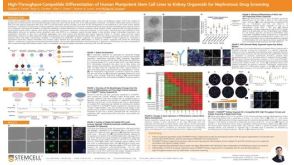 科学海报High-Throughput-Compatible Differentiation of Human Pluripotent Stem Cell Lines to Kidney Organoids for Nephrotoxic Drug Screening
 实验方案How to Dissociate and Plate Human Pluripotent Stem Cell-Derived Cardiomyocytes for Microelectrode Array (MEA) Assay
 沪公网安备31010102008431号