Reya T and Clevers H (APR 2005)
Nature 434 7035 843--50
Wnt signalling in stem cells and cancer.
The canonical Wnt cascade has emerged as a critical regulator of stem cells. In many tissues,activation of Wnt signalling has also been associated with cancer. This has raised the possibility that the tightly regulated self-renewal mediated by Wnt signalling in stem and progenitor cells is subverted in cancer cells to allow malignant proliferation. Insights gained from understanding how the Wnt pathway is integrally involved in both stem cell and cancer cell maintenance and growth in the intestinal,epidermal and haematopoietic systems may serve as a paradigm for understanding the dual nature of self-renewal signals.
View Publication
产品类型:
产品号#:
100-1052
72544
72552
72554
72562
72564
72672
72674
产品名:
XAV939
IWP-3
IWP-4
IWP-4
IWR-1-endo
IWR-1-endo
XAV939
XAV939
Wang X et al. (DEC 2013)
Oncogene 32 49 5512--21
PPARγ maintains ERBB2-positive breast cancer stem cells.
Overexpression of the adverse prognostic marker ERBB2 occurs in 30% of breast cancers and is associated with aggressive disease and poor outcomes. Our recent findings have shown that NR1D1 and the peroxisome proliferator-activated receptor-γ (PPARγ)-binding protein (PBP) act through a common pathway in upregulating several genes in the de novo fatty acid synthesis network,which is highly active in ERBB2-positive breast cancer cells. NR1D1 and PBP are functionally related to PPARγ,a well-established positive regulator of adipogenesis and lipid storage. Here,we report that inhibition of the PPARγ pathway reduces the aldehyde dehydrogenase (ALDH)-positive population in ERBB2-positive breast cancer cells. Results from in vitro tumorsphere formation assays demonstrate that the PPARγ antagonists GW9662 and T0070907 decrease tumorsphere formation in ERBB2-positive cells,but not other breast cells. We show that the mechanism by which GW9662 treatment causes a reduction in ALDH-positive population cells is partially due to ROS,as it can be rescued by treatment with N-acetyl-cysteine. Furthermore,global gene expression analyses show that GW9662 treatment suppresses the expression of several lipogenic genes,including ACLY,MIG12,FASN and NR1D1,and the stem-cell related genes KLF4 and ALDH in BT474 cells. Antagonist treatment also decreases the level of acetylation in histone 3 and histone 4 in BT474 cells,compared with MCF7 cells. In vivo,GW9662 pre-treatment inhibits the tumor-seeding ability of BT474 cells. Together,these results show that the PPARγ pathway is critical for the cancer stem cell properties of ERBB2-positive breast cancer cells.
View Publication
Boonyaratanakornkit JB et al. (DEC 2010)
The Journal of investigative dermatology 130 12 2799--808
Selection of tumorigenic melanoma cells using ALDH.
Despite increasing knowledge regarding melanoma-initiating cells (MICs),questions persist regarding the number and phenotypic nature of cells with tumor-generating capability. Evidence for a phenotypically distinct human MIC has been found in NOD/SCID (non-obese diabetic/severe combined immunodeficiency) mice. However,a phenotypically distinct human MIC was not found in the NOD/SCIDIl2rg(-)/(-) (NSG) mouse model. The demonstration of a distinct population of human melanoma cells responsible for tumorigenesis and tumor cell self-renewal would provide an important target for new melanoma therapies. In this study,we show a 100-fold range in MIC frequency in human melanoma (1 in 18,000 to 1 in 1,851,000 cells) in the NOD/SCID mouse. In this model,human melanoma cells with high aldehyde dehydrogenase (ALDH) activity were enriched 16.8-fold in tumorigenic cells over unfractionated (UNF) cells,such that 1 in 21,000 cells was a MIC. In the NSG mouse,the ALDH expressing cell population was enriched 100-fold in tumorigenic cells over UNF cells,such that one in four cells was a MIC. Xenograft melanomas that developed from ALDH(+) cells displayed robust self-renewal,whereas those from ALDH(-) cells showed minimal self-renewal in vitro. Thus,ALDH(+) melanoma cells have enhanced tumorigenicity over ALDH(-) cells and superior self-renewal ability.
View Publication
产品类型:
产品号#:
01700
01702
01705
产品名:
ALDEFLUOR™ 试剂盒
ALDEFLUOR™测定缓冲液
ALDEFLUOR™ DEAB试剂
K. E. Hammerick et al. (feb 2011)
Tissue engineering. Part A 17 4-Mar 495--502
Elastic properties of induced pluripotent stem cells.
The recent technique of transducing key transcription factors into unipotent cells (fibroblasts) to generate pluripotent stem cells (induced pluripotent stem cells [iPSCs]) has significantly changed the stem cell field. These cells have great promise for many clinical applications,including that of regenerative medicine. Our findings show that iPSCs can be derived from human adipose-derived stromal cells (hASCs),a notable advancement in the clinical applicability of these cells. To investigate differences between two iPS cell lines (fibroblast-iPSC and hASC-iPSC),and also the gold standard human embryonic stem cell,we looked at cell stiffness as a possible indicator of cell differentiation-potential differences. We used atomic force microscopy as a tool to determine stem cell stiffness,and hence differences in material properties between cells. Human fibroblast and hASC stiffness was also ascertained for comparison. Interestingly,cells exhibited a noticeable difference in stiffness. From least to most stiff,the order of cell stiffness was as follows: hASC-iPSC,human embryonic stem cell,fibroblast-iPSC,fibroblasts,and,lastly,as the stiffest cell,hASC. In comparing hASC-iPSCs to their origin cell,the hASC,the reprogrammed cell is significantly less stiff,indicating that greater differentiation potentials may correlate with a lower cellular modulus. The stiffness differences are not dependent on cell culture density; hence,material differences between cells cannot be attributed solely to cell-cell constraints. The change in mechanical properties of the cells in response to reprogramming offers insight into how the cell interacts with its environment and might lend clues to how to efficiently reprogram cell populations as well as how to maintain their pluripotent state.
View Publication
产品类型:
产品号#:
85850
85857
产品名:
mTeSR™1
mTeSR™1
Ichikawa S et al. (MAY 2011)
Journal of immunology (Baltimore,Md. : 1950) 186 10 5549--55
Hepatic stellate cells function as regulatory bystanders.
Regulatory T cells (Tregs) contribute significantly to the tolerogenic nature of the liver. The mechanisms,however,underlying liver-associated Treg induction are still elusive. We recently identified the vitamin A metabolite,retinoic acid (RA),as a key controller that promotes TGF-β-dependent Foxp3(+) Treg induction but inhibits TGF-β-driven Th17 differentiation. To investigate whether the RA producing hepatic stellate cells (HSC) are part of the liver tolerance mechanism,we investigated the ability of HSC to function as regulatory APC. Different from previous reports,we found that highly purified HSC did not express costimulatory molecules and only upregulated MHC class II after in vitro culture in the presence of exogenous IFN-γ. Consistent with an insufficient APC function,HSC failed to stimulate naive OT-II TCR transgenic CD4(+) T cells and only moderately stimulated α-galactosylceramide-primed invariant NKT cells. In contrast,HSC functioned as regulatory bystanders and promoted enhanced Foxp3 induction by OT-II TCR transgenic T cells primed by spleen dendritic cells,whereas they greatly inhibited the Th17 differentiation. Furthermore,the regulatory bystander capacity of the HSC was completely dependent on their ability to produce RA. Our data thus suggest that HSC can function as regulatory bystanders,and therefore,by promoting Tregs and suppressing Th17 differentiation,they might represent key players in the mechanism that drives liver-induced tolerance.
View Publication
产品类型:
产品号#:
01700
01702
01705
产品名:
ALDEFLUOR™ 试剂盒
ALDEFLUOR™测定缓冲液
ALDEFLUOR™ DEAB试剂
Amenduni M et al. (DEC 2011)
European Journal of Human Genetics 19131 10 1246--1255
ARTICLE iPS cells to model CDKL5-related disorders
Rett syndrome (RTT) is a progressive neurologic disorder representing one of the most common causes of mental retardation in females. To date mutations in three genes have been associated with this condition. Classic RTT is caused by mutations in the MECP2 gene,whereas variants can be due to mutations in either MECP2 or FOXG1 or CDKL5. Mutations in CDKL5 have been identified both in females with the early onset seizure variant of RTT and in males with X-linked epileptic encephalopathy. CDKL5 is a kinase protein highly expressed in neurons,but its exact function inside the cell is unknown. To address this issue we established a human cellular model for CDKL5-related disease using the recently developed technology of induced pluripotent stem cells (iPSCs). iPSCs can be expanded indefinitely and differentiated in vitro into many different cell types,including neurons. These features make them the ideal tool to study disease mechanisms directly on the primarily affected neuronal cells. We derived iPSCs from fibroblasts of one female with p.Q347X and one male with p.T288I mutation,affected by early onset seizure variant and X-linked epileptic encephalopathy,respectively. We demonstrated that female CDKL5-mutated iPSCs maintain X-chromosome inactivation and clones express either the mutant CDKL5 allele or the wild-type allele that serve as an ideal experimental control. Array CGH indicates normal isogenic molecular karyotypes without detection of de novo CNVs in the CDKL5-mutated iPSCs. Furthermore,the iPS cells can be differentiated into neurons and are thus suitable to model disease pathogenesis in vitro.
View Publication
产品类型:
产品号#:
85850
85857
产品名:
mTeSR™1
mTeSR™1
Joseph R et al. (JUL 2016)
Investigative ophthalmology & visual science 57 8 3685--3697
Modeling Keratoconus Using Induced Pluripotent Stem Cells.
PURPOSE To model keratoconus (KC) using induced pluripotent stem cells (iPSC) generated from fibroblasts of both KC and normal human corneal stroma by a viral method. METHODS Both normal and KC corneal fibroblasts from four human donors were reprogramed directly by delivering reprogramming factors in a single virus using 2A self-cleaving" peptides�
View Publication
产品类型:
产品号#:
85850
85857
产品名:
mTeSR™1
mTeSR™1
Jones RJ et al. (MAY 1995)
Blood 85 10 2742--6
Assessment of aldehyde dehydrogenase in viable cells.
Cytosolic aldehyde dehydrogenase (ALDH),an enzyme responsible for oxidizing intracellular aldehydes,has an important role in ethanol,vitamin A,and cyclophosphamide metabolism. High expression of this enzyme in primitive stem cells from multiple tissues,including bone marrow and intestine,appears to be an important mechanism by which these cells are resistant to cyclophosphamide. However,although hematopoietic stem cells (HSC) express high levels of cytosolic ALDH,isolating viable HSC by their ALDH expression has not been possible because ALDH is an intracellular protein. We found that a fluorescent aldehyde,dansyl aminoacetaldehyde (DAAA),could be used in flow cytometry experiments to isolate viable mouse and human cells based on their ALDH content. The level of dansyl fluorescence exhibited by cells after incubation with DAAA paralleled cytosolic ALDH levels determined by Western blotting and the sensitivity of the cells to cyclophosphamide. Moreover,DAAA appeared to be a more sensitive means of assessing cytosolic ALDH levels than Western blotting. Bone marrow progenitors treated with DAAA proliferated normally. Furthermore,marrow cells expressing high levels of dansyl fluorescence after incubation with DAAA were enriched for hematopoietic progenitors. The ability to isolate viable cells that express high levels of cytosolic ALDH could be an important component of methodology for identifying and purifying HSC and for studying cyclophosphamide-resistant tumor cell populations.
View Publication
产品类型:
产品号#:
01700
01702
01705
产品名:
ALDEFLUOR™ 试剂盒
ALDEFLUOR™测定缓冲液
ALDEFLUOR™ DEAB试剂
Griggs TF et al. ( 2017)
Respiratory research 18 1 84
Rhinovirus C targets ciliated airway epithelial cells.
BACKGROUND The Rhinovirus C (RV-C),first identified in 2006,produce high symptom burdens in children and asthmatics,however,their primary target host cell in the airways remains unknown. Our primary hypotheses were that RV-C target ciliated airway epithelial cells (AECs),and that cell specificity is determined by restricted and high expression of the only known RV-C cell-entry factor,cadherin related family member 3 (CDHR3). METHODS RV-C15 (C15) infection in differentiated human bronchial epithelial cell (HBEC) cultures was assessed using immunofluorescent and time-lapse epifluorescent imaging. Morphology of C15-infected differentiated AECs was assessed by immunohistochemistry. RESULTS C15 produced a scattered pattern of infection,and infected cells were shed from the epithelium. The percentage of cells infected with C15 varied from 1.4 to 14.7% depending on cell culture conditions. Infected cells had increased staining for markers of ciliated cells (acetylated-alpha-tubulin [aat],p < 0.001) but not markers of goblet cells (wheat germ agglutinin or Muc5AC,p = ns). CDHR3 expression was increased on ciliated epithelial cells,but not other epithelial cells (p < 0.01). C15 infection caused a 27.4% reduction of ciliated cells expressing CDHR3 (p < 0.01). During differentiation of AECs,CDHR3 expression progressively increased and correlated with both RV-C binding and replication. CONCLUSIONS The RV-C only replicate in ciliated AECs in vitro,leading to infected cell shedding. CDHR3 expression positively correlates with RV-C binding and replication,and is largely confined to ciliated AECs. Our data imply that factors regulating differentiation and CDHR3 production may be important determinants of RV-C illness severity.
View Publication


 EasySep™小鼠TIL(CD45)正选试剂盒




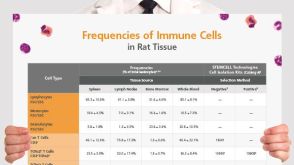 挂图Frequencies of Immune Cells in Rat Tissue Lists the estimated frequencies of more than 15 immune cell types in Sprague Dawley rats


 沪公网安备31010102008431号