A1-reprogrammed mesenchymal stromal cells prime potent antitumoral responses
SummaryMesenchymal stromal cells (MSCs) have been modified via genetic or pharmacological engineering into potent antigen-presenting cells-like capable of priming responding CD8 T cells. In this study,our screening of a variant library of Accum molecule revealed a molecule (A1) capable of eliciting antigen cross-presentation properties in MSCs. A1-reprogrammed MSCs (ARM) exhibited improved soluble antigen uptake and processing. Our comprehensive analysis,encompassing cross-presentation assays and molecular profiling,among other cellular investigations,elucidated A1’s impact on endosomal escape,reactive oxygen species production,and cytokine secretion. By evaluating ARM-based cellular vaccine in mouse models of lymphoma and melanoma,we observe significant therapeutic potency,particularly in allogeneic setting and in combination with anti-PD-1 immune checkpoint inhibitor. Overall,this study introduces a strong target for developing an antigen-adaptable vaccination platform,capable of synergizing with immune checkpoint blockers to trigger tumor regression,supporting further investigation of ARMs as an effective and versatile anti-cancer vaccine. Graphical abstract Highlights•Treatment with A1/antigen mix reprograms MSCs into antigen-presenting cells•The antigen cross-presenting ability of ARM cells require ROS and UPR•ARMs synergize with immune-checkpoint inhibitors in priming potent antitumoral activity Classification Description: Immunology; Pharmaceutical engineering; Cancer
View Publication
产品类型:
产品号#:
18953
18953RF
产品名:
EasySep™小鼠CD8a正选试剂盒II
RoboSep™ 小鼠CD8a正选试剂盒II
B. R. Correa et al. ( 2018)
Scientific Reports 8 1
Preclinical in vitro models provide an essential tool to study cancer cell biology as well as aid in translational research,including drug target identification and drug discovery efforts. For any model to be clinically relevant,it needs to recapitulate the biology and cell heterogeneity of the primary tumor. We recently developed and described a conditional reprogramming (CR) cell technology that addresses many of these needs and avoids the deficiencies of most current cancer cell lines,which are usually clonal in origin. Here,we used the CR cell method to generate a collection of patient-derived cell cultures from non-small cell lung cancers (NSCLC). Whole exome sequencing and copy number variations are used for the first time to address the capability of CR cells to keep their tumor-derived heterogeneity. Our results indicated that these primary cultures largely maintained the molecular characteristics of the original tumors. Using a mutant-allele tumor heterogeneity (MATH) score,we showed that CR cells are able to keep and maintain most of the intra-tumoral heterogeneity,suggesting oligoclonality of these cultures. CR cultures therefore represent a pre-clinical lung cancer model for future basic and translational studies.
View Publication
Intrinsic Immunity Shapes Viral Resistance of Stem Cells.
Stem cells are highly resistant to viral infection compared to their differentiated progeny; however,the mechanism is mysterious. Here,we analyzed gene expression in mammalian stem cells and cells at various stages of differentiation. We find that,conserved across species,stem cells express a subset of genes previously classified as interferon (IFN) stimulated genes (ISGs) but that expression is intrinsic,as stem cells are refractory to interferon. This intrinsic ISG expression varies in a cell-type-specific manner,and many ISGs decrease upon differentiation,at which time cells become IFN responsive,allowing induction of a broad spectrum of ISGs by IFN signaling. Importantly,we show that intrinsically expressed ISGs protect stem cells against viral infection. We demonstrate the in vivo importance of intrinsic ISG expression for protecting stem cells and their differentiation potential during viral infection. These findings have intriguing implications for understanding stem cell biology and the evolution of pathogen resistance.
View Publication
Chen S et al. (JAN 2004)
Journal of the American Chemical Society 126 2 410--1
Dedifferentiation of lineage-committed cells by a small molecule.
Combinatorial libraries were screened for molecules that induce mouse myogenic lineage committed cells to dedifferentiate in vitro. A 2,6-disubstituted purine,reversine,was discovered that induces lineage reversal of C2C12 cells to become multipotent progenitor cells which can redifferentiate into osteoblasts and adipocytes. This and other such molecules are likely to provide new insights into the molecular mechanisms that control cellular dedifferentiation and may ultimately be useful to in vivo stem cell biology and therapy.
View Publication
产品类型:
产品号#:
72612
72614
产品名:
Reversine
逆转素(Reversine)
Chen S et al. (JUN 2007)
Proceedings of the National Academy of Sciences of the United States of America 104 25 10482--7
Reversine increases the plasticity of lineage-committed mammalian cells.
Previously,a small molecule,reversine,was identified that reverses lineage-committed murine myoblasts to a more primitive multipotent state. Here,we show that reversine can increase the plasticity of C2C12 myoblasts at the single-cell level and that reversine-treated cells gain the ability to differentiate into osteoblasts and adipocytes under lineage-specific inducing conditions. Moreover,reversine is active in multiple cell types,including 3T3E1 osteoblasts and human primary skeletal myoblasts. Biochemical and cellular experiments suggest that reversine functions as a dual inhibitor of nonmuscle myosin II heavy chain and MEK1,and that both activities are required for reversine's effect. Inhibition of MEK1 and nonmuscle myosin II heavy chain results in altered cell cycle and changes in histone acetylation status,but other factors also may contribute to the activity of reversine,including activation of the PI3K signaling pathway.
View Publication
产品类型:
产品号#:
72612
72614
产品名:
Reversine
逆转素(Reversine)
Bhattacharyya S and Khanduja KL (APR 2010)
Acta biochimica et biophysica Sinica 42 4 237--42
New hope in the horizon: cancer stem cells.
The major goal of researchers and oncologists is to develop promising ground for novel therapeutic strategies to prevent recurrence or relapse of cancer. Recent evidences suggest that a subset of cells called cancer stem cells (CSCs) are present within the tumor mass which possess tumorigenic capacity and may be responsible for propagation,relapse,and metastatic dissemination. These cells have certain stem cell-like properties,e.g. quiescence,selfrenewal,asymmetric division,and multidrug resistance which allow them to drive tumor growth and evade conventional therapies. A number of markers and assays have been designed to isolate and characterize the CSC population from the bulk tumor. The objective now is to selectively target the CSCs in order to eliminate the tumor from root,overcoming the emergence of clones capable of evading traditional therapy. This approach may help in increasing the overall disease-free survival in some cancers.
View Publication
产品类型:
产品号#:
01700
01705
01702
产品名:
ALDEFLUOR™ 试剂盒
ALDEFLUOR™ DEAB试剂
ALDEFLUOR™测定缓冲液
Moore JJC et al. (JAN 2010)
Stem Cell Research & Therapy 1 3 23
Efficient, high-throughput transfection of human embryonic stem cells.
Genetic manipulation of human embryonic stem cells (hESC) has been limited by their general resistance to common methods used to introduce exogenous DNA or RNA. Efficient and high throughput transfection of nucleic acids into hESC would be a valuable experimental tool to manipulate these cells for research and clinical applications. We investigated the ability of two commercially available electroporation systems,the Nucleofection® 96-well Shuttle® System from Lonza and the Neon™ Transfection System from Invitrogen to efficiently transfect hESC. Transfection efficiency was measured by flow cytometry for the expression of the green fluorescent protein and the viability of the transfected cells was determined by an ATP catalyzed luciferase reaction. The transfected cells were also analyzed by flow cytometry for common markers of pluripotency. Both systems are capable of transfecting hESC at high efficiencies with little loss of cell viability. However,the reproducibility and the ease of scaling for high throughput applications led us to perform more comprehensive tests on the Nucleofection® 96-well Shuttle® System. We demonstrate that this method yields a large fraction of transiently transfected cells with minimal loss of cell viability and pluripotency,producing protein expression from plasmid vectors in several different hESC lines. The method scales to a 96-well plate with similar transfection efficiencies at the start and end of the plate. We also investigated the efficiency with which stable transfectants can be generated and recovered under antibiotic selection. Finally,we found that this method is effective in the delivery of short synthetic RNA oligonucleotides (siRNA) into hESC for knockdown of translation activity via RNA interference. Our results indicate that these electroporation methods provide a reliable,efficient,and high-throughput approach to the genetic manipulation of hESC.
View Publication
产品类型:
产品号#:
85850
85857
产品名:
mTeSR™1
mTeSR™1
Zhou T et al. (JUL 2011)
Journal of the American Society of Nephrology : JASN 22 7 1221--1228
Generation of induced pluripotent stem cells from urine
Forced expression of selected transcription factors can transform somatic cells into embryonic stem cell (ESC)-like cells,termed induced pluripotent stem cells (iPSCs). There is no consensus regarding the preferred tissue from which to harvest donor cells for reprogramming into iPSCs,and some donor cell types may be more prone than others to accumulation of epigenetic imprints and somatic cell mutations. Here,we present a simple,reproducible,noninvasive method for generating human iPSCs from renal tubular cells present in urine. This procedure eliminates many problems associated with other protocols,and the resulting iPSCs display an excellent ability to differentiate. These data suggest that urine may be a preferred source for generating iPSCs.
View Publication
产品类型:
产品号#:
85850
85857
产品名:
mTeSR™1
mTeSR™1
Mansouri M et al. ( 2016)
Nature Communications 7 May 11529
Highly efficient baculovirus-mediated multigene delivery in primary cells
Multigene delivery and subsequent cellular expression is emerging as a key technology required in diverse research fields including,synthetic and structural biology,cellular reprogramming and functional pharmaceutical screening. Current viral delivery systems such as retro- and adenoviruses suffer from limited DNA cargo capacity,thus impeding unrestricted multigene expression. We developed MultiPrime,a modular,non-cytotoxic,non-integrating,baculovirus-based vector system expediting highly efficient transient multigene expression from a variety of promoters. MultiPrime viruses efficiently transduce a wide range of cell types,including non-dividing primary neurons and induced-pluripotent stem cells (iPS). We show that MultiPrime can be used for reprogramming,and for genome editing and engineering by CRISPR/Cas9. Moreover,we implemented dual-host-specific cassettes enabling multiprotein expression in insect and mammalian cells using a single reagent. Our experiments establish MultiPrime as a powerful and highly efficient tool,to deliver multiple genes for a wide range of applications in primary and established mammalian cells.
View Publication


 EasySep™小鼠TIL(CD45)正选试剂盒




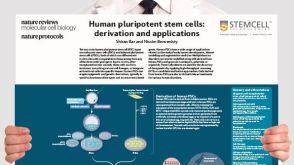 挂图Derivation and Applications of Human Pluripotent Stem Cells Overview of the derivation of human embryonic stem cells (hESCs) and induced pluripotent stem cells (iPSCs)

 沪公网安备31010102008431号