Comparison of skeletal and soft tissue pericytes identifies CXCR4+ bone forming mural cells in human tissues.
Human osteogenic progenitors are not precisely defined,being primarily studied as heterogeneous multipotent cell populations and termed mesenchymal stem cells (MSCs). Notably,select human pericytes can develop into bone-forming osteoblasts. Here,we sought to define the differentiation potential of CD146+ human pericytes from skeletal and soft tissue sources,with the underlying goal of defining cell surface markers that typify an osteoblastogenic pericyte. CD146+CD31-CD45- pericytes were derived by fluorescence-activated cell sorting from human periosteum,adipose,or dermal tissue. Periosteal CD146+CD31-CD45- cells retained canonical features of pericytes/MSC. Periosteal pericytes demonstrated a striking tendency to undergo osteoblastogenesis in vitro and skeletogenesis in vivo,while soft tissue pericytes did not readily. Transcriptome analysis revealed higher CXCR4 signaling among periosteal pericytes in comparison to their soft tissue counterparts,and CXCR4 chemical inhibition abrogated ectopic ossification by periosteal pericytes. Conversely,enrichment of CXCR4+ pericytes or stromal cells identified an osteoblastic/non-adipocytic precursor cell. In sum,human skeletal and soft tissue pericytes differ in their basal abilities to form bone. Diversity exists in soft tissue pericytes,however,and CXCR4+ pericytes represent an osteoblastogenic,non-adipocytic cell precursor. Indeed,enrichment for CXCR4-expressing stromal cells is a potential new tactic for skeletal tissue engineering.
View Publication
产品类型:
产品号#:
05412
05455
产品名:
MesenCult™ 脂肪分化试剂盒 (人)
MesenCult™-ACF软骨细胞分化试剂盒
M. S. Choe et al. (jul 2019)
Cell biology international
Trolox-induced cardiac differentiation is mediated by the inhibition of Wnt/$\beta$-catenin signaling in human embryonic stem cells.
Cardiac differentiation of human pluripotent stem cells may be induced under chemically defined conditions,wherein the regulation of Wnt/$\beta$-catenin pathway is often desirable. Here,we examined the effect of trolox,a vitamin E analog,on the cardiac differentiation of human embryonic stem cells (hESCs). 6-Hydroxy-2,5,7,8-tetramethylchromane-2-carboxylic acid (Trolox) significantly enhanced cardiac differentiation in a time- and dose-dependent manner after the mesodermal differentiation of hESCs. Trolox promoted hESC cardiac differentiation through its inhibitory activity against the Wnt/$\beta$-catenin pathway. This study demonstrates an efficient cardiac differentiation method and reveals a novel Wnt/$\beta$-catenin regulator.
View Publication
产品类型:
产品号#:
100-0572
100-0573
产品名:
Trolox
Trolox
K.-L. Chu et al. (NOV 2018)
Mucosal immunology
GITRL on inflammatory antigen presenting cells in the lung parenchyma provides signal 4 for T-cell accumulation and tissue-resident memory T-cell formation.
T-cell responses in the lung are critical for protection against respiratory pathogens. TNFR superfamily members play important roles in providing survival signals to T cells during respiratory infections. However,whether these signals take place mainly during priming in the secondary lymphoid organs and/or in the peripheral tissues remains unknown. Here we show that under conditions of competition,GITR provides a T-cell intrinsic advantage to both CD4 and CD8 effector T cells in the lung tissue,as well as for the formation of CD4 and CD8 tissue-resident memory T cells during respiratory influenza infection in mice. In contrast,under non-competitive conditions,GITR has a preferential effect on CD8 over CD4 T cells. The nucleoprotein-specific CD8 T-cell response partially compensated for GITR deficiency by expansion of higher affinity T cells; whereas,the polymerase-specific response was less flexible and more GITR dependent. Following influenza infection,GITR is expressed on lung T cells and GITRL is preferentially expressed on lung monocyte-derived inflammatory antigen presenting cells. Accordingly,we show that GITR+/+ T cells in the lung parenchyma express more phosphorylated-ribosomal protein S6 than their GITR-/- counterparts. Thus,GITR signaling within the lung tissue critically regulates effector and tissue-resident memory T-cell accumulation.
View Publication
产品类型:
产品号#:
19852
19852RF
19853
19853RF
产品名:
EasySep™小鼠CD4+ T细胞分选试剂盒
RoboSep™ 小鼠CD4+ T细胞分选试剂盒
EasySep™小鼠CD8+ T细胞分选试剂盒
RoboSep™ 小鼠CD8+ T细胞分选试剂盒
S. L. Rogers et al. (JUL 2006)
Journal of immunology (Baltimore,Md. : 1950) 177 1 414--21
A role for DNA hypomethylation and histone acetylation in maintaining allele-specific expression of mouse NKG2A in developing and mature NK cells.
The repertoire of receptors that is expressed by NK cells is critical for their ability to kill virally infected or transformed cells. However,the molecular mechanisms that determine whether and when NK receptor genes are transcribed during hemopoiesis remain unclear. In this study,we show that hypomethylation of a CpG-rich region in the mouse NKG2A gene is associated with transcription of NKG2A in ex vivo NK cells and NK cell lines. This observation was extended to various developmental stages of NK cells sorted from bone marrow,in which we demonstrate that the CpGs are methylated in the NKG2A-negative stages (hemopoietic stem cells,NK progenitors,and NKG2A-negative NK cells),and hypomethylated specifically in the NKG2A-positive NK cells. Furthermore,we provide evidence that DNA methylation is important in maintaining the allele-specific expression of NKG2A. Finally,we show that acetylated histones are associated with the CpG-rich region in NKG2A positive,but not negative,cell lines,and that treatment with the histone deacetylase inhibitor trichostatin A alone is sufficient to induce NKG2A expression. Treatment with the methyltransferase inhibitor 5-azacytidine only is insufficient to induce transcription,but cotreatment with both drugs resulted in a significantly greater induction,suggesting a cooperative role for DNA methylation and histone acetylation status in regulating gene expression. These results enhance our understanding of the formation and maintenance of NK receptor repertoires in developing and mature NK cells.
View Publication
产品类型:
产品号#:
07100
36750
产品名:
L-谷氨酰胺
RPMI 1640培养基
Lu HF et al. (MAR 2014)
Biomaterials 35 9 2816--2826
A defined xeno-free and feeder-free culture system for the derivation, expansion and direct differentiation of transgene-free patient-specific induced pluripotent stem cells
A defined xeno-free system for patient-specific iPSC derivation and differentiation is required for translation to clinical applications. However,standard somatic cell reprogramming protocols rely on using MEFs and xenogeneic medium,imposing a significant obstacle to clinical translation. Here,we describe a well-defined culture system based on xeno-free media and LN521 substrate which supported i) efficient reprogramming of normal or diseased skin fibroblasts from human of different ages into hiPSCs with a 15-30 fold increase in efficiency over conventional viral vector-based method; ii) long-term self-renewal of hiPSCs; and iii) direct hiPSC lineage-specific differentiation. Using an excisable polycistronic vector and optimized culture conditions,we achieved up to 0.15%-0.3% reprogramming efficiencies. Subsequently,transgene-free hiPSCs were obtained by Cre-mediated excision of the reprogramming factors. The derived iPSCs maintained long-term self-renewal,normal karyotype and pluripotency,as demonstrated by the expression of stem cell markers and ability to form derivatives of three germ layers both in vitro and in vivo. Importantly,we demonstrated that Parkinson's patient transgene-free iPSCs derived using the same system could be directed towards differentiation into dopaminergic neurons under xeno-free culture conditions. Our approach provides a safe and robust platform for the generation of patient-specific iPSCs and derivatives for clinical and translational applications. textcopyright 2013 Elsevier Ltd.
View Publication
产品类型:
产品号#:
07920
07922
07923
200-0117
77003
85850
85857
产品名:
ACCUTASE™
ACCUTASE™
Dispase (1 U/mL)
CellAdhere™ Laminin-521
CellAdhere™ Laminin-521
mTeSR™1
mTeSR™1
Figueroa ME et al. (DEC 2010)
Cancer cell 18 6 553--67
Leukemic IDH1 and IDH2 mutations result in a hypermethylation phenotype, disrupt TET2 function, and impair hematopoietic differentiation.
Cancer-associated IDH mutations are characterized by neomorphic enzyme activity and resultant 2-hydroxyglutarate (2HG) production. Mutational and epigenetic profiling of a large acute myeloid leukemia (AML) patient cohort revealed that IDH1/2-mutant AMLs display global DNA hypermethylation and a specific hypermethylation signature. Furthermore,expression of 2HG-producing IDH alleles in cells induced global DNA hypermethylation. In the AML cohort,IDH1/2 mutations were mutually exclusive with mutations in the α-ketoglutarate-dependent enzyme TET2,and TET2 loss-of-function mutations were associated with similar epigenetic defects as IDH1/2 mutants. Consistent with these genetic and epigenetic data,expression of IDH mutants impaired TET2 catalytic function in cells. Finally,either expression of mutant IDH1/2 or Tet2 depletion impaired hematopoietic differentiation and increased stem/progenitor cell marker expression,suggesting a shared proleukemogenic effect.
View Publication
产品类型:
产品号#:
03434
03444
09600
09650
产品名:
MethoCult™GF M3434
MethoCult™GF M3434
StemSpan™ SFEM
StemSpan™ SFEM
Zhou S et al. ( 2017)
PloS one 12 1 e0169899
Reprogramming Malignant Cancer Cells toward a Benign Phenotype following Exposure to Human Embryonic Stem Cell Microenvironment.
The embryonic microenvironment is well known to be non-permissive for tumor development because early developmental signals naturally suppress the expression of proto-oncogenes. In an analogous manner,mimicking an early embryonic environment during embryonic stem cell culture has been shown to suppress oncogenic phenotypes of cancer cells. Exosomes derived from human embryonic stem cells harbor substances that mirror the content of the cells of origin and have been reported to reprogram hematopoietic stem/progenitor cells via horizontal transfer of mRNA and proteins. However,the possibility that these embryonic stem cells-derived exosomes might be the main effectors of the anti-tumor effect mediated by the embryonic stem cells has not been explored yet. The present study aims to investigate whether exosomes derived from human embryonic stem cells can reprogram malignant cancer cells to a benign stage and reduce their tumorigenicity. We show that the embryonic stem cell-conditioned medium contains factors that inhibit cancer cell growth and tumorigenicity in vitro and in vivo. Moreover,we demonstrate that exosomes derived from human embryonic stem cells display anti-proliferation and pro-apoptotic effects,and decrease tumor size in a xenograft model. These exosomes are also able to transfer their cargo into target cancer cells,inducing a dose-dependent increase in SOX2,OCT4 and Nanog proteins,leading to a dose-dependent decrease of cancer cell growth and tumorigenicity. This study shows for the first time that human embryonic stem cell-derived exosomes play an important role in the tumor suppressive activity displayed by human embryonic stem cells.
View Publication
Differentiation of human embryonic stem cells to regional specific neural precursors in chemically defined medium conditions.
BACKGROUND: Human embryonic stem cells (hESC) provide a unique model to study early events in human development. The hESC-derived cells can potentially be used to replace or restore different tissues including neuronal that have been damaged by disease or injury.backslashnbackslashnMETHODOLOGY AND PRINCIPAL FINDINGS: The cells of two different hESC lines were converted to neural rosettes using adherent and chemically defined conditions. The progenitor cells were exposed to retinoic acid (RA) or to human recombinant basic fibroblast growth factor (bFGF) in the late phase of the rosette formation. Exposing the progenitor cells to RA suppressed differentiation to rostral forebrain dopamine neural lineage and promoted that of spinal neural tissue including motor neurons. The functional characteristics of these differentiated neuronal precursors under both,rostral (bFGF) and caudalizing (RA) signals were confirmed by patch clamp analysis.backslashnbackslashnCONCLUSIONS/SIGNIFICANCE: These findings suggest that our differentiation protocol has the capacity to generate region-specific and electrophysiologically active neurons under in vitro conditions without embryoid body formation,co-culture with stromal cells and without presence of cells of mesodermal or endodermal lineages.
View Publication
产品类型:
产品号#:
85850
85857
产品名:
mTeSR™1
mTeSR™1
Muntasell A et al. (JUN 2010)
Blood 115 25 5170--9
Inhibition of NKG2D expression in NK cells by cytokines secreted in response to human cytomegalovirus infection.
The NKG2D receptor activates natural killer (NK) cell cytotoxicity and cytokine production on recognition of self-molecules induced by cellular stress under different conditions such as viral infections. The importance of NKG2D in the immune response to human cytomegalovirus (HCMV) is supported by the identification of several viral molecules that prevent the expression of NKG2D ligands by infected cells. In this study we report that,paradoxically,a significant,selective,and transient reduction of NKG2D expression on NK cells is detected during HCMV infection of peripheral blood mononuclear cells if needed. Antagonizing type I interferon (IFN),interleukin-12 (IL-12),and IFNgamma prevented HCMV-induced down-regulation of surface NKG2D. Moreover,treatment of purified NK cells with recombinant IFNbeta1 and IL-12 mimicked the effect,supporting a direct role of these cytokines in regulating NKG2D surface expression in NK cells. The loss of NKG2D expression selectively impaired NK-cell cytotoxicity against cells expressing NKG2D ligands but preserved the response triggered through other activating receptors. These results support that down-regulation of NKG2D expression on NK cells by cytokines with a key role in antiviral immune response may constitute a physiologic mechanism to control NK-cell reactivity against normal cells expressing NKG2D ligands in the context of inflammatory responses to viral infections.
View Publication
产品类型:
产品号#:
19055
19055RF
产品名:
EasySep™人NK细胞富集试剂盒
RoboSep™ 人NK细胞富集试剂盒含滤芯吸头
Ramachandra CJA et al. (SEP 2011)
Nucleic Acids Research 39 16 e107
Efficient recombinase-mediated cassette exchange at the AAVS1 locus in human embryonic stem cells using baculoviral vectors
Insertion of a transgene into a defined genomic locus in human embryonic stem cells (hESCs) is crucial in preventing random integration-induced insertional mutagenesis,and can possibly enable persistent transgene expression during hESC expansion and in their differentiated progenies. Here,we employed homologous recombination in hESCs to introduce heterospecific loxP sites into the AAVS1 locus,a site with an open chromatin structure that allows averting transgene silencing phenomena. We then performed Cre recombinase mediated cassette exchange using baculoviral vectors to insert a transgene into the modified AAVS1 locus. Targeting efficiency in the master hESC line with the loxP-docking sites was up to 100%. Expression of the inserted transgene lasted for at least 20 passages during hESC expansion and was retained in differentiated cells derived from the genetically modified hESCs. Thus,this study demonstrates the feasibility of genetic manipulation at the AAVS1 locus with homologous recombination and using viral transduction in hESCs to facilitate recombinase-mediated cassette exchange. The method developed will be useful for repeated gene targeting at a defined locus of the hESC genome.
View Publication
产品类型:
产品号#:
85850
85857
产品名:
mTeSR™1
mTeSR™1
Amps K et al. (DEC 2011)
Nature biotechnology 29 12 1132--44
Screening ethnically diverse human embryonic stem cells identifies a chromosome 20 minimal amplicon conferring growth advantage.
The International Stem Cell Initiative analyzed 125 human embryonic stem (ES) cell lines and 11 induced pluripotent stem (iPS) cell lines,from 38 laboratories worldwide,for genetic changes occurring during culture. Most lines were analyzed at an early and late passage. Single-nucleotide polymorphism (SNP) analysis revealed that they included representatives of most major ethnic groups. Most lines remained karyotypically normal,but there was a progressive tendency to acquire changes on prolonged culture,commonly affecting chromosomes 1,12,17 and 20. DNA methylation patterns changed haphazardly with no link to time in culture. Structural variants,determined from the SNP arrays,also appeared sporadically. No common variants related to culture were observed on chromosomes 1,12 and 17,but a minimal amplicon in chromosome 20q11.21,including three genes expressed in human ES cells,ID1,BCL2L1 and HM13,occurred in textgreater20% of the lines. Of these genes,BCL2L1 is a strong candidate for driving culture adaptation of ES cells.
View Publication


 EasySep™小鼠TIL(CD45)正选试剂盒




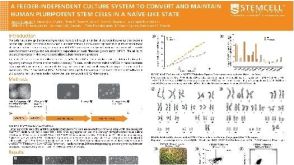 科学海报A Feeder-Independent Culture System to Convert and Maintain Human Pluripotent Stem Cells in a Naïve-Like State
 沪公网安备31010102008431号