E. V. Vinogradova et al. (aug 2020)
Cell 182 4 1009--1026.e29
An Activity-Guided Map of Electrophile-Cysteine Interactions in Primary Human T Cells.
Electrophilic compounds originating from nature or chemical synthesis have profound effects on immune cells. These compounds are thought to act by cysteine modification to alter the functions of immune-relevant proteins; however,our understanding of electrophile-sensitive cysteines in the human immune proteome remains limited. Here,we present a global map of cysteines in primary human T cells that are susceptible to covalent modification by electrophilic small molecules. More than 3,000 covalently liganded cysteines were found on functionally and structurally diverse proteins,including many that play fundamental roles in immunology. We further show that electrophilic compounds can impair T cell activation by distinct mechanisms involving the direct functional perturbation and/or degradation of proteins. Our findings reveal a rich content of ligandable cysteines in human T cells and point to electrophilic small molecules as a fertile source for chemical probes and ultimately therapeutics that modulate immunological processes and their associated disorders.
View Publication
产品类型:
产品号#:
17951
100-0695
17951RF
产品名:
EasySep™人T细胞分选试剂盒
EasySep™人T细胞分选试剂盒
RoboSep™ 人T细胞分选试剂盒
Lemieux ME et al. (AUG 1997)
Experimental hematology 25 9 951--7
Differential ability of flt3-ligand, interleukin-11, and Steel factor to support the generation of B cell progenitors and myeloid cells from primitive murine fetal liver cells.
A variety of factors produced by stromal fibroblasts,including Flt3-ligand (FL),interleukin-11 (IL-11),Steel factor (SF),and IL-7,have been implicated in stimulating the production of pre-B cells and myeloid cells from primitive hematopoietic precursors. To investigate their relative roles in this process,either as single-acting or synergistic agents,we compared the yield and types of cells produced after 2 weeks from small numbers of Sca-1+ Lin- (i.e.,B220-,Ly-1-,Gr-1-,and Ter-119-) day 14.5 murine fetal liver cells placed in stromal cell-free cultures containing all possible combinations of FL,SF,IL-7,and IL-11. None of these factors alone supported the production (or survival) of any cells beyond 1 week: only pairs of factors consisting of either FL or SF plus either IL-11 or IL-7 were effective in this regard,with FL plus IL-11 being the most potent pair (approximately 7 x 10(4) cells obtained per 100 Sca-1+ Lin- input cells). The maximum numbers of cells were produced in the presence of FL,IL-11,and IL-7: these included both B220+ and Mac-1+/Gr-1+ cells (approximately 10(6) and approximately 2 x 10(5),respectively,per 100 Sca-1+ Lin- input cells). Both of these lineages were also obtained with each of the other possible three-factor combinations,albeit with variable effectiveness. Omission of either FL or IL-7 caused the greatest reduction in the yield of B220+ cells (approximately 130-fold and approximately 80-fold,respectively). Omission of IL-11 and,to a lesser extent,FL caused the greatest reduction in the yield of Mac-1+/Gr-1+ cells (approximately 90-fold and approximately 3-fold,respectively). When fetal calf serum was replaced with a defined serum substitute,the out put of B220+ cells remained the same but myelopoiesis was consistently enhanced (approximately 5- to 20-fold). These findings support a model involving factor redundancy in the extracellular signals required to stimulate the production and amplification of both lymphoid and myeloid cells from early Sca-1+ Lin- cells. They also reveal quantitative differences in the abilities of different competent factor combinations to promote this process,which may be further modulated by the presence of undefined serum components.
View Publication
ABC transporters as phenotypic markers and functional regulators of stem cells.
Characterization of molecules with tightly controlled expression patterns during differentiation represents an approach to understanding regulation of hematopoietic stem cell commitment. The multidrug resistance-1 (MDR1) gene product,P-glycoprotein,and the breast cancer resistance protein (BCRP) are expressed differentially during hematopoiesis,with the highest levels in primitive bone marrow stem cell populations that are CD34(low) and CD34(-),respectively. Roles for ATP-binding cassette (ABC) transporter superfamily members in conferring drug resistance have been extensively described. However,recent hematopoietic overexpression studies have begun to reveal previously unknown roles for ABC transporter function in normal and malignant hematopoiesis. Expression of MDR1 and BCRP transporters in the myeloid lineage has been reported in blasts from acute myeloid leukemia,but very low to undetectable in normal myelomonocytic cells. Retroviral-mediated dysregulated expression of the MDR1 transporter resulted in increased hematopoietic repopulating activity and myeloproliferative disease in mice. A distinct functional role for the BCRP transporter as a negative regulator of hematopoietic repopulating activity has recently been demonstrated using the same approach. Additionally,the presence of BCRP expression specifically on hematopoietic side-population stem cells and neural stem/progenitors,makes BCRP an attractive candidate marker for isolation of stem cells with the ability to respond to diverse environmental cues. Regulation of stem cell biology by ABC transporters has emerged as an important new field of investigation. In light of these findings,it will be critical to further characterize this family of proteins in hematopoietic lineage-restricted stem cells and in pluripotent stem cells capable of crossing lineage barriers.
View Publication
产品类型:
产品号#:
产品名:
Takahashi T et al. (APR 2003)
Circulation 107 14 1912--6
Ascorbic acid enhances differentiation of embryonic stem cells into cardiac myocytes.
BACKGROUND Embryonic stem (ES) cells are capable of self-renewal and differentiation into cellular derivatives of all 3 germ layers. In appropriate culture conditions,ES cells can differentiate into specialized cells,including cardiac myocytes,but the efficiency is typically low and the process is incompletely understood. METHODS AND RESULTS We evaluated a chemical library for its potential to induce cardiac differentiation of ES cells in the absence of embryoid body formation. Using ES cells stably transfected with cardiac-specific alpha-cardiac myosin heavy chain (MHC) promoter-driven enhanced green fluorescent protein (EGFP),880 compounds approved for human use were screened for their ability to induce cardiac differentiation. Treatment with ascorbic acid,also known as vitamin C,markedly increased the number of EGFP-positive cells,which displayed spontaneous and rhythmic contractile activity and stained positively for sarcomeric myosin and alpha-actinin. Furthermore,ascorbic acid induced the expression of cardiac genes,including GATA4,alpha-MHC,and beta-MHC in untransfected ES cells in a developmentally controlled manner. This effect of ascorbic acid on cardiac differentiation was not mimicked by the other antioxidants such as N-acetylcysteine,Tiron,or vitamin E. CONCLUSIONS Ascorbic acid induces cardiac differentiation in ES cells. This study demonstrates the potential for chemically modifying the cardiac differentiation program of ES cells.
View Publication
产品类型:
产品号#:
72132
产品名:
抗坏血酸(Ascorbic Acid)
S. Omenetti et al. (jun 2019)
Immunity
The Intestine Harbors Functionally Distinct Homeostatic Tissue-Resident and Inflammatory Th17 Cells.
T helper 17 (Th17) cells are pathogenic in many inflammatory diseases,but also support the integrity of the intestinal barrier in a non-inflammatory manner. It is unclear what distinguishes inflammatory Th17 cells elicited by pathogens and tissue-resident homeostatic Th17 cells elicited by commensals. Here,we compared the characteristics of Th17 cells differentiating in response to commensal bacteria (SFB) to those differentiating in response to a pathogen (Citrobacter rodentium). Homeostatic Th17 cells exhibited little plasticity towards expression of inflammatory cytokines,were characterized by a metabolism typical of quiescent or memory T cells,and did not participate in inflammatory processes. In contrast,infection-induced Th17 cells showed extensive plasticity towards pro-inflammatory cytokines,disseminated widely into the periphery,and engaged aerobic glycolysis in addition to oxidative phosphorylation typical for inflammatory effector cells. These findings will help ensure that future therapies directed against inflammatory Th17 cells do not inadvertently damage the resident gut population.
View Publication
Susceptibility of human fetal mesenchymal stem cells to Kaposi sarcoma-associated herpesvirus.
Recent reports link Kaposi sarcoma-associated herpesvirus (KSHV) infection of bone marrow cells to bone marrow failure and lymphoproliferative syndromes. The identity of the infected marrow cells,however,remains unclear. Other work has demonstrated that circulating mononuclear cells can harbor KSHV where its detection predicts the onset and severity of Kaposi sarcoma. In either setting,bone marrow precursors may serve as viral reservoirs. Since mesenchymal stem cells (MSCs) in human bone marrow regulate the differentiation and proliferation of adjacent hematopoietic precursors,we investigated their potential role in KSHV infection. Our results indicate that primary MSCs are susceptible to both cell-free and cell-associated KSHV in culture. Moreover,infection persisted within nearly half of the cells for up to 6 weeks. Thus,MSCs possess a clear capacity to support KSHV infection and warrant further exploration into their potential role in KSHV-related human disease.
View Publication
产品类型:
产品号#:
15027
15067
产品名:
RosetteSep™人骨髓祖细胞预富集抗体混合物
RosetteSep™人骨髓祖细胞预富集抗体混合物
Hsieh J et al. (NOV 2004)
Proceedings of the National Academy of Sciences of the United States of America 101 47 16659--64
It has become apparent that chromatin modification plays a critical role in the regulation of cell-type-specific gene expression. Here,we show that an inhibitor of histone deacetylase,valproic acid (VPA),induced neuronal differentiation of adult hippocampal neural progenitors. In addition,VPA inhibited astrocyte and oligodendrocyte differentiation,even in conditions that favored lineage-specific differentiation. Among the VPA-up-regulated,neuron-specific genes,a neurogenic basic helix-loop-helix transcription factor,NeuroD,was identified. Overexpression of NeuroD resulted in the induction and suppression of neuronal and glial differentiation,respectively. These results suggest that VPA promotes neuronal fate and inhibits glial fate simultaneously through the induction of neurogenic transcription factors including NeuroD.
View Publication
产品类型:
产品号#:
72112
72114
72292
100-0249
产品名:
Forskolin
Forskolin
Valproic Acid (Sodium Salt)
Forskolin
Chen T-H et al. (APR 2007)
Biochemical and biophysical research communications 355 4 913--8
Sodium butyrate activates ERK to regulate differentiation of mesenchymal stem cells.
Histone deacetylase inhibitors such as sodium butyrate are known to regulate the differentiation of a variety of cells. Mesenchymal stem cells (MSCs) differentiate into osteoblasts and adipocytes under transcriptional control of Runx2 and PPARgamma2,respectively. How these two transcription factors are regulated by sodium butyrate in order to specify the alternate cell fates remains a pivotal question. Sodium butyrate stimulated osteogenic differentiation and increased expression of Runx2 and genes regulated by Runx2 when cells were induced to undergo osteogenic differentiation. Sodium butyrate suppressed the adipogenic differentiation and decreased the expression of PPARgamma2 and LPL when MSCs were treated under conditions that promote adipogenic differentiation. Sodium butyrate also decreased the ratio of RANKL/OPG gene expression by MSCs. Analysis of MSCs induced in the presence of sodium butyrate revealed an immediate increase in ERK phosphorylation by sodium butyrate. The MEK-specific inhibitor,PD98059 but not p38- or JNK-specific inhibitor and the transfection with dominant negative ERK expressing plasmids blocked the sodium butyrate-induced regulation of MSC differentiation and increase in the RANKL/OPG ratio. Our results suggest that sodium butyrate modulates MSC differentiation and the RANKL/OPG ratio via activating ERK,and could be applied for in vivo bone growth using MSCs.
View Publication
产品类型:
产品号#:
72242
产品名:
丁酸钠(Sodium Butyrate)
Tsonis PA (JAN 1991)
Developmental biology 143 1 130--4
1,25-Dihydroxyvitamin D3 stimulates chondrogenesis of the chick limb bud mesenchymal cells.
Vitamin D has been known to be important for skeletal development and growth but the mechanism whereby it affects these processes is not well understood. We report now that the hormonal metabolite of vitamin D3,namely 1,25-dihydroxyvitamin D3,stimulates chondrogenesis in cultures of stage 24 chick embryo limb bud mesenchymal cells,as evidenced by morphologic changes as well as by increased transcription of collagen type II and core protein genes. This effect appears to be specific to 1,25(OH)2D3 since 24,25(OH)2D3 or D3 does not influence chondrogenesis in this system,and is probably mediated via the specific 1,25(OH)2D3 receptor protein which is undetectable in untreated cells but appears following exposure to the hormone.
View Publication
产品类型:
产品号#:
72412
产品名:
骨化三醇(Calcitriol)
Sarugaser R et al. ( 2009)
Methods in molecular biology (Clifton,N.J.) 482 269--79
Isolation, propagation, and characterization of human umbilical cord perivascular cells (HUCPVCs).
Current sources of mesenchymal cells,including bone marrow,fat and muscle,all require invasive procurement procedures,and provide relatively low frequencies of progenitors. Here,we describe the non-invasive isolation,and characterization,of a rich source of mesenchymal progenitor cells,which we call human umbilical cord perivascular cells (HUCPVCs). HUCPVCs show a similar immunological phenotype to bone marrow-derived mesenchymal stromal cells (BM-MSCs),since they are non-alloreactive,exhibit immunosuppression,and significantly reduce lymphocyte activation,in vitro. They present a non-hematopoietic myofibroblastic mesenchymal phenotype (CD45-,CD34-,CD105+,CD73+,CD90+,CD44+,CD106+,3G5+,CD146+); with a 1:300 frequency at harvest,a short-doubling time,and a clonogenic frequency of textgreater1:3 in culture. Furthermore,in addition to robust quinti-potential differentiation capacity in vitro,HUCPVCs have been shown to contribute to both musculo-skeletal and dermal wound healing in vivo.
View Publication


 EasySep™小鼠TIL(CD45)正选试剂盒




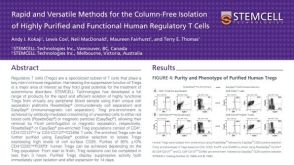 科学海报Column-Free Isolation of Highly Purified and Functional Human Regulatory T Cells

 沪公网安备31010102008431号