Osakada F et al. (JAN 2009)
Nature protocols 4 6 811--24
Stepwise differentiation of pluripotent stem cells into retinal cells.
Embryonic stem (ES) cells are pluripotent cells derived from the inner cell mass of blastocyst-stage embryos. They can maintain an undifferentiated state indefinitely and can differentiate into derivatives of all three germ layers,namely ectoderm,endoderm and mesoderm. Although much progress has been made in the propagation and differentiation of ES cells,induction of photoreceptors has generally required coculture with or transplantation into developing retinal tissue. Here,we describe a protocol for generating retinal cells from ES cells by stepwise treatment with defined factors. This method preferentially induces photoreceptor and retinal pigment epithelium (RPE) cells from mouse and human ES cells. In our protocol,differentiation of RPE and photoreceptors from mouse ES cells requires 28 d and the differentiation of human ES cells into mature RPE and photoreceptors requires 120 and 150 d,respectively. This differentiation system and the resulting pluripotent stem cell-derived retinal cells will facilitate the development of transplantation therapies for retinal diseases,drug testing and in vitro disease modeling. It will also improve our understanding of the development of the central nervous system,especially the eye.
View Publication
产品类型:
产品号#:
72082
产品名:
DAPT
Lemieux ME et al. (AUG 1995)
Blood 86 4 1339--47
Characterization and purification of a primitive hematopoietic cell type in adult mouse marrow capable of lymphomyeloid differentiation in long-term marrow switch" cultures."
In this report,we describe a modification of the assay for long-term culture-initiating cells (LTC-IC) that allows a subset of murine LTC-IC (designated as LTC-ICML) to express both their myeloid (M) and lymphoid (L) differentiative potentials in vitro. The modified assay involves culturing test cells at limiting dilutions on irradiated mouse marrow feeder layers for an initial 4 weeks under conditions that support myelopoiesis and then for an additional week under conditions permissive for B-lymphopoiesis. All of the clonogenic pre-B progenitors (colony-forming unit [CFU] pre-B) detected in such postswitch LTC appear to be the progeny of uncommitted cells present in the original cell suspension because exposure of lymphoid-restricted progenitors to myeloid LTC conditions for textgreater or = 7 days was found to irreversibly terminate CFU-pre-B production and,in cultures initiated with limiting numbers of input cells (no progenitors of any type detected in textgreater 70% of cultures 1 week after the switch),the presence of CFU-pre-B was tightly associated with the presence of myeloid clonogenic cells,regardless of the purity of the input population. Limiting dilution analysis of the proportion of negative cultures measured for different numbers of input cells showed the frequency of LTC-ICML in normal adult mouse marrow to be 1 per 5 x 10(5) cells with an enrichment of approximately 500-fold in the Sca-1+ Lin-WGA+ fraction,as was also found for competitive in vivo repopulating units (CRU) and conventionally defined LTC-IC. LTC-ICML also exhibited the same resistance to treatment in vivo with 5-fluorouracil (5-FU) as CRU and LTC-IC,thereby distinguishing these three populations from the great majority of both in vitro clonogenic cells and day 12 CFU-S. The ability to quantitate cells with dual lymphoid and myeloid differentiation potentials in vitro,without the need for their prior purification,should facilitate studies of totipotent hematopoietic stem cell regulation.
View Publication
产品类型:
产品号#:
03134
03231
03234
03236
03334
03434
03444
03534
03630
产品名:
MethoCult™M3134
MethoCult™M3231
MethoCult™M3234
MethoCult™SF M3236
MethoCult™M3334
MethoCult™GF M3434
MethoCult™GF M3434
MethoCult™GF M3534
MethoCult™M3630
Ramgolam VS et al. (OCT 2009)
Journal of immunology (Baltimore,Md. : 1950) 183 8 5418--27
IFN-beta inhibits human Th17 cell differentiation.
IFN-beta-1a has been used over the past 15 years as a primary therapy for relapsing-remitting multiple sclerosis (MS). However,the immunomodulatory mechanisms that provide a therapeutic effect against this CNS inflammatory disease are not yet completely elucidated. The effect of IFN-beta-1a on Th17 cells,which play a critical role in the development of the autoimmune response,has not been extensively studied in humans. We have investigated the effect of IFN-beta-1a on dendritic cells (DCs) and naive CD4(+)CD45RA(+) T cells derived from untreated MS patients and healthy controls in the context of Th17 cell differentiation. We report that IFN-beta-1a treatment down-regulated the expression of IL-1beta and IL-23p19 in DCs,whereas it induced the gene expression of IL-12p35 and IL-27p28. We propose that IFN-beta-1a-mediated up-regulation of the suppressor of cytokine signaling 3 expression,induced via STAT3 phosphorylation,mediates IL-1beta and IL-23 down-regulation,while IFN-beta-1a-induced STAT1 phosphorylation induces IL-27p28 expression. CD4(+)CD45RA(+) naive T cells cocultured with supernatants from IFN-beta-1a-treated DCs exhibited decreased gene expression of the Th17 cell markers retinoic acid-related orphan nuclear hormone receptor c (RORc),IL-17A,and IL-23R. A direct IFN-beta-1a treatment of CD45RA(+) T cells cultured in Th17-polarizing conditions also down-regulated RORc,IL-17A,and IL-23R,but up-regulated IL-10 gene expression. Studies of the mechanisms involved in the Th17 cell differentiation suggest that IFN-beta-1a inhibits IL-17 and induces IL-10 secretion via activated STAT1 and STAT3,respectively. IFN-beta's suppression of Th17 cell differentiation may represent its most relevant mechanism of selective suppression of the autoimmune response in MS.
View Publication
M. T. Pham et al. ( 2018)
NeuroReport 29 7 588--593
Generation of human vascularized brain organoids
The aim of this study was to vascularize brain organoids with a patient's own endothelial cells (ECs). Induced pluripotent stem cells (iPSCs) of one UC Davis patient were grown into whole-brain organoids. Simultaneously,iPSCs from the same patient were differentiated into ECs. On day 34,the organoid was re-embedded in Matrigel with 250 000 ECs. Vascularized organoids were grown in vitro for 3-5 weeks or transplanted into immunodeficient mice on day 54,and animals were perfused on day 68. Coating of brain organoids on day 34 with ECs led to robust vascularization of the organoid after 3-5 weeks in vitro and 2 weeks in vivo. Human CD31-positive blood vessels were found inside and in-between rosettes within the center of the organoid after transplantation. Vascularization of brain organoids with a patient's own iPSC-derived ECs is technically feasible.
View Publication
Dedifferentiation of committed epithelial cells into stem cells in vivo.
Cellular plasticity contributes to the regenerative capacity of plants,invertebrates,teleost fishes and amphibians. In vertebrates,differentiated cells are known to revert into replicating progenitors,but these cells do not persist as stable stem cells. Here we present evidence that differentiated airway epithelial cells can revert into stable and functional stem cells in vivo. After the ablation of airway stem cells,we observed a surprising increase in the proliferation of committed secretory cells. Subsequent lineage tracing demonstrated that the luminal secretory cells had dedifferentiated into basal stem cells. Dedifferentiated cells were morphologically indistinguishable from stem cells and they functioned as well as their endogenous counterparts in repairing epithelial injury. Single secretory cells clonally dedifferentiated into multipotent stem cells when they were cultured ex vivo without basal stem cells. By contrast,direct contact with a single basal stem cell was sufficient to prevent secretory cell dedifferentiation. In analogy to classical descriptions of amphibian nuclear reprogramming,the propensity of committed cells to dedifferentiate is inversely correlated to their state of maturity. This capacity of committed cells to dedifferentiate into stem cells may have a more general role in the regeneration of many tissues and in multiple disease states,notably cancer.
View Publication
Chemically defined generation of human cardiomyocytes.
Existing methods for human induced pluripotent stem cell (hiPSC) cardiac differentiation are efficient but require complex,undefined medium constituents that hinder further elucidation of the molecular mechanisms of cardiomyogenesis. Using hiPSCs derived under chemically defined conditions on synthetic matrices,we systematically developed an optimized cardiac differentiation strategy,using a chemically defined medium consisting of just three components: the basal medium RPMI 1640,L-ascorbic acid 2-phosphate and rice-derived recombinant human albumin. Along with small molecule-based induction of differentiation,this protocol produced contractile sheets of up to 95% TNNT2(+) cardiomyocytes at a yield of up to 100 cardiomyocytes for every input pluripotent cell and was effective in 11 hiPSC lines tested. This chemically defined platform for cardiac specification of hiPSCs will allow the elucidation of cardiomyocyte macromolecular and metabolic requirements and will provide a minimal system for the study of maturation and subtype specification.
View Publication


 EasySep™小鼠TIL(CD45)正选试剂盒




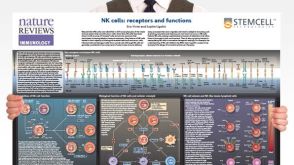 挂图Natural Killer Cells Overview of NK cell receptors, subsets, activation and function




 沪公网安备31010102008431号