Amita M et al. (MAR 2013)
Proceedings of the National Academy of Sciences of the United States of America 110 13 E1212--E1221
Complete and unidirectional conversion of human embryonic stem cells to trophoblast by BMP4
Human ES cells (hESC) exposed to bone morphogenic protein 4 (BMP4) in the absence of FGF2 have become widely used for studying trophoblast development,but the soundness of this model has been challenged by others,who concluded that differentiation was primarily toward mesoderm rather than trophoblast. Here we confirm that hESC grown under the standard conditions on a medium conditioned by mouse embryonic fibroblasts in the presence of BMP4 and absence of FGF2 on a Matrigel substratum rapidly convert to an epithelium that is largely KRT7+ within 48 h,with minimal expression of mesoderm markers,including T (Brachyury). Instead,they begin to express a series of trophoblast markers,including HLA-G,demonstrate invasive properties that are independent of the continued presence of BMP4 in the medium,and,over time,produce extensive amounts of human chorionic gonadotropin,progesterone,placental growth factor,and placental lactogen. This process of differentiation is not dependent on conditioning of the medium by mouse embryonic fibroblasts and is accelerated in the presence of inhibitors of Activin and FGF2 signaling,which at day 2 provide colonies that are entirely KRT7+ and in which the majority of cells are transiently CDX2+. Colonies grown on two chemically defined media,including the one in which BMP4 was reported to drive mesoderm formation,also differentiate at least partially to trophoblast in response to BMP4. The experiments demonstrate that the in vitro BMP4/hESC model is valid for studying the emergence and differentiation of trophoblasts.
View Publication
产品类型:
产品号#:
05850
05857
05870
05875
07923
85850
85857
85870
85875
产品名:
Dispase (1 U/mL)
mTeSR™1
mTeSR™1
Li X-J et al. (APR 2008)
Stem cells (Dayton,Ohio) 26 4 886--93
Directed differentiation of ventral spinal progenitors and motor neurons from human embryonic stem cells by small molecules.
Specification of distinct cell types from human embryonic stem cells (hESCs) is key to the potential application of these naïve pluripotent cells in regenerative medicine. Determination of the nontarget differentiated populations,which is lacking in the field,is also crucial. Here,we show an efficient differentiation of motor neurons ( approximately 50%) by a simple sequential application of retinoid acid and sonic hedgehog (SHH) in a chemically defined suspension culture. We also discovered that purmorphamine,a small molecule that activates the SHH pathway,could replace SHH for the generation of motor neurons. Immunocytochemical characterization indicated that cells differentiated from hESCs were nearly completely restricted to the ventral spinal progenitor fate (NKX2.2+,Irx3+,and Pax7-),with the exception of motor neurons (HB9+) and their progenitors (Olig2+). Thus,the directed neural differentiation system with small molecules,even without further purification,will facilitate basic and translational studies using human motoneurons at a minimal cost.
View Publication
产品类型:
产品号#:
72202
72204
100-1049
产品名:
Purmorphamine
Purmorphamine
Purmorphamine
Warren L et al. (NOV 2010)
Cell stem cell 7 5 618--630
Highly efficient reprogramming to pluripotency and directed differentiation of human cells with synthetic modified mRNA
Clinical application of induced pluripotent stem cells (iPSCs) is limited by the low efficiency of iPSC derivation and the fact that most protocols modify the genome to effect cellular reprogramming. Moreover,safe and effective means of directing the fate of patient-specific iPSCs toward clinically useful cell types are lacking. Here we describe a simple,nonintegrating strategy for reprogramming cell fate based on administration of synthetic mRNA modified to overcome innate antiviral responses. We show that this approach can reprogram multiple human cell types to pluripotency with efficiencies that greatly surpass established protocols. We further show that the same technology can be used to efficiently direct the differentiation of RNA-induced pluripotent stem cells (RiPSCs) into terminally differentiated myogenic cells. This technology represents a safe,efficient strategy for somatic cell reprogramming and directing cell fate that has broad applicability for basic research,disease modeling,and regenerative medicine. ?? 2010 Elsevier Inc.
View Publication
产品类型:
产品号#:
04434
04444
05850
05857
05870
05875
07913
27100
27150
85850
85857
85870
85875
产品名:
MethoCult™ H4434 Classic
MethoCult™ H4434 Classic
Dispase(5 U/mL)
35 mm培养皿
35 mm培养皿
mTeSR™1
mTeSR™1
Swartz EW et al. (NOV 2016)
STEM CELLS Translational Medicine 5 11 1461--1472
A Novel Protocol for Directed Differentiation of C9orf72-Associated Human Induced Pluripotent Stem Cells Into Contractile Skeletal Myotubes
Induced pluripotent stem cells (iPSCs) offer an unlimited resource of cells to be used for the study of underlying molecular biology of disease,therapeutic drug screening,and transplant-based regenerative medicine. However,methods for the directed differentiation of skeletal muscle for these purposes remain scarce and incomplete. Here,we present a novel,small molecule-based protocol for the generation of multinucleated skeletal myotubes using eight independent iPSC lines. Through combinatorial inhibition of phosphoinositide 3-kinase (PI3K) and glycogen synthase kinase 3β (GSK3β) with addition of bone morphogenic protein 4 (BMP4) and fibroblast growth factor 2 (FGF2),we report up to 64% conversion of iPSCs into the myogenic program by day 36 as indicated by MYOG+ cell populations. These cells began to exhibit spontaneous contractions as early as 34 days in vitro in the presence of a serum-free medium formulation. We used this protocol to obtain iPSC-derived muscle cells from frontotemporal dementia (FTD) patients harboring C9orf72 hexanucleotide repeat expansions (rGGGGCC),sporadic FTD,and unaffected controls. iPSCs derived from rGGGGCC carriers contained RNA foci but did not vary in differentiation efficiency when compared to unaffected controls nor display mislocalized TDP-43 after as many as 120 days in vitro. This study presents a rapid,efficient,and transgene-free method for generating multinucleated skeletal myotubes from iPSCs and a resource for further modeling the role of skeletal muscle in amyotrophic lateral sclerosis and other motor neuron diseases. SIGNIFICANCE Protocols to produce skeletal myotubes for disease modeling or therapy are scarce and incomplete. The present study efficiently generates functional skeletal myotubes from human induced pluripotent stem cells using a small molecule-based approach. Using this strategy,terminal myogenic induction of up to 64% in 36 days and spontaneously contractile myotubes within 34 days were achieved. Myotubes derived from patients carrying the C9orf72 repeat expansion show no change in differentiation efficiency and normal TDP-43 localization after as many as 120 days in vitro when compared to unaffected controls. This study provides an efficient,novel protocol for the generation of skeletal myotubes from human induced pluripotent stem cells that may serve as a valuable tool in drug discovery and modeling of musculoskeletal and neuromuscular diseases.
View Publication
Raju R et al. (FEB 2017)
Stem cells and development 26 4 274--284
Cell Expansion During Directed Differentiation of Stem Cells Toward the Hepatic Lineage.
The differentiation of human pluripotent stem cells toward the hepatocyte lineage can potentially provide an unlimited source of functional hepatocytes for transplantation and extracorporeal bioartificial liver applications. It is anticipated that the quantities of cells needed for these applications will be in the order of 10(9)-10(10) cells,because of the size of the liver. An ideal differentiation protocol would be to enable directed differentiation to the hepatocyte lineage with simultaneous cell expansion. We introduced a cell expansion stage after the commitment of human embryonic stem cells to the endodermal lineage,to allow for at least an eightfold increase in cell number,with continuation of cell maturation toward the hepatocyte lineage. The progressive changes in the transcriptome were measured by expression array,and the expression dynamics of certain lineage markers was measured by mass cytometry during the differentiation and expansion process. The findings revealed that while cells were expanding they were also capable of progressing in their differentiation toward the hepatocyte lineage. In addition,our transcriptome,protein and functional studies,including albumin secretion,drug-induced CYP450 expression and urea production,all indicated that the hepatocyte-like cells obtained with or without cell expansion are very similar. This method of simultaneous cell expansion and hepatocyte differentiation should facilitate obtaining large quantities of cells for liver cell applications.
View Publication
产品类型:
产品号#:
05850
05857
05870
05875
85850
85857
85870
85875
产品名:
mTeSR™1
mTeSR™1
Ma R et al. (FEB 2017)
Thyroid : official journal of the American Thyroid Association 27 2 292--299
TAZ Induction Directs Differentiation of Thyroid Follicular Cells from Human Embryonic Stem Cells.
OBJECTIVE The differentiation program for human thyroid follicular cells (TFCs) relies on the interplay between sequence-specific transcription factors and transcriptional co-regulators. Transcriptional co-activator with PDZ-binding motif (TAZ) is a co-activator that regulates several transcription factors,including PAX8 and NKX2-1,which play a central role in thyroid-specific gene transcription. TAZ and PAX8/NKX2-1 are co-expressed in the nuclei of thyroid cells,and TAZ interacts directly with both PAX8 and NKX2-1,leading to their enhanced transcriptional activity on the thyroglobulin (TG) promoter and additional genes. METHODS The use of a small molecule,ethacridine,recently identified as a TAZ activator,in the differentiation of thyroid cells from human embryonic stem (hES) cells was studied. First,endodermal cells were derived from hES cells using Activin A,followed by induction of differentiation into thyroid cells directed by ethacridine and thyrotropin (TSH). RESULTS The expression of TAZ was increased in the Activin A-derived endodermal cells by ethacridine in a dose-dependent manner and followed by increases in PAX8 and NKX2-1 when assessed by both quantitative polymerase chain reaction and immunostaining. Following further differentiation with the combination of ethacridine and TSH,the thyroid-specific genes TG,TPO,TSHR,and NIS were all induced in the differentiated hES cells. When these cells were cultured with extracellular matrix-coated dishes,thyroid follicle formation and abundant TG protein expression were observed. Furthermore,such hES cell-derived thyroid follicles showed a marked TSH-induced and dose-dependent increase in radioiodine uptake and protein-bound iodine accumulation. CONCLUSION These data show that fully functional human thyroid cells can be derived from hES cells using ethacridine,a TAZ activator,which induces thyroid-specific gene expression and promotes thyroid cell differentiation from the hES cells. These studies again demonstrate the importance of transcriptional regulation in thyroid cell development. This approach also yields functional human thyrocytes,without any gene transfection or complex culture conditions,by directly manipulating the transcriptional machinery without interfering with intermediate signaling events.
View Publication
产品类型:
产品号#:
05850
05857
05870
05875
85850
85857
85870
85875
产品名:
mTeSR™1
mTeSR™1
Krakstad C et al. (SEP 2004)
Journal of leukocyte biology 76 3 641--7
cAMP protects neutrophils against TNF-alpha-induced apoptosis by activation of cAMP-dependent protein kinase, independently of exchange protein directly activated by cAMP (Epac).
It is unclear by which receptor cyclic adenosine monophosphate (cAMP) acts to promote neutrophil survival. We found that 8-(4-chlorophenylthio)-2'-O-methyl-cAMP,a specific activator of the recently discovered cAMP receptor,cAMP-regulated guanosine 5'-triphosphate exchange protein directly activated by cAMP,failed to protect human neutrophils from cell death. In contrast,specific activators of cAMP-dependent protein kinase type I (cA-PKI) could protect against death receptor [tumor necrosis factor receptor 1 (TNFR-1),Fas]-mediated apoptosis as well as cycloheximide-accelerated spontaneous" apoptosis. A novel "caged" cA-PK-activating analog�
View Publication
产品类型:
产品号#:
73602
73604
产品名:
8-Bromo-cAMP
8-Bromo-cAMP
van de Sandt CE et al. (FEB 2014)
Journal of Virology 88 3 1684--93
Human cytotoxic T lymphocytes directed to seasonal influenza A viruses cross-react with the newly emerging H7N9 virus
In February 2013,zoonotic transmission of a novel influenza A virus of the H7N9 subtype was reported in China. Although at present no sustained human-to-human transmission has been reported,a pandemic outbreak of this H7N9 virus is feared. Since neutralizing antibodies to the hemagglutinin (HA) globular head domain of the virus are virtually absent in the human population,there is interest in identifying other correlates of protection,such as cross-reactive CD8(+) T cells (cytotoxic T lymphocytes [CTLs]) elicited during seasonal influenza A virus infections. These virus-specific CD8(+) T cells are known to recognize conserved internal proteins of influenza A viruses predominantly,but it is unknown to what extent they cross-react with the newly emerging H7N9 virus. Here,we assessed the cross-reactivity of seasonal H3N2 and H1N1 and pandemic H1N1 influenza A virus-specific polyclonal CD8(+) T cells,obtained from HLA-typed study subjects,with the novel H7N9 virus. The cross-reactivity of CD8(+) T cells to H7N9 variants of known influenza A virus epitopes and H7N9 virus-infected cells was determined by their gamma interferon (IFN-γ) response and lytic activity. It was concluded that,apart from recognition of individual H7N9 variant epitopes,CD8(+) T cells to seasonal influenza viruses display considerable cross-reactivity with the novel H7N9 virus. The presence of these cross-reactive CD8(+) T cells may afford some protection against infection with the new virus.
View Publication
产品类型:
产品号#:
03800
03801
03802
03803
03804
03805
03806
产品名:
ClonaCell™-HY杂交瘤试剂盒
ClonaCell™-HY培养基A
ClonaCell™-HY 培养基 B
ClonaCell™-HY 培养基 C
ClonaCell™-HY 培养基 D
ClonaCell™-HY 培养基 E
ClonaCell™-HY PEG
Cheung C et al. (APR 2014)
Nature protocols 9 4 929--38
Directed differentiation of embryonic origin-specific vascular smooth muscle subtypes from human pluripotent stem cells.
Vascular smooth muscle cells (SMCs) arise from diverse developmental origins. Regional distribution of vascular diseases may,in part,be attributed to this inherent heterogeneity in SMC lineage. Therefore,systems for generating human SMC subtypes of distinct embryonic origins would represent useful platforms for studying the influence of SMC lineage on the spatial specificity of vascular disease. Here we describe how human pluripotent stem cells can be differentiated into distinct populations of SMC subtypes under chemically defined conditions. The initial stage (days 0-5 or 0-7) begins with the induction of three intermediate lineages: neuroectoderm,lateral plate mesoderm and paraxial mesoderm. Subsequently,these precursor lineages are differentiated into contractile SMCs (days 5-19+). At key stages,the emergence of lineage-specific markers confirms recapitulation of embryonic developmental pathways and generation of functionally distinct SMC subtypes. The ability to derive an unlimited supply of human SMCs will accelerate applications in regenerative medicine and disease modeling.
View Publication
产品类型:
产品号#:
05850
05857
05870
05875
85850
85857
85870
85875
产品名:
mTeSR™1
mTeSR™1
Ankam S et al. (APR 2015)
Biomaterials 47 20--28
Actomyosin contractility plays a role in MAP2 expression during nanotopography-directed neuronal differentiation of human embryonic stem cells
Pluripotent human embryonic stem cells (hESCs) have the capability of differentiating into different lineages based on specific environmental cues. We had previously shown that hESCs can be primed to differentiate into either neurons or glial cells,depending on the arrangement,geometry and size of their substrate topography. In particular,anisotropically patterned substrates like gratings were found to favour the differentiation of hESCs into neurons rather than glial cells. In this study,our aim is to elucidate the underlying mechanisms of topography-induced differentiation of hESCs towards neuronal lineages. We show that high actomyosin contractility induced by a nano-grating topography is crucial for neuronal maturation. Treatment of cells with the myosin II inhibitor (blebbistatin) and myosin light chain kinase inhibitor (ML-7) greatly reduces the expression level of microtubule-associated protein 2 (MAP2). On the other hand,our qPCR array results showed that PAX5,BRN3A and NEUROD1 were highly expressed in hESCs grown on nano-grating substrates as compared to unpatterned substrates,suggesting the possible involvement of these genes in topography-mediated neuronal differentiation of hESCs. Interestingly,YAP was localized to the cytoplasm of differentiating hESCs. Taken together,our study has provided new insights in understanding the mechanotransduction of topographical cues during neuronal differentiation of hESCs.
View Publication


 EasySep™小鼠TIL(CD45)正选试剂盒




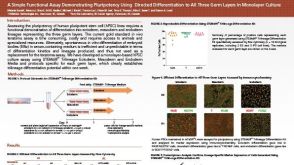 科学海报A Simple Functional Assay Demonstrating Pluripotency Using Directed Differentiation to All Three Germ Layers in Monolayer Culture
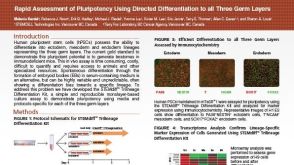 科学海报Rapid Assessment of Pluripotency Using Directed Differentiation to all Three Germ Layers
 沪公网安备31010102008431号