Darabi R et al. (MAY 2012)
Cell stem cell 10 5 610--619
Human ES- and iPS-derived myogenic progenitors restore DYSTROPHIN and improve contractility upon transplantation in dystrophic mice.
A major obstacle in the application of cell-based therapies for the treatment of neuromuscular disorders is obtaining the appropriate number of stem/progenitor cells to produce effective engraftment. The use of embryonic stem (ES) or induced pluripotent stem (iPS) cells could overcome this hurdle. However,to date,derivation of engraftable skeletal muscle precursors that can restore muscle function from human pluripotent cells has not been achieved. Here we applied conditional expression of PAX7 in human ES/iPS cells to successfully derive large quantities of myogenic precursors,which,upon transplantation into dystrophic muscle,are able to engraft efficiently,producing abundant human-derived DYSTROPHIN-positive myofibers that exhibit superior strength. Importantly,transplanted cells also seed the muscle satellite cell compartment,and engraftment is present over 11 months posttransplant. This study provides the proof of principle for the derivation of functional skeletal myogenic progenitors from human ES/iPS cells and highlights their potential for future therapeutic application in muscular dystrophies.
View Publication
产品类型:
产品号#:
85850
85857
产品名:
mTeSR™1
mTeSR™1
Nova-Lamperti E et al. (JAN 2016)
Scientific Reports 6 20044
IL-10-produced by human transitional B-cells down-regulates CD86 expression on B-cells leading to inhibition of CD4+T-cell responses.
A novel subset of human regulatory B-cells has recently been described. They arise from within the transitional B-cell subpopulation and are characterised by the production of IL-10. They appear to be of significant importance in regulating T-cell immunity in vivo. Despite this important function,the molecular mechanisms by which they control T-cell activation are incompletely defined. Here we show that transitional B-cells produced more IL-10 and expressed higher levels of IL-10 receptor after CD40 engagement compared to other B-cell subsets. Furthermore,under this stimulatory condition,CD86 expressed by transitional B-cells was down regulated and T-cell proliferation was reduced. We provide evidence to demonstrate that the down-regulation of CD86 expression by transitional B-cells was due to the autocrine effect of IL-10,which in turn leads to decreased T-cell proliferation and TNF-α production. This analysis was further extended to peripheral B-cells in kidney transplant recipients. We observed that B-cells from patients tolerant to the graft maintained higher IL-10 production after CD40 ligation,which correlates with lower CD86 expression compared to patients with chronic rejection. Hence,the results obtained in this study shed light on a new alternative mechanism by which transitional B-cells inhibit T-cell proliferation and cytokine production.
View Publication
产品类型:
产品号#:
15022
15062
15024
15064
产品名:
RosetteSep™人CD4+ T细胞富集抗体混合物
RosetteSep™人CD4+ T细胞富集抗体混合物
RosetteSep™ 人B细胞富集抗体混合物
RosetteSep™人B细胞富集抗体混合物
Costa V et al. (APR 2016)
Cell reports 15 1 86--95
mTORC1 Inhibition Corrects Neurodevelopmental and Synaptic Alterations in a Human Stem Cell Model of Tuberous Sclerosis.
Hyperfunction of the mTORC1 pathway has been associated with idiopathic and syndromic forms of autism spectrum disorder (ASD),including tuberous sclerosis,caused by loss of either TSC1 or TSC2. It remains largely unknown how developmental processes and biochemical signaling affected by mTORC1 dysregulation contribute to human neuronal dysfunction. Here,we have characterized multiple stages of neurogenesis and synapse formation in human neurons derived from TSC2-deleted pluripotent stem cells. Homozygous TSC2 deletion causes severe developmental abnormalities that recapitulate pathological hallmarks of cortical malformations in patients. Both TSC2(+/-) and TSC2(-/-) neurons display altered synaptic transmission paralleled by molecular changes in pathways associated with autism,suggesting the convergence of pathological mechanisms in ASD. Pharmacological inhibition of mTORC1 corrects developmental abnormalities and synaptic dysfunction during independent developmental stages. Our results uncouple stage-specific roles of mTORC1 in human neuronal development and contribute to a better understanding of the onset of neuronal pathophysiology in tuberous sclerosis.
View Publication
ROCK Inhibition Promotes Attachment, Proliferation, and Wound Closure in Human Embryonic Stem Cell-Derived Retinal Pigmented Epithelium.
PURPOSE Nonexudative (dry) age-related macular degeneration (AMD),a leading cause of blindness in the elderly,is associated with the loss of retinal pigmented epithelium (RPE) cells and the development of geographic atrophy,which are areas devoid of RPE cells and photoreceptors. One possible treatment option would be to stimulate RPE attachment and proliferation to replace dying/dysfunctional RPE and bring about wound repair. Clinical trials are underway testing injections of RPE cells derived from pluripotent stem cells to determine their safety and efficacy in treating AMD. However,the factors regulating RPE responses to AMD-associated lesions are not well understood. Here,we use cell culture to investigate the role of RhoA coiled coil kinases (ROCKs) in human embryonic stem cell-derived RPE (hESC-RPE) attachment,proliferation,and wound closure. METHODS H9 hESC were spontaneously differentiated into RPE cells. hESC-RPE cells were treated with a pan ROCK1/2 or a ROCK2 only inhibitor; attachment,and proliferation and cell size within an in vitro scratch assay were examined. RESULTS Pharmacological inhibition of ROCKs promoted hESC-RPE attachment and proliferation,and increased the rate of closure of in vitro wounds. ROCK inhibition decreased phosphorylation of cofilin and myosin light chain,suggesting that regulation of the cytoskeleton underlies the mechanism of action of ROCK inhibition. CONCLUSIONS ROCK inhibition promotes attachment,proliferation,and wound closure in H9 hESC-RPE cells. ROCK isoforms may have different roles in wound healing. TRANSLATIONAL RELEVANCE Modulation of the ROCK-cytoskeletal axis has potential in stimulating wound repair in transplanted RPE cells and attachment in cellular therapies.
View Publication
产品类型:
产品号#:
85850
85857
产品名:
mTeSR™1
mTeSR™1
Mahbub AA et al. (DEC 2013)
Anti-cancer agents in medicinal chemistry 13 10 1601--13
Differential effects of polyphenols on proliferation and apoptosis in human myeloid and lymphoid leukemia cell lines.
BACKGROUND Mortality rates for leukemia are high despite considerable improvements in treatment. Since polyphenols exert pro-apoptotic effects in solid tumors,our study investigated the effects of polyphenols in haematological malignancies. The effect of eight polyphenols (quercetin,chrysin,apigenin,emodin,aloe-emodin,rhein,cis-stilbene and trans-stilbene) were studied on cell proliferation,cell cycle and apoptosis in four lymphoid and four myeloid leukemic cells lines,together with normal haematopoietic control cells. METHODS Cellular proliferation was measured by CellTiter-Glo(®) luminescent assay; and cell cycle arrest was assessed using flow cytometry of propidium iodide stained cells. Apoptosis was investigated by caspase-3 activity assay using flow cytometry and apoptotic morphology was confirmed by Hoescht 33342 staining. RESULTS Emodin,quercetin,and cis-stilbene were the most effective polyphenols at decreasing cell viability (IC50 values of 5-22 μM,8-33 μM,and 25-85 μM respectively) and inducing apoptosis (AP50 values (the concentration which 50% of cells undergo apoptosis) of 2-27 μM,19-50 μM,and 8-50 μM respectively). Generally,lymphoid cell lines were more sensitive to polyphenol treatment compared to myeloid cell lines,however the most resistant myeloid (KG-1a and K562) cell lines were still found to respond to emodin and quercetin treatment at low micromolar levels. Non-tumor cells were less sensitive to all polyphenols compared to the leukemia cells. CONCLUSIONS These findings suggest that polyphenols have anti-tumor activity against leukemia cells with differential effects. Importantly,the differential sensitivity of emodin,quercetin,and cis-stilbene between leukemia and normal cells suggests that polyphenols are potential therapeutic agents for leukemia.
View Publication
产品类型:
产品号#:
200-0000
200-0001
200-0002
70008
70008.1
70008.2
70008.3
70008.4
70008.5
产品名:
冻存的人脐带血CD34+细胞
冻存的人脐带血CD34+细胞
冻存的人脐带血CD34+细胞
冻存的人脐带血CD34+细胞
冻存的人脐带血CD34+细胞
冻存的人脐带血CD34+细胞
冻存的人脐带血CD34+细胞
冻存的人脐带血CD34+细胞
冻存的人脐带血CD34+细胞
(Feb 2024)
Inflammation and Regeneration 44 3
Novel artificial nerve transplantation of human iPSC-derived neurite bundles enhanced nerve regeneration after peripheral nerve injury
BackgroundSevere peripheral nerve damage always requires surgical treatment. Autologous nerve transplantation is a standard treatment,but it is not sufficient due to length limitations and extended surgical time. Even with the available artificial nerves,there is still large room for improvement in their therapeutic effects. Novel treatments for peripheral nerve injury are greatly expected.MethodsUsing a specialized microfluidic device,we generated artificial neurite bundles from human iPSC-derived motor and sensory nerve organoids. We developed a new technology to isolate cell-free neurite bundles from spheroids. Transplantation therapy was carried out for large nerve defects in rat sciatic nerve with novel artificial nerve conduit filled with lineally assembled sets of human neurite bundles. Quantitative comparisons were performed over time to search for the artificial nerve with the therapeutic effect,evaluating the recovery of motor and sensory functions and histological regeneration. In addition,a multidimensional unbiased gene expression profiling was carried out by using next-generation sequencing.ResultAfter transplantation,the neurite bundle-derived artificial nerves exerted significant therapeutic effects,both functionally and histologically. Remarkably,therapeutic efficacy was achieved without immunosuppression,even in xenotransplantation. Transplanted neurite bundles fully dissolved after several weeks,with no tumor formation or cell proliferation,confirming their biosafety. Posttransplant gene expression analysis highlighted the immune system’s role in recovery.ConclusionThe combination of newly developed microfluidic devices and iPSC technology enables the preparation of artificial nerves from organoid-derived neurite bundles in advance for future treatment of peripheral nerve injury patients. A promising,safe,and effective peripheral nerve treatment is now ready for clinical application.Supplementary InformationThe online version contains supplementary material available at 10.1186/s41232-024-00319-4.
View Publication
产品类型:
产品号#:
17899
产品名:
EasySep™ 死细胞去除 (Annexin V) 试剂盒
D. M. Sahasrabudhe et al. (Jun 2024)
Scientific Reports 14 18
In silico predicted compound targeting the IQGAP1-GRD domain selectively inhibits growth of human acute myeloid leukemia
Acute myeloid leukemia (AML) is fatal in the majority of adults. Identification of new therapeutic targets and their pharmacologic modulators are needed to improve outcomes. Previous studies had shown that immunization of rabbits with normal peripheral WBCs that had been incubated with fluorodinitrobenzene elicited high titer antibodies that bound to a spectrum of human leukemias. We report that proteomic analyses of immunoaffinity-purified lysates of primary AML cells showed enrichment of scaffolding protein IQGAP1. Immunohistochemistry and gene-expression analyses confirmed IQGAP1 mRNA overexpression in various cytogenetic subtypes of primary human AML compared to normal hematopoietic cells. shRNA knockdown of IQGAP1 blocked proliferation and clonogenicity of human leukemia cell-lines. To develop small molecules targeting IQGAP1 we performed in-silico screening of 212,966 compounds,selected 4 hits targeting the IQGAP1-GRD domain,and conducted SAR of the ‘fittest hit’ to identify UR778Br,a prototypical agent targeting IQGAP1. UR778Br inhibited proliferation,induced apoptosis,resulted in G2/M arrest,and inhibited colony formation by leukemia cell-lines and primary-AML while sparing normal marrow cells. UR778Br exhibited favorable ADME/T profiles and drug-likeness to treat AML. In summary, AML shows response to IQGAP1 inhibition,and UR778Br,identified through in-silico studies,selectively targeted AML cells while sparing normal marrow. Subject terms: Cancer,Cell biology,Drug discovery,Immunology,Oncology
View Publication
产品类型:
产品号#:
04435
04445
产品名:
MethoCult™H4435富集
MethoCult™H4435富集
T. Roodsant et al. ( 2020)
Frontiers in cellular and infection microbiology 10 272
A Human 2D Primary Organoid-Derived Epithelial Monolayer Model to Study Host-Pathogen Interaction in the Small Intestine.
Gut organoids are stem cell derived 3D models of the intestinal epithelium that are useful for studying interactions between enteric pathogens and their host. While the organoid model has been used for both bacterial and viral infections,this is a closed system with the luminal side being inaccessible without microinjection or disruption of the organoid polarization. In order to overcome this and simplify their applicability for transepithelial studies,permeable membrane based monolayer approaches are needed. In this paper,we demonstrate a method for generating a monolayer model of the human fetal intestinal polarized epithelium that is fully characterized and validated. Proximal and distal small intestinal organoids were used to generate 2D monolayer cultures,which were characterized with respect to epithelial cell types,polarization,barrier function,and gene expression. In addition,viral replication and bacterial translocation after apical infection with enteric pathogens Enterovirus A71 and Listeria monocytogenes were evaluated,with subsequent monitoring of the pro-inflammatory host response. This human 2D fetal intestinal monolayer model will be a valuable tool to study host-pathogen interactions and potentially reduce the use of animals in research.
View Publication
产品类型:
产品号#:
06010
产品名:
IntestiCult™ 类器官生长培养基 (人)
P. W. Burridge et al. ( 2016)
Nature medicine 22 5 547--56
Human induced pluripotent stem cell-derived cardiomyocytes recapitulate the predilection of breast cancer patients to doxorubicin-induced cardiotoxicity.
Doxorubicin is an anthracycline chemotherapy agent effective in treating a wide range of malignancies,but it causes a dose-related cardiotoxicity that can lead to heart failure in a subset of patients. At present,it is not possible to predict which patients will be affected by doxorubicin-induced cardiotoxicity (DIC). Here we demonstrate that patient-specific human induced pluripotent stem cell-derived cardiomyocytes (hiPSC-CMs) can recapitulate the predilection to DIC of individual patients at the cellular level. hiPSC-CMs derived from individuals with breast cancer who experienced DIC were consistently more sensitive to doxorubicin toxicity than hiPSC-CMs from patients who did not experience DIC,with decreased cell viability,impaired mitochondrial and metabolic function,impaired calcium handling,decreased antioxidant pathway activity,and increased reactive oxygen species production. Taken together,our data indicate that hiPSC-CMs are a suitable platform to identify and characterize the genetic basis and molecular mechanisms of DIC.
View Publication
Wellington M et al. (DEC 2003)
Infection and immunity 71 12 7228--31
Enhanced phagocytosis of Candida species mediated by opsonization with a recombinant human antibody single-chain variable fragment.
Specific antibody opsonization significantly enhances the level of phagocytosis of Candida in the absence of complement. Furthermore,we have described a system using a recombinant human antibody single-chain variable fragment that allows a comparative study of phagocytosis of multiple Candida species opsonized via a common antigen.
View Publication
产品类型:
产品号#:
15028
15068
产品名:
RosetteSep™ 人单核细胞富集抗体混合物
RosetteSep™人单核细胞富集抗体混合物
Jones RB et al. (SEP 2009)
Journal of virology 83 17 8722--32
Human immunodeficiency virus type 1 escapes from interleukin-2-producing CD4+ T-cell responses without high-frequency fixation of mutations.
The presence of interleukin-2 (IL-2)-producing human immunodeficiency virus type 1 (HIV-1)-specific CD4(+) T-cell responses has been associated with the immunological control of HIV-1 replication; however,the causal relationship between these factors remains unclear. Here we show that IL-2-producing HIV-1-specific CD4(+) T cells can be cloned from acutely HIV-1-infected individuals. Despite the early presence of these cells,each of the individuals in the present study exhibited progressive disease,with one individual showing rapid progression. In this rapid progressor,three IL-2-producing HIV-1 Gag-specific CD4(+) T-cell responses were identified and mapped to the following optimal epitopes: HIVWASRELER,REPRGSDIAGT,and FRDYVDRFYKT. Responses to these epitopes in peripheral blood mononuclear cells were monitored longitudinally to textgreater1 year postinfection,and contemporaneous circulating plasma viruses were sequenced. A variant of the FRDYVDRFYKT epitope sequence,FRDYVDQFYKT,was observed in 1/21 plasma viruses sequenced at 5 months postinfection and 1/10 viruses at 7 months postinfection. This variant failed to stimulate the corresponding CD4(+) T-cell clone and thus constitutes an escape mutant. Responses to each of the three Gag epitopes were rapidly lost,and this loss was accompanied by a loss of antigen-specific cells in the periphery as measured by using an FRDYVDRFYKT-presenting major histocompatibility complex class II tetramer. Highly active antiretroviral therapy was associated with the reemergence of FRDYVDRFYKT-specific cells by tetramer. Thus,our data support that IL-2-producing HIV-1-specific CD4(+) T-cell responses can exert immune pressure during early HIV-1 infection but that the inability of these responses to enforce enduring control of viral replication is related to the deletion and/or dysfunction of HIV-1-specific CD4(+) T cells rather than to the fixation of escape mutations at high frequencies.
View Publication


 EasySep™小鼠TIL(CD45)正选试剂盒




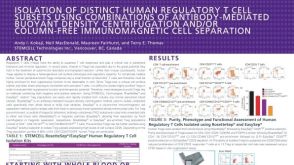 科学海报Isolation of Distinct Human Regulatory T Cell Subsets Using Combinations of Antibody Mediated Buoyant Density Centrifugation
 沪公网安备31010102008431号