Maciejewski JP et al. (SEP 1996)
Blood 88 6 1983--91
A severe and consistent deficit in marrow and circulating primitive hematopoietic cells (long-term culture-initiating cells) in acquired aplastic anemia.
We examined the stem cell compartment of patients with acquired aplastic anemia (AA) using the long-term culture-initiating cell assay (LTC-IC),in parallel with measurements of CD34+ cells and mature hematopoietic progenitors. Secondary colonies from cells surviving 5 weeks of long-term bone marrow culture (LTBMC) were determined for the peripheral blood (PB) of 68 AA patients and 13 normal controls and for BM of 49 AA patients and 14 controls; because of low cell numbers,formal limiting dilution analysis could only be performed in 10 patients. The relationship of cell input in LTBMC and the output of secondary colonies was linear,allowing quantification of LTC-IC number from bulk cultures. Secondary colony formation was markedly abnormal in severe AA. In contrast to 7.8 colony-forming cells (CFC)/10(5) mononuclear cells in normal BM and 0.14 CFC/10(5) normal PB mononuclear cells,patients with severe disease showed 0.024 CFC/10(5) in BM and 0.0068 CFC/10(5) in PB. Under limiting dilution conditions,patients' cells also showed markedly lower colony-forming ability. In contrast to 4.3 +/- 1 colonies/normal LTC-IC,we obtained only 1.27 +/- 0.09 and 2.0 +/- 0.35 colonies from BM of acute and recovered cases,respectively. These values were used to extrapolate LTC-IC numbers from secondary colony formation in suspension cultures. In PB,calculated LTC-IC were decreased 7.4-fold in new and relapsed severe AA and 2.8-fold in recovered AA. In BM,LTC-IC were decreased 10-fold in new and relapsed AA and sixfold in recovered cases. Compared with measurements obtained on presentation,LTC-IC were lower in post-treatment samples from patients who had failed to recover after intensive immunosuppression and relatively higher in cases at relapse. In recovered patients,LTC-IC number increased but remained below the normal range in 20 of 25. In patients studied serially for 3 to 12 months after treatment,LTC-IC numbers remained stable but low. LTC-IC number correlated with concurrently determined CD34+ cell number and primary hematopoietic colony formation. These results indicate that stem cell numbers,as quantitated by the LTC-IC assay,are markedly diminished in number in all severe AA. Additionally,the function of the stem cell or the stem cell compartment in AA is also abnormal,as inferred from the low clonogenic potential in secondary colony assays. Early hematologic improvement in some patients occurs without increasing numbers of LTC-IC,and a minority of recovered cases show apparent repopulation of the LTC-IC compartment years after treatment.
View Publication
产品类型:
产品号#:
05150
产品名:
MyeloCult™H5100
V. Saint-Criq et al. (sep 2020)
Cells 9 9 2137
Choice of Differentiation Media Significantly Impacts Cell Lineage and Response to CFTR Modulators in Fully Differentiated Primary Cultures of Cystic Fibrosis Human Airway Epithelial Cells.
In vitro cultures of primary human airway epithelial cells (hAECs) grown at air-liquid interface have become a valuable tool to study airway biology under normal and pathologic conditions,and for drug discovery in lung diseases such as cystic fibrosis (CF). An increasing number of different differentiation media,are now available,making comparison of data between studies difficult. Here,we investigated the impact of two common differentiation media on phenotypic,transcriptomic,and physiological features of CF and non-CF epithelia. Cellular architecture and density were strongly impacted by the choice of medium. RNA-sequencing revealed a shift in airway cell lineage; one medium promoting differentiation into club and goblet cells whilst the other enriched the growth of ionocytes and multiciliated cells. Pathway analysis identified differential expression of genes involved in ion and fluid transport. Physiological assays (intracellular/extracellular pH,Ussing chamber) specifically showed that ATP12A and CFTR function were altered,impacting pH and transepithelial ion transport in CF hAECs. Importantly,the two media differentially affected functional responses to CFTR modulators. We argue that the effect of growth conditions should be appropriately determined depending on the scientific question and that our study can act as a guide for choosing the optimal growth medium for specific applications.
View Publication
产品类型:
产品号#:
05001
05022
05021
产品名:
PneumaCult™-ALI 培养基
PneumaCult™-ALI 培养基含6.5 mm Transwell®插件
PneumaCult™-ALI 培养基含12 mm Transwell®插件
Ishimoto T et al. ( 2014)
PloS one 9 2 e89434
Organic cation transporter-mediated ergothioneine uptake in mouse neural progenitor cells suppresses proliferation and promotes differentiation into neurons.
The aim of the present study is to clarify the functional expression and physiological role in neural progenitor cells (NPCs) of carnitine/organic cation transporter OCTN1/SLC22A4,which accepts the naturally occurring food-derived antioxidant ergothioneine (ERGO) as a substrate in vivo. Real-time PCR analysis revealed that mRNA expression of OCTN1 was much higher than that of other organic cation transporters in mouse cultured cortical NPCs. Immunocytochemical analysis showed colocalization of OCTN1 with the NPC marker nestin in cultured NPCs and mouse embryonic carcinoma P19 cells differentiated into neural progenitor-like cells (P19-NPCs). These cells exhibited time-dependent [(3)H]ERGO uptake. These results demonstrate that OCTN1 is functionally expressed in murine NPCs. Cultured NPCs and P19-NPCs formed neurospheres from clusters of proliferating cells in a culture time-dependent manner. Exposure of cultured NPCs to ERGO or other antioxidants (edaravone and ascorbic acid) led to a significant decrease in the area of neurospheres with concomitant elimination of intracellular reactive oxygen species. Transfection of P19-NPCs with small interfering RNA for OCTN1 markedly promoted formation of neurospheres with a concomitant decrease of [(3)H]ERGO uptake. On the other hand,exposure of cultured NPCs to ERGO markedly increased the number of cells immunoreactive for the neuronal marker βIII-tubulin,but decreased the number immunoreactive for the astroglial marker glial fibrillary acidic protein (GFAP),with concomitant up-regulation of neuronal differentiation activator gene Math1. Interestingly,edaravone and ascorbic acid did not affect such differentiation of NPCs,in contrast to the case of proliferation. Knockdown of OCTN1 increased the number of cells immunoreactive for GFAP,but decreased the number immunoreactive for βIII-tubulin,with concomitant down-regulation of Math1 in P19-NPCs. Thus,OCTN1-mediated uptake of ERGO in NPCs inhibits cellular proliferation via regulation of oxidative stress,and also promotes cellular differentiation by modulating the expression of basic helix-loop-helix transcription factors via an unidentified mechanism different from antioxidant action.
View Publication
产品类型:
产品号#:
05707
产品名:
NeuroCult™化学解离试剂盒(小鼠)
Bañ et al. (SEP 2008)
DNA repair 7 9 1471--1483
Mouse but not human embryonic stem cells are deficient in rejoining of ionizing radiation-induced DNA double-strand breaks.
Mouse embryonic stem (mES) cells will give rise to all of the cells of the adult mouse,but they failed to rejoin half of the DNA double-strand breaks (dsb) produced by high doses of ionizing radiation. A deficiency in DNA-PK(cs) appears to be responsible since mES cells expressed textless10% of the level of mouse embryo fibroblasts (MEFs) although Ku70/80 protein levels were higher than MEFs. However,the low level of DNA-PK(cs) found in wild-type cells appeared sufficient to allow rejoining of dsb after doses textless20Gy even in G1 phase cells. Inhibition of DNA-PK(cs) with wortmannin and NU7026 still sensitized mES cells to radiation confirming the importance of the residual DNA-PK(cs) at low doses. In contrast to wild-type cells,mES cells lacking H2AX,a histone protein involved in the DNA damage response,were radiosensitive but they rejoined double-strand breaks more rapidly. Consistent with more rapid dsb rejoining,H2AX(-/-) mES cells also expressed 6 times more DNA-PK(cs) than wild-type mES cells. Similar results were obtained for ATM(-/-) mES cells. Differentiation of mES cells led to an increase in DNA-PK(cs),an increase in dsb rejoining rate,and a decrease in Ku70/80. Unlike mouse ES,human ES cells were proficient in rejoining of dsb and expressed high levels of DNA-PK(cs). These results confirm the importance of homologous recombination in the accurate repair of double-strand breaks in mES cells,they help explain the chromosome abnormalities associated with deficiencies in H2AX and ATM,and they add to the growing list of differences in the way rodent and human cells deal with DNA damage.
View Publication
产品类型:
产品号#:
85850
85857
产品名:
mTeSR™1
mTeSR™1
Larochelle A et al. (FEB 2011)
Blood 117 5 1550--4
Human and rhesus macaque hematopoietic stem cells cannot be purified based only on SLAM family markers.
Various combinations of antibodies directed to cell surface markers have been used to isolate human and rhesus macaque hematopoietic stem cells (HSCs). These protocols result in poor enrichment or require multiple complex steps. Recently,a simple phenotype for HSCs based on cell surface markers from the signaling lymphocyte activation molecule (SLAM) family of receptors has been reported in the mouse. We examined the possibility of using the SLAM markers to facilitate the isolation of highly enriched populations of HSCs in humans and rhesus macaques. We isolated SLAM (CD150(+)CD48(-)) and non-SLAM (not CD150(+)CD48(-)) cells from human umbilical cord blood CD34(+) cells as well as from human and rhesus macaque mobilized peripheral blood CD34(+) cells and compared their ability to form colonies in vitro and reconstitute immune-deficient (nonobese diabetic/severe combined immunodeficiency/interleukin-2 γc receptor(null),NSG) mice. We found that the CD34(+) SLAM population contributed equally or less to colony formation in vitro and to long-term reconstitution in NSG mice compared with the CD34(+) non-SLAM population. Thus,SLAM family markers do not permit the same degree of HSC enrichment in humans and rhesus macaques as in mice.
View Publication
产品类型:
产品号#:
04435
04445
产品名:
MethoCult™H4435富集
MethoCult™H4435富集
D. T. Claiborne et al. (Jan 2025)
Nature Communications 16
High frequency CCR5 editing in human hematopoietic stem progenitor cells protects xenograft mice from HIV infection
The only cure of HIV has been achieved in a small number of people who received a hematopoietic stem cell transplant (HSCT) comprising allogeneic cells carrying a rare,naturally occurring,homozygous deletion in the CCR5 gene. The rarity of the mutation and the significant morbidity and mortality of such allogeneic transplants precludes widespread adoption of this HIV cure. Here,we show the application of CRISPR/Cas9 to achieve >90% CCR5 editing in human,mobilized hematopoietic stem progenitor cells (HSPC),resulting in a transplant that undergoes normal hematopoiesis,produces CCR5 null T cells,and renders xenograft mice refractory to HIV infection. Titration studies transplanting decreasing frequencies of CCR5 edited HSPCs demonstrate that <90% CCR5 editing confers decreasing protective benefit that becomes negligible between 54% and 26%. Our study demonstrates the feasibility of using CRISPR/Cas9/RNP to produce an HSPC transplant with high frequency CCR5 editing that is refractory to HIV replication. These results raise the potential of using CRISPR/Cas9 to produce a curative autologous HSCT and bring us closer to the development of a cure for HIV infection. Subject terms: HIV infections,CRISPR-Cas9 genome editing,Retrovirus,Translational research
View Publication
产品类型:
产品号#:
04034
04044
22001
22005
22006
22007
22008
22009
22011
22012
产品名:
MethoCult™H4034 Optimum
MethoCult™H4034 Optimum
STEMvision™ 人脐带血7-天CFU分析包
STEMvision™ 彩色人脐带血14-天CFU分析包
STEMvision™ 彩色人骨髓14-天CFU分析包
STEMvision™ 彩色人动员外周血14-天CFU分析包
STEMvision™ 小鼠总CFU分析包
STEMvision™ 小鼠髓系CFU分析包
STEMvision™ 小鼠红系CFU分析包
STEMvision™ 小鼠CFU分析包(髓系和红系)
Gerges N et al. (JAN 2010)
British medical bulletin 94 49--64
New technologies for the detection of circulating tumour cells.
The vast majority of cancer-related death is due to the metastatic spread of the primary tumour. Circulating tumour cells (CTC) are essential for establishing metastasis and their detection has long been considered as a possible tool to assess the aggressiveness of a given tumour and its potential of subsequent growth at distant organs. Conventional markers are not reliable in detecting occult metastasis and,for example,fail to identify approximately 40% of cancer patients in need of more aggressive or better adjusted therapies. Recent studies in metastatic breast cancer have shown that CTC detection can be used as a marker for overall survival and assessment of the therapeutic response. The benefits of CTC detection in early breast cancer and other solid tumours need further validation. Moreover,optimal CTC detection techniques are the subject of controversy as several lack reproducibility,sensitivity and/or specificity. Recent technical advances allow CTC detection and characterization at the single-cell level in the blood or in the bone marrow. Their reproducibility propels the use of CTC in cancer staging and real-time monitoring of systemic anticancer therapies in several large clinical trials. CTC assays are being integrated in large clinical trials to establish their potential in the management of cancer patients and improve our understanding of metastasis biology. This review will focus on the techniques currently used,the technical advancements made,the limitations of CTC detection and future perspectives in this field.
View Publication
产品类型:
产品号#:
15127
15167
产品名:
含抗CD36的RosetteSep™ CTC富集抗体混合物
含抗CD36的 RosetteSep™ CTC富集抗体混合物
Gü et al. (MAY 2012)
International immunopharmacology 13 1 61--8
Cryopreservation of adenovirus-transfected dendritic cells (DCs) for clinical use.
In this study,we examined the effects of cryoprotectant,freezing and thawing,and adenovirus (Adv) transduction on the viability,transgene expression,phenotype,and function of human dendritic cells (DCs). DCs were differentiated from cultured peripheral blood (PB) monocytes following Elutra isolation using granulocyte-macrophage colony-stimulating factor (GM-CSF) and interleukin-4 (IL-4) for 6 days and then transduced using an Adv vector with an IL-12 transgene. Fresh,cryopreserved,and thawed transduced immature DCs were examined for their: 1) cellular concentration and viability; 2) antigenicity using an allogeneic mixed lymphocyte reaction (MLR); 3) phenotype (HLA-DR and CD11c) and activation (CD83); and 4) transgene expression based on IL-12 secretion. Stability studies revealed that transduced DCs could be held in cryoprotectant for as long as 75 min at 2-8°C prior to freezing with little effect on their viability and cellularity. Further,cryopreservation,storage,and thawing reduced the viability of the transduced DCs by an average of 7.7%; and had no significant impact on DC phenotype and activation. In summary,cryopreservation,storage,and thawing had no significant effect on DC viability,function,and transgene expression by Adv-transduced DCs.
View Publication
产品类型:
产品号#:
07930
07931
07933
07940
07949
07952
07953
07955
07959
100-1061
产品名:
CryoStor® CS10
CryoStor® CS10
CryoStor®CS5
CryoStor® CS10
CryoStor®CS5
CryoStor® CS10
CryoStor®CS5
CryoStor® CS10
CryoStor® CS10
CryoStor® CS10
W. Zhu et al. (FEB 2017)
Journal of visualized experiments : JoVE 120
Pluripotent Stem Cell Derived Cardiac Cells for Myocardial Repair.
Human induced pluripotent stem cells (hiPSCs) must be fully differentiated into specific cell types before administration,but conventional protocols for differentiating hiPSCs into cardiomyocytes (hiPSC-CMs),endothelial cells (hiPSC-ECs),and smooth muscle cells (SMCs) are often limited by low yield,purity,and/or poor phenotypic stability. Here,we present novel protocols for generating hiPSC-CMs,-ECs,and -SMCs that are substantially more efficient than conventional methods,as well as a method for combining cell injection with a cytokine-containing patch created over the site of administration. The patch improves both the retention of the injected cells,by sealing the needle track to prevent the cells from being squeezed out of the myocardium,and cell survival,by releasing insulin-like growth factor (IGF) over an extended period. In a swine model of myocardial ischemia-reperfusion injury,the rate of engraftment was more than two-fold greater when the cells were administered with the cytokine-containing patch comparing to the cells without patch,and treatment with both the cells and the patch,but not with the cells alone,was associated with significant improvements in cardiac function and infarct size.
View Publication


 EasySep™小鼠TIL(CD45)正选试剂盒




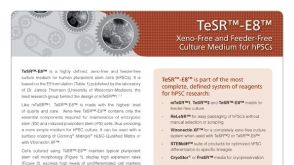 产品手册TeSR™-E8™: Feeder-Free Culture Medium for Human Pluripotent Stem Cells

 沪公网安备31010102008431号