Tohyama S et al. (APR 2016)
Cell Metabolism 23 4 663--674
Glutamine Oxidation Is Indispensable for Survival of Human Pluripotent Stem Cells
Summary Human pluripotent stem cells (hPSCs) are uniquely dependent on aerobic glycolysis to generate ATP. However,the importance of oxidative phosphorylation (OXPHOS) has not been elucidated. Detailed amino acid profiling has revealed that glutamine is indispensable for the survival of hPSCs. Under glucose- and glutamine-depleted conditions,hPSCs quickly died due to the loss of ATP. Metabolome analyses showed that hPSCs oxidized pyruvate poorly and that glutamine was the main energy source for OXPHOS. hPSCs were unable to utilize pyruvate-derived citrate due to negligible expression of aconitase 2 (ACO2) and isocitrate dehydrogenase 2/3 (IDH2/3) and high expression of ATP-citrate lyase. Cardiomyocytes with mature mitochondria were not able to survive without glucose and glutamine,although they were able to use lactate to synthesize pyruvate and glutamate. This distinguishing feature of hPSC metabolism allows preparation of clinical-grade cell sources free of undifferentiated hPSCs,which prevents tumor formation during stem cell therapy.
View Publication
产品号#:
05850
05857
05870
05875
85850
85857
85870
85875
产品名:
mTeSR™1
mTeSR™1
Carpentier A et al. (MAR 2016)
Stem Cell Research 16 3 640--650
Hepatic differentiation of human pluripotent stem cells in miniaturized format suitable for high-throughput screen
The establishment of protocols to differentiate human pluripotent stem cells (hPSCs) including embryonic (ESC) and induced pluripotent (iPSC) stem cells into functional hepatocyte-like cells (HLCs) creates new opportunities to study liver metabolism,genetic diseases and infection of hepatotropic viruses (hepatitis B and C viruses) in the context of specific genetic background. While supporting efficient differentiation to HLCs,the published protocols are limited in terms of differentiation into fully mature hepatocytes and in a smaller-well format. This limitation handicaps the application of these cells to high-throughput assays. Here we describe a protocol allowing efficient and consistent hepatic differentiation of hPSCs in 384-well plates into functional hepatocyte-like cells,which remain differentiated for more than 3 weeks. This protocol affords the unique opportunity to miniaturize the hPSC-based differentiation technology and facilitates screening for molecules in modulating liver differentiation,metabolism,genetic network,and response to infection or other external stimuli.
View Publication
产品号#:
05110
05850
05857
05870
05875
85850
85857
85870
85875
产品名:
STEMdiff™定型内胚层检测试剂盒
mTeSR™1
mTeSR™1
Saxena P et al. ( 2016)
Nature communications 7 11247
A programmable synthetic lineage-control network that differentiates human IPSCs into glucose-sensitive insulin-secreting beta-like cells.
Synthetic biology has advanced the design of standardized transcription control devices that programme cellular behaviour. By coupling synthetic signalling cascade- and transcription factor-based gene switches with reverse and differential sensitivity to the licensed food additive vanillic acid,we designed a synthetic lineage-control network combining vanillic acid-triggered mutually exclusive expression switches for the transcription factors Ngn3 (neurogenin 3; OFF-ON-OFF) and Pdx1 (pancreatic and duodenal homeobox 1; ON-OFF-ON) with the concomitant induction of MafA (V-maf musculoaponeurotic fibrosarcoma oncogene homologue A; OFF-ON). This designer network consisting of different network topologies orchestrating the timely control of transgenic and genomic Ngn3,Pdx1 and MafA variants is able to programme human induced pluripotent stem cells (hIPSCs)-derived pancreatic progenitor cells into glucose-sensitive insulin-secreting beta-like cells,whose glucose-stimulated insulin-release dynamics are comparable to human pancreatic islets. Synthetic lineage-control networks may provide the missing link to genetically programme somatic cells into autologous cell phenotypes for regenerative medicine.
View Publication
Enhanced CLIP Uncovers IMP Protein-RNA Targets in Human Pluripotent Stem Cells Important for Cell Adhesion and Survival
Human pluripotent stem cells (hPSCs) require precise control of post-transcriptional RNA networks to maintain proliferation and survival. Using enhanced UV crosslinking and immunoprecipitation (eCLIP),we identify RNA targets of the IMP/IGF2BP family of RNA-binding proteins in hPSCs. At the broad region and binding site levels,IMP1 and IMP2 show reproducible binding to a large and overlapping set of 3' UTR-enriched targets. RNA Bind-N-seq applied to recombinant full-length IMP1 and IMP2 reveals CA-rich motifs that are enriched in eCLIP-defined binding sites. We observe that IMP1 loss in hPSCs recapitulates IMP1 phenotypes,including a reduction in cell adhesion and increase in cell death. For cell adhesion,we find IMP1 maintains levels of integrin mRNA specifically regulating RNA stability of ITGB5 in hPSCs. Additionally,we show that IMP1 can be linked to hPSC survival via direct target BCL2. Thus,transcriptome-wide binding profiles identify hPSC targets modulating well-characterized IMP1 roles.
View Publication
产品号#:
05850
05857
05870
05875
85850
85857
85870
85875
产品名:
mTeSR™1
mTeSR™1
Patel R and Alahmad AJ ( 2016)
Fluids and barriers of the CNS 13 6
BACKGROUND Patient-derived induced pluripotent stem cells (iPSCs) are an innovative source as an in vitro model for neurological diseases. Recent studies have demonstrated the differentiation of brain microvascular endothelial cells (BMECs) from various stem cell sources,including iPSC lines. However,the impact of the culturing conditions used to maintain such stem cell pluripotency on their ability to differentiate into BMECs remains undocumented. In this study,we investigated the effect of different sources of Matrigel and stem cell maintenance medium on BMEC differentiation efficiency. METHODS The IMR90-c4 iPSC line was maintained on mTeSR1 or in essential-8 (E-8) medium on growth factor-reduced (GFR) Matrigel from three different manufacturers. Cells were differentiated into BMECs following published protocols. The phenotype of BMEC monolayers was assessed by immunocytochemistry. Barrier function was assessed by transendothelial electrical resistance (TEER) and permeability to sodium fluorescein,whereas the presence of drug efflux pumps was assessed by uptake assay using fluorescent substrates. RESULTS Stem cell maintenance medium had little effect on the yield and barrier phenotype of IMR90-derived BMECs. The source of GFR-Matrigel used for the differentiation process significantly impacted the ability of IMR90-derived BMECs to form tight monolayers,as measured by TEER and fluorescein permeability. However,the Matrigel source had minimal effect on BMEC phenotype and drug efflux pump activity. CONCLUSION This study supports the ability to differentiate BMECs from iPSCs grown in mTeSR1 or E-8 medium and also suggests that the origin of GFR-Matrigel has a marked inpact on BMEC barrier properties.
View Publication
产品号#:
05850
05857
05870
05875
85850
85857
85870
85875
产品名:
mTeSR™1
mTeSR™1
Titmarsh DM et al. ( 2016)
Scientific reports 6 April 24637
Induction of Human iPSC-Derived Cardiomyocyte Proliferation Revealed by Combinatorial Screening in High Density Microbioreactor Arrays.
Inducing cardiomyocyte proliferation in post-mitotic adult heart tissue is attracting significant attention as a therapeutic strategy to regenerate the heart after injury. Model animal screens have identified several candidate signalling pathways,however,it remains unclear as to what extent these pathways can be exploited,either individually or in combination,in the human system. The advent of human cardiac cells from directed differentiation of human pluripotent stem cells (hPSCs) now provides the ability to interrogate human cardiac biology in vitro,but it remains difficult with existing culture formats to simply and rapidly elucidate signalling pathway penetrance and interplay. To facilitate high-throughput combinatorial screening of candidate biologicals or factors driving relevant molecular pathways,we developed a high-density microbioreactor array (HDMA) - a microfluidic cell culture array containing 8100 culture chambers. We used HDMAs to combinatorially screen Wnt,Hedgehog,IGF and FGF pathway agonists. The Wnt activator CHIR99021 was identified as the most potent molecular inducer of human cardiomyocyte proliferation,inducing cell cycle activity marked by Ki67,and an increase in cardiomyocyte numbers compared to controls. The combination of human cardiomyocytes with the HDMA provides a versatile and rapid tool for stratifying combinations of factors for heart regeneration.
View Publication
产品号#:
05850
05857
05870
05875
85850
85857
85870
85875
产品名:
mTeSR™1
mTeSR™1
Li D et al. (MAY 2016)
Stem Cell Reports 6 5 717--728
Optimized Approaches for Generation of Integration-free iPSCs from Human Urine-Derived Cells with Small Molecules and Autologous Feeder
Generation of induced pluripotent stem cells (iPSCs) from human urine-derived cells (hUCs) provides a convenient and non-invasive way to obtain patient-specific iPSCs. However,many isolated hUCs exhibit very poor proliferation and are difficult to reprogram. In this study,we optimized reprogramming approaches for hUCs with very poor proliferation. We report here that a compound cocktail containing cyclic pifithrin-a (a P53 inhibitor),A-83-01,CHIR99021,thiazovivin,NaB,and PD0325901 significantly improves the reprogramming efficiency (170-fold more) for hUCs. In addition,we showed that replacement of Matrigel with autologous hUC feeders can overcome the reprogramming failure due to the massive cell death that occurs during delivery of reprogramming factors. In summary,we describe improved approaches to enable iPSC generation from hUCs that were otherwise difficult to reprogram,a valuable asset for banking patient-specific iPSCs.
View Publication


 EasySep™小鼠TIL(CD45)正选试剂盒




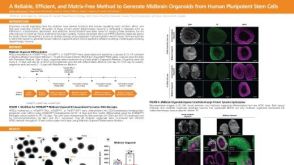 科学海报A Reliable, Efficient, and Matrix-Free Method to Generate Midbrain Organoids from Human Pluripotent Stem Cells




 沪公网安备31010102008431号