Gadkari R et al. (JUL 2014)
Regenerative medicine 9 4 453--465
Human embryonic stem cell derived-mesenchymal stem cells: an alternative mesenchymal stem cell source for regenerative medicine therapy.
AIM To enumerate and characterize mesenchymal stem cells (MSC) derived from human embryonic stem cells (hESC) for clinical application. MATERIALS & METHODS hESC were differentiated into hESC-MSC and characterized by the expression of surface markers using flow cytometry. hESC-MSC were evaluated with respect to growth kinetics,colony-forming potential,as well as osteogenic and adipogenic differentiation capacity. Immunosuppressive effects were assessed using peripheral blood mononuclear cell (PBMC) proliferation and cytotoxicity assays. RESULTS hESC-MSC showed similar morphology,and cell surface markers as adipose (AMSC) and bone marrow-derived MSC (BMSC). hESC-MSC exhibited a higher growth rate during early in vitro expansion and equivalent adipogenic and osteogenic differentiation and colony-forming potential as AMSC and BMSC. hESC-MSC demonstrated similar immunosuppressive effects as AMSC and BMSC. CONCLUSION hESC-MSC were comparable to BMSC and AMSC and hence can be used as an alternative source of MSC for clinical applications.
View Publication
产品号#:
产品名:
Nishimura K et al. (FEB 2011)
The Journal of biological chemistry 286 6 4760--71
Development of defective and persistent Sendai virus vector: a unique gene delivery/expression system ideal for cell reprogramming.
The ectopic expression of transcription factors can reprogram differentiated tissue cells into induced pluripotent stem cells. However,this is a slow and inefficient process,depending on the simultaneous delivery of multiple genes encoding essential reprogramming factors and on their sustained expression in target cells. Moreover,once cell reprogramming is accomplished,these exogenous reprogramming factors should be replaced with their endogenous counterparts for establishing autoregulated pluripotency. Complete and designed removal of the exogenous genes from the reprogrammed cells would be an ideal option for satisfying this latter requisite as well as for minimizing the risk of malignant cell transformation. However,no single gene delivery/expression system has ever been equipped with these contradictory characteristics. Here we report the development of a novel replication-defective and persistent Sendai virus (SeVdp) vector based on a noncytopathic variant virus,which fulfills all of these requirements for cell reprogramming. The SeVdp vector could accommodate up to four exogenous genes,deliver them efficiently into various mammalian cells (including primary tissue cells and human hematopoietic stem cells) and express them stably in the cytoplasm at a prefixed balance. Furthermore,interfering with viral transcription/replication using siRNA could erase the genomic RNA of SeVdp vector from the target cells quickly and thoroughly. A SeVdp vector installed with Oct4/Sox2/Klf4/c-Myc could reprogram mouse primary fibroblasts quite efficiently; ∼1% of the cells were reprogrammed to Nanog-positive induced pluripotent stem cells without chromosomal gene integration. Thus,this SeVdp vector has potential as a tool for advanced cell reprogramming and for stem cell research.
View Publication


 EasySep™小鼠TIL(CD45)正选试剂盒




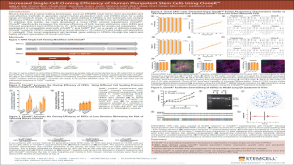 科学海报Increased Single-Cell Cloning Efficiency of Human Pluripotent Stem Cells Using CloneR™




 沪公网安备31010102008431号