Grimaldi JC et al. (JUN 1999)
Journal of Leukocyte Biology 65 6 846--53
Depletion of eosinophils in mice through the use of antibodies specific for C-C chemokine receptor 3 (CCR3).
We have generated rat monoclonal antibodies specific for the mouse eotaxin receptor,C-C chemokine receptor 3 (CCR3). Several anti-CCR3 mAbs proved to be useful for in vivo depletion of CCR3-expressing cells and immunofluorescent staining. In vivo CCR3 mAbs of the IgG2b isotype substantially depleted blood eosinophil levels in Nippostrongyus brasiliensis-infected mice. Repeated anti-CCR3 mAb treatment in these mice significantly reduced tissue eosinophilia in the lung tissue and bronchoalveolar lavage fluid. Flow cytometry revealed that mCCR3 was expressed on eosinophils but not on stem cells,dendritic cells,or cells from the thymus,lymph node,or spleen of normal mice. Unlike human Th2 cells,mouse Th2 cells did not express detectable levels of CCR3 nor did they give a measurable response to eotaxin. None of the mAbs were antagonists or agonists of CCR3 calcium mobilization. To our knowledge,the antibodies described here are the first mAbs reported to be specific for mouse eosinophils and to be readily applicable for the detection,isolation,and in vivo depletion of eosinophils.
View Publication
S. Jaleco et al. (Jul 2003)
The Journal of Immunology 171 61-68
Homeostasis of Naive and Memory CD4 + T Cells: IL-2 and IL-7 Differentially Regulate the Balance Between Proliferation and Fas-Mediated Apoptosis
Cytokines play a crucial role in the maintenance of polyclonal naive and memory T cell populations. It has previously been shown that ex vivo,the IL-7 cytokine induces the proliferation of naive recent thymic emigrants (RTE) isolated from umbilical cord blood but not mature adult-derived naive and memory human CD4(+) T cells. We find that the combination of IL-2 and IL-7 strongly promotes the proliferation of RTE,whereas adult CD4(+) T cells remain relatively unresponsive. Immunological activity is controlled by a balance between proliferation and apoptotic cell death. However,the relative contributions of IL-2 and IL-7 in regulating these processes in the absence of MHC/peptide signals are not known. Following exposure to either IL-2 or IL-7 alone,RTE,as well as mature naive and memory CD4(+) T cells,are rendered only minimally sensitive to Fas-mediated cell death. However,in the presence of the two cytokines,Fas engagement results in a high level of caspase-dependent apoptosis in both RTE as well as naive adult CD4(+) T cells. In contrast,equivalently treated memory CD4(+) T cells are significantly less sensitive to Fas-induced cell death. The increased susceptibility of RTE and naive CD4(+) T cells to Fas-induced apoptosis correlates with a significantly higher IL-2/IL-7-induced Fas expression on these T cell subsets than on memory CD4(+) T cells. Thus,IL-2 and IL-7 regulate homeostasis by modulating the equilibrium between proliferation and apoptotic cell death in RTE and mature naive and memory T cell subsets.
View Publication
产品号#:
15023
15063
产品名:
RosetteSep™人CD8+ T细胞富集抗体混合物
RosetteSep™人CD8+ T细胞富集抗体混合物
A. Reuter et al. ( 2015)
The Journal of Immunology 194 2696-2705
Criteria for Dendritic Cell Receptor Selection for Efficient Antibody-Targeted Vaccination
Ab-targeted vaccination involves targeting a receptor of choice expressed by dendritic cells (DCs) with Ag-coupled Abs. Currently,there is little consensus as to which criteria determine receptor selection to ensure superior Ag presentation and immunity. In this study,we investigated parameters of DC receptor internalization and determined how they impact Ag presentation outcomes. First,using mixed bone marrow chimeras,we established that Ag-targeted,but not nontargeted,DCs are responsible for Ag presentation in settings of Ab-targeted vaccination in vivo. Next,we analyzed parameters of DEC205 (CD205),Clec9A,CD11c,CD11b,and CD40 endocytosis and obtained quantitative measurements of internalization speed,surface turnover,and delivered Ag load. Exploiting these parameters in MHC class I (MHC I) and MHC class II (MHC II) Ag presentation assays,we showed that receptor expression level,proportion of surface turnover,or speed of receptor internalization did not impact MHC I or MHC II Ag presentation efficiency. Furthermore,the Ag load delivered to DCs did not correlate with the efficiency of MHC I or MHC II Ag presentation. In contrast,targeting Ag to CD8(+) or CD8(-) DCs enhanced MHC I or MHC II Ag presentation,respectively. Therefore,receptor expression levels,speed of internalization,and/or the amount of Ag delivered can be excluded as major determinants that dictate Ag presentation efficiency in setting of Ab-targeted vaccination.
View Publication


 EasySep™小鼠TIL(CD45)正选试剂盒




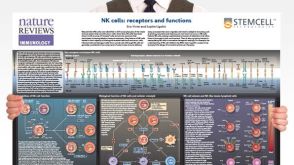 挂图Natural Killer Cells Overview of NK cell receptors, subsets, activation and function


 科学海报One-Step Enrichment of Leukocyte Subsets Directly in the Blood Collection Tube
 科学海报Immunomagnetic Isolation Method for Mouse CD4+CD25+ Regulatory T Cells

 沪公网安备31010102008431号