Hunger RE et al. (MAR 2004)
The Journal of clinical investigation 113 5 701--8
Langerhans cells utilize CD1a and langerin to efficiently present nonpeptide antigens to T cells.
Langerhans cells (LCs) constitute a subset of DCs that initiate immune responses in skin. Using leprosy as a model,we investigated whether expression of CD1a and langerin,an LC-specific C-type lectin,imparts a specific functional role to LCs. LC-like DCs and freshly isolated epidermal LCs presented nonpeptide antigens of Mycobacterium leprae to T cell clones derived from a leprosy patient in a CD1a-restricted and langerin-dependent manner. LC-like DCs were more efficient at CD1a-restricted antigen presentation than monocyte-derived DCs. LCs in leprosy lesions coexpress CD1a and langerin,placing LCs in position to efficiently present a subset of antigens to T cells as part of the host response to human infectious disease.
View Publication
Intact fetal cell isolation from maternal blood: improved isolation using a simple whole blood progenitor cell enrichment approach (RosetteSep).
Isolation and analysis of intact fetal cells in maternal blood is an attractive method of non-invasive prenatal diagnosis; however,detection levels are not optimal. The poor sensitivity and inconsistent recovery of fetal cells is compounded by small numbers of circulating fetal cells and loss of fetal cells during enrichment procedures. Optimizing selection criteria by utilizing less complicated methods for target cell enrichment is essential. We report here salutary results using a simple density-based depletion method that requires neither MACS (magnetic-activated cell sorting) nor flow cytometric separation for enrichment of progenitor cells. Maternal blood samples (n = 81) were obtained from women prior to invasive prenatal genetic diagnostic procedures and processed randomly within 24 h using one of two density-based enrichment methods. For progenitor cell enrichment,samples (n = 49) were labeled with a RosetteSep progenitor antibody cocktail to remove unwanted mature T-cells,B-cells,granulocytes,natural killer cells,neutrophils and myelomonocytic cells. For CD45-negative cell enrichment,samples (n = 14) were labeled with RosetteSep CD45 antibody to remove unwanted maternal white cells. The desired cellular fraction was collected and analyzed by either fluorescent in situ hybridization (FISH) or real-time PCR for the presence of intact fetal cells and to quantify Y-chromosome-specific DYS1 sequences,respectively. Overall,FISH and real-time PCR correct detection rates for the progenitor cell enrichment approach were 53% and 89% with 3% (1 out of 30 cases) and 0% false-positive detection,respectively. Fetal sequences were detected in the range from 0.067 to 1.167 genome equivalents per milliliter of blood. No fetal cells were detected using the CD45-negative enrichment method. Flow cytometric analysis of cord blood showed that a unique myeloid population of cells was recovered using RosetteSep trade mark progenitor enrichment compared with the CD45-negative enrichment method. Sensitivity of the RosetteSep progenitor enrichment approach for detection of fetal cells in this pilot study shows great promise with recovery of cells that are suitable for FISH and automated microscope scanning. This simple and rapid method may also allow expansion in culture and characterization of the fetal cell type(s) that circulate in maternal blood,hence,greatly improving reliability of non-invasive prenatal diagnosis.
View Publication
产品号#:
15122
15162
15026
15066
产品名:
RosetteSep™人CD45去除抗体混合物
RosetteSep™人CD45去除抗体混合物
RosetteSep™人造血祖细胞富集抗体混合物
RosetteSep™人造血祖细胞富集抗体混合物
Lim Y-P et al. (SEP 2003)
The Journal of infectious diseases 188 6 919--26
Correlation between mortality and the levels of inter-alpha inhibitors in the plasma of patients with severe sepsis.
Inter-alpha inhibitor protein (IalphaIp) is an endogenous serine protease inhibitor in human plasma. Circulating IalphaIp levels were lower in 51 patients with severe sepsis than in healthy volunteers. Mean levels were 688+/-295 mg/L in patients with severe sepsis who survived (n=32),486+/-193 mg/L in patients with sepsis who died (n=19),and 872+/-234 mg/L in control subjects (n=25). IalphaIp levels were lower in patients with shock versus those without (540+/-246 [n=33] vs. 746+/-290 [n=18] mg/L; P=.0102). IalphaIp levels were inversely correlated with 28-day mortality rates and Acute Physiology and Chronic Health Evaluation II scores and directly correlated with antithrombin III,protein C,and protein S levels. The administration of IalphaIp (30 mg/kg body weight intravenously) increased the 50% lethal dose in mice by 100-fold after an intravenous challenge of Escherichia coli. Thus,human IalphaIp may be a useful predictive marker and potential therapeutic agent in sepsis.
View Publication
产品号#:
03800
03801
03802
03803
03804
03805
03806
产品名:
ClonaCell™-HY杂交瘤试剂盒
ClonaCell™-HY培养基A
ClonaCell™-HY 培养基 B
ClonaCell™-HY 培养基 C
ClonaCell™-HY 培养基 D
ClonaCell™-HY 培养基 E
ClonaCell™-HY PEG
Heinonen KM et al. (MAY 2004)
Blood 103 9 3457--64
T-cell protein tyrosine phosphatase deletion results in progressive systemic inflammatory disease.
The deregulation of the immune response is a critical component in inflammatory disease. Recent in vitro data show that T-cell protein tyrosine phosphatase (TC-PTP) is a negative regulator of cytokine signaling. Furthermore,tc-ptp(-/-) mice display immune defects and die within 5 weeks of birth. We report here that tc-ptp(-/-) mice develop progressive systemic inflammatory disease as shown by chronic myocarditis,gastritis,nephritis,and sialadenitis as well as elevated serum interferon-gamma. The widespread mononuclear cellular infiltrates correlate with exaggerated interferon-gamma,tumor necrosis factor-alpha,interleukin-12,and nitric oxide production in vivo. Macrophages grown from tc-ptp(-/-) mice are inherently hypersensitive to lipopolysaccharide,which can also be detected in vivo as an increased susceptibility to endotoxic shock. These results identify T-cell protein tyrosine phosphatase as a key modulator of inflammatory signals and macrophage function.
View Publication
产品号#:
18752
18752RF
18753
18753RF
产品名:
Rouhi A et al. (MAR 2006)
Journal of immunology (Baltimore,Md. : 1950) 176 5 2991--9
Evidence for epigenetic maintenance of Ly49a monoallelic gene expression.
Although structurally unrelated,the human killer cell Ig-like (KIR) genes and the rodent lectin-like Ly49 genes serve similar functional roles in NK cells. Moreover,both gene families display variegated,monoallelic expression patterns established at the transcriptional level. DNA methylation has been shown to play an important role in maintenance of expression patterns of KIR genes,which have CpG island promoters. The potential role of DNA methylation in expression of Ly49 genes,which have CpG-poor promoters,is unknown. In this study,we show that hypomethylation of the region encompassing the Pro-2 promoter of Ly49a and Ly49c in primary C57BL/6 NK cells correlates with expression of the gene. Using C57BL/6 x BALB/c F1 hybrid mice,we demonstrate that the expressed allele of Ly49a is hypomethylated while the nonexpressed allele is heavily methylated,indicating a role for epigenetics in maintaining monoallelic Ly49 gene expression. Furthermore,the Ly49a Pro-2 region is heavily methylated in fetal NK cells but variably methylated in nonlymphoid tissues. Finally,in apparent contrast to the KIR genes,we show that DNA methylation and the histone acetylation state of the Pro-2 region are strictly linked with Ly49a expression status.
View Publication
产品号#:
18554
18554RF
18564
18564RF
产品名:
Bonaparte MI and Barker E (OCT 2004)
Blood 104 7 2087--94
Killing of human immunodeficiency virus-infected primary T-cell blasts by autologous natural killer cells is dependent on the ability of the virus to alter the expression of major histocompatibility complex class I molecules.
In the current study,we evaluated whether the capacity of HIV to modulate major histocompatibility complex (MHC) class I molecules has an impact on the ability of autologous natural killer (NK) cells to kill the HIV-infected cells. Analysis of HIV-infected T-cell blasts revealed that the decrease in MHC class I molecules on the infected cell surface was selective. HLA-A and -B were decreased on cells infected with HIV strains that could decrease MHC class I molecules,whereas HLA-C and -E remained on the surface. Blocking the interaction between HLA-C and -E and their corresponding inhibitory receptors increased NK cell killing of T-cell blasts infected with HIV strains that reduced MHC class I molecules. Moreover,we demonstrate that NK cells lacking HLA-C and -E inhibitory receptors kill T-cell blasts infected with HIV strains that decrease MHC class I molecules. In contrast,NK cells are incapable of destroying T-cell blasts infected with HIV strains that were unable to reduce MHC class I molecules. These findings suggest that NK cells lacking inhibitory receptors to HLA-C and -E kill HIV-infected CD4+ T cells,and they indicate that the capacity of NK cells to destroy HIV-infected cells depends on the ability of the virus to modulate MHC class I molecules.
View Publication
产品号#:
18055
18055RF
产品名:
Esplugues E et al. (MAY 2003)
The Journal of experimental medicine 197 9 1093--106
Enhanced antitumor immunity in mice deficient in CD69.
We investigated the in vivo role of CD69 by analyzing the susceptibility of CD69-/- mice to tumors. CD69-/- mice challenged with MHC class I- tumors (RMA-S and RM-1) showed greatly reduced tumor growth and prolonged survival compared with wild-type (WT) mice. The enhanced anti-tumor response was NK cell and T lymphocyte-mediated,and was due,at least in part,to an increase in local lymphocytes. Resistance of CD69-/- mice to MHC class I- tumor growth was also associated with increased production of the chemokine MCP-1,diminished TGF-beta production,and decreased lymphocyte apoptosis. Moreover,the in vivo blockade of TGF-beta in WT mice resulted in enhanced anti-tumor response. In addition,CD69 engagement induced NK and T cell production of TGF-beta,directly linking CD69 signaling to TGF-beta regulation. Furthermore,anti-CD69 antibody treatment in WT mice induced a specific down-regulation in CD69 expression that resulted in augmented anti-tumor response. These data unmask a novel role for CD69 as a negative regulator of anti-tumor responses and show the possibility of a novel approach for the therapy of tumors.
View Publication
产品号#:
09500
09600
09650
产品名:
BIT 9500血清替代物
StemSpan™ SFEM
StemSpan™ SFEM
Yu S et al. (FEB 2006)
The Journal of experimental medicine 203 2 349--58
B cell-deficient NOD.H-2h4 mice have CD4+CD25+ T regulatory cells that inhibit the development of spontaneous autoimmune thyroiditis.
Wild-type (WT) NOD.H-2h4 mice develop spontaneous autoimmune thyroiditis (SAT) when given 0.05% NaI in their drinking water,whereas B cell-deficient NOD.H-2h4 mice are SAT resistant. To test the hypothesis that resistance of B cell-deficient mice to SAT was due to the activity of regulatory CD4+CD25+ T (T reg) cells activated if autoantigen was initially presented on non-B cells,CD25+ T reg cells were transiently depleted in vivo using anti-CD25. B cell-deficient NOD.H-2h4 mice given three weekly injections of anti-CD25 developed SAT 8 wk after NaI water. Thyroid lesions were similar to those in WT mice except there were no B cells in thyroid infiltrates. WT and B cell-deficient mice had similar numbers of CD4+CD25+Foxp3+ cells. Mice with transgenic nitrophenyl-specific B cells unable to secrete immunoglobulin were also resistant to SAT,and transient depletion of T reg cells resulted in severe SAT with both T and B cells in thyroid infiltrates. T reg cells that inhibit SAT were eliminated by day 3 thymectomy,indicating they belong to the subset of naturally occurring T reg cells. However,T reg cell depletion did not increase SAT severity in WT mice,suggesting that T reg cells may be nonfunctional when effector T cells are activated; i.e.,by autoantigen-presenting B cells.
View Publication


 EasySep™小鼠TIL(CD45)正选试剂盒




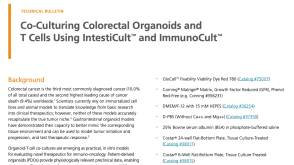 技术公告Co-Culturing Colorectal Organoids and T Cells using IntestiCult™ and ImmunoCult™


 沪公网安备31010102008431号