Ratajczak J et al. (AUG 2011)
Leukemia 25 8 1278--85
Hematopoietic differentiation of umbilical cord blood-derived very small embryonic/epiblast-like stem cells.
A population of CD133(+)Lin(-)CD45(-) very small embryonic/epiblast-like stem cells (VSELs) has been purified by multiparameter sorting from umbilical cord blood (UCB). To speed up isolation of these cells,we employed anti-CD133-conjugated paramagnetic beads followed by staining with Aldefluor to detect aldehyde dehydrogenase (ALDH) activity; we subsequently sorted CD45(-)/GlyA(-)/CD133(+)/ALDH(high) and CD45(-)/GlyA(-)/CD133(+)/ALDH(low) cells,which are enriched for VSELs,and CD45(+)/GlyA /CD133(+)/ALDH(high) and CD45(+)/GlyA(-)/CD133(+)/ALDH(low) cells,which are enriched for hematopoietic stem/progenitor cells (HSPCs). Although freshly isolated CD45(-) VSELs did not grow hematopoietic colonies,the same cells,when activated/expanded over OP9 stromal support,acquired hematopoietic potential and grew colonies composed of CD45(+) hematopoietic cells in methylcellulose cultures. We also observed that CD45(-)/GlyA(-)/CD133(+)/ALDH(high) VSELs grew colonies earlier than CD45(-)/GlyA(-)/CD133(+)/ALDH(low) VSELs,which suggests that the latter cells need more time to acquire hematopoietic commitment. In support of this possibility,real-time polymerase chain reaction analysis confirmed that,whereas freshly isolated CD45(-)/GlyA(-)/CD133(+)/ALDH(high) VSELs express more hematopoietic transcripts (for example,c-myb),CD45(-)/GlyA(-)/CD133(+)/ALDH(low) VSELs exhibit higher levels of pluripotent stem cell markers (for example,Oct-4). More importantly,hematopoietic cells derived from VSELs that were co-cultured over OP9 support were able to establish human lympho-hematopoietic chimerism in lethally irradiated non-obese diabetic/severe combined immunodeficiency mice 4-6 weeks after transplantation. Overall,our data suggest that UCB-VSELs correspond to the most primitive population of HSPCs in UCB.
View Publication
Adherent cells generated during long-term culture of human umbilical cord blood CD34+ cells have characteristics of endothelial cells and beneficial effect on cord blood ex vivo expansion.
Hematopoiesis depends on the association of hematopoietic stem cells with stromal cells that constitute the hematopoietic microenvironment. The in vitro development of the endothelial cell from umbilical cord blood (UCB) is not well established and has met very limited success. In this study,UCB CD34(+) cells were cultured for 5 weeks in a stroma-free liquid culture system using thrombopoietin,flt3 ligand,and granulocyte-colony stimulating factor. By week 4-5,we found that firmly adherent fibroblast-like cells were established. These cells showed characteristics of endothelial cells expressing von Willebrand factor,human vascular cell adhesion molecule-1,human intracellular adhesion molecule-1,human CD31,E-selectin,and human macrophage. Furthermore,when comparing an ex vivo system without an established endothelial monolayer to an ex vivo system with an established endothelial monolayer,better expansion of total nucleated cells,CD34(+) cells,and colony-forming units (CFUs)-granulocyte-macrophage and CFUs-granulocyte-erythroid-megakaryocyte-macrophage were found during culture. This phenomenon was in part due to the fact that a significant reduction of apoptotic fractions was found in the CD34(+) cells,which were cultured on the adherent monolayer for up to 5 weeks. To gather quantitative data on the number of endothelial cells derived from a given number of CD34 cells,we performed limiting dilution assay by using Poisson distribution: the number of tested cells (linear scale) producing a 37% negative culture (logarithmic scale) is the number of cells containing one endothelial cell. By this method,one endothelial cell may be found from 314 CD34(+) cells after 5 weeks of culture. These results suggest that the UCB CD34(+) cell fraction contains endothelial cell precursors,establishing the hematopoietic microenvironment and providing the beneficial effects through downregulating apoptosis on UCB expansion protocols. These observations may provide insight for future cellular therapy or graft engineering.
View Publication
Eichler H et al. (JAN 2003)
Stem cells (Dayton,Ohio) 21 2 208--16
Engraftment capacity of umbilical cord blood cells processed by either whole blood preparation or filtration.
Umbilical cord blood (UCB) preparation needs to be optimized in order to develop more simplified procedures for volume reduction,as well as to reduce the amount of contaminating cells within the final stem cell transplant. We evaluated a novel filter device (StemQuick((TM))E) and compared it with our routine buffy coat (BC) preparation procedure for the enrichment of hematopoietic progenitor cells (HPCs). Two groups of single or pooled UCB units were filtered (each n = 6),or equally divided in two halves and processed by filtration and BC preparation in parallel (n = 10). The engraftment capacity of UCB samples processed by whole blood (WB) preparation was compared with paired samples processed by filtration in the nonobese diabetic/severe combined immunodeficient (NOD/SCID) mouse animal model. Filtration of UCB units in the two groups with a mean volume of 87.8 and 120.7 ml,respectively,and nucleated cell (NC) content of 9.7 and 23.8 x 10(8) resulted in a sufficient mean cell recovery for mononucleated cells ([MNCs] 74.2%-77.5%),CD34(+) cells (76.3%-79.0%),and colony-forming cells (64.1%-86.3%). Moreover,we detected a relevant depletion of the transplants for RBCs (89.2%-90.0%) and platelets ([PLTs] 77.5%-86.1%). In contrast,the mean depletion rate using BC processing proved to be significantly different for PLTs (10%,p = 0.03) and RBCs (39.6%,p textless 0.01). The NC composition showed a highly significant increase in MNCs and a decrease in granulocytes after filtration (p textless 0.01),compared with a less significant MNC increase in the BC group (p textless 0.05). For mice transplanted with WB-derived progenitors,we observed a mean of 15.3% +/- 15.5% of human CD45(+) cells within the BM compared with 19.9% +/- 16.8% for mice transplanted with filter samples (p = 0.03). The mean percentage of human CD34(+) cells was 4.2% +/- 3.1% for WB samples and 4.5% +/- 3.2% for filter samples (p = 0.68). As the data of NOD/SCID mice transplantation demonstrated a significant engraftment capacity of HPCs processed by filtration,no negative effect on the engraftment potential of filtered UCB cells versus non-volume-reduced cells from WB transplants was found. The StemQuick((TM))E filter devices proved to be a useful tool for Good Manufacturing Practices conform enrichment of HPCs and MNCs out of UCB. Filtration enables a quick and standardized preparation of a volume-reduced UCB transplant,including a partial depletion of granulocytes,RBCs,and PLTs without the need for centrifugation. Therefore,it seems very probable that filter-processed UCB transplants will also result in sufficient hematopoietic reconstitution in humans.
View Publication


 EasySep™小鼠TIL(CD45)正选试剂盒




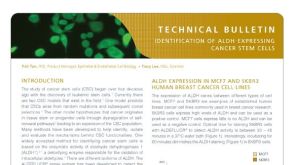 技术公告Identification of ALDH-Expressing Cancer Stem Cells Using ALDEFLUOR™


 沪公网安备31010102008431号