Okabe S et al. (SEP 1996)
Mechanisms of development 59 1 89--102
Development of neuronal precursor cells and functional postmitotic neurons from embryonic stem cells in vitro.
To understand the mechanism of the sequential restriction of multipotency of stem cells during development,we have established culture conditions that allow the differentiation of neuroepithelial precursor cells from embryonic stem (ES) cells. A highly enriched population of neuroepithelial precursor cells derived from ES cells proliferates in the presence of basic fibroblast growth factor (bFGF). These cells differentiate into both neurons and glia following withdrawal of bFGF. By further differentiating the cells in serum-containing medium,the neurons express a wide variety of neuron-specific genes and generate both excitatory and inhibitory synaptic connections. The expression pattern of position-specific neural markers suggests the presence of a variety of central nervous system (CNS) neuronal cell types. These findings indicate that neuronal precursor cells can be isolated from ES cells and that these cells can efficiently differentiate into functional post-mitotic neurons of diverse CNS structures.
View Publication
产品号#:
06902
06952
00321
00322
00323
00324
00325
产品名:
Bain G et al. (APR 1995)
Developmental biology 168 2 342--57
Embryonic stem cells express neuronal properties in vitro.
Mouse embryonic stem (ES) cells cultured as aggregates and exposed to retinoic acid are induced to express multiple phenotypes normally associated with neurons. A large percentage of treated aggregates produce a rich neuritic outgrowth. Dissociating the induced aggregates with trypsin and plating the cells as a monolayer results in cultures in which a sizable percentage of the cells have a neuronal appearance. These neuron-like cells express class III beta-tubulin and the neurofilament M subunit. Induced cultures express transcripts for neural-associated genes including the neurofilament L subunit,glutamate receptor subunits,the transcription factor Brn-3,and GFAP. Levels of neurofilament L and GAD67 and GAD65 transcripts rise dramatically upon induction. Physiological studies show that the neuron-like cells generate action potentials and express TTX-sensitive sodium channels,as well as voltage-gated potassium channels and calcium channels. We conclude that a complex system of neuronal gene expression can be activated in cultured ES cells. This system should be favorable for investigating some of the mechanisms that regulate neuronal differentiation.
View Publication
产品号#:
06902
06952
00321
00322
00323
00324
00325
产品名:
Zhou J et al. (AUG 2016)
Neurochemical Research 41 8 2065--2074
Generation of Human Embryonic Stem Cell Line Expressing zsGreen in Cholinergic Neurons Using CRISPR/Cas9 System
Lineage specific human embryonic stem cell (hESC) reporter cell line is a versatile tool for biological studies on real time monitoring of differentiation,physiological and biochemical features of special cell types and pathological mechanism of disease. Here we report the generation of ChAT-zsGreen reporter hESC line that express zsGreen under the control of the choline acetyltransferase (ChAT) promoter using CRISPR (Clustered Regularly Interspersed Short Palindromic Repeats)/Cas9 system. We show that the ChAT-zsGreen hESC reporter cell lines retain the features of undifferentiated hESC. After cholinergic neuronal differentiation,cholinergic neurons were clearly labeled with green fluorescence protein (zsGreen). The ChAT-zsGreen reporter hESC lines are invaluable not only for the monitoring cholinergic neuronal differentiation but also for study physiological and biochemical hallmarks of cholinergic neurons.
View Publication


 EasySep™小鼠TIL(CD45)正选试剂盒




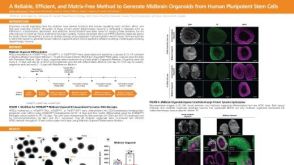 科学海报A Reliable, Efficient, and Matrix-Free Method to Generate Midbrain Organoids from Human Pluripotent Stem Cells
 科学海报Rapid, High-Efficiency Differentiation of Motor Neurons from Human Pluripotent Stem Cells
 专家访谈Scott Allen, PhD Seeking Metabolic Therapies for an Incurable Neurodegenerative Disease


 沪公网安备31010102008431号