Human CD68 promoter GFP transgenic mice allow analysis of monocyte to macrophage differentiation in vivo.
The recruitment of monocytes and their differentiation into macrophages at sites of inflammation are key events in determining the outcome of the inflammatory response and initiating the return to tissue homeostasis. To study monocyte trafficking and macrophage differentiation in vivo,we have generated a novel transgenic reporter mouse expressing a green fluorescent protein (GFP) under the control of the human CD68 promoter. CD68-GFP mice express high levels of GFP in both monocyte and embryo-derived tissue resident macrophages in adult animals. The human CD68 promoter drives GFP expression in all CD115(+) monocytes of adult blood,spleen,and bone marrow; we took advantage of this to directly compare the trafficking of bone marrow-derived CD68-GFP monocytes to that of CX3CR1(GFP) monocytes in vivo using a sterile zymosan peritonitis model. Unlike CX3CR1(GFP) monocytes,which downregulate GFP expression on differentiation into macrophages in this model,CD68-GFP monocytes retain high-level GFP expression for 72 hours after differentiation into macrophages,allowing continued cell tracking during resolution of inflammation. In summary,this novel CD68-GFP transgenic reporter mouse line represents a powerful resource for analyzing monocyte mobilization and monocyte trafficking as well as studying the fate of recruited monocytes in models of acute and chronic inflammation.
View Publication
Tyagi RK et al. (FEB 2017)
Scientific reports 7 41083
Human IDO-competent, long-lived immunoregulatory dendritic cells induced by intracellular pathogen, and their fate in humanized mice.
Targeting of myeloid-dendritic cell receptor DC-SIGN by numerous chronic infectious agents,including Porphyromonas gingivalis,is shown to drive-differentiation of monocytes into dysfunctional mDCs. These mDCs exhibit alterations of their fine-tuned homeostatic function and contribute to dysregulated immune-responses. Here,we utilize P. gingivalis mutant strains to show that pathogen-differentiated mDCs from primary human-monocytes display anti-apoptotic profile,exhibited by elevated phosphorylated-Foxo1,phosphorylated-Akt1,and decreased Bim-expression. This results in an overall inhibition of DC-apoptosis. Direct stimulation of complex component CD40 on DCs leads to activation of Akt1,suggesting CD40 involvement in anti-apoptotic effects observed. Further,these DCs drove dampened CD8(+) T-cell and Th1/Th17 effector-responses while inducing CD25(+)Foxp3(+)CD127(-) Tregs. In vitro Treg induction was mediated by DC expression of indoleamine 2,3-dioxygenase,and was confirmed in IDO-KO mouse model. Pathogen-infected &CMFDA-labeled MoDCs long-lasting survival was confirmed in a huMoDC reconstituted humanized mice. In conclusion,our data implicate PDDCs as an important target for resolution of chronic infection.
View Publication
Human Immune Cytokines
Infographic of key cytokines for expansion, differentiation and characterization of major immune cell types
Gilbert C et al. (JUL 2007)
Journal of virology 81 14 7672--82
Human immunodeficiency virus type 1 replication in dendritic cell-T-cell cocultures is increased upon incorporation of host LFA-1 due to higher levels of virus production in immature dendritic cells.
Dendritic cells (DCs) act as a portal for invasion by human immunodeficiency virus type-1 (HIV-1). Here,we investigated whether virion-incorporated host cell membrane proteins can affect virus replication in DC-T-cell cocultures. Using isogenic viruses either devoid of or bearing host-derived leukocyte function-associated antigen 1 (LFA-1),we showed that HIV-1 production is augmented when LFA-1-bearing virions are used compared to that for viral entities lacking this adhesion molecule. This phenomenon was observed in immature monocyte-derived DCs (IM-MDDCs) only and not in DCs displaying a mature phenotype. The increase is not due to higher virus production in responder CD4(+) T cells but rather is linked with a more important productive infection of IM-MDDCs. We provided evidence that virus-associated host LFA-1 molecules do not affect a late event in the HIV-1 life cycle but rather exert an effect on an early step in virus replication. We demonstrated that the enhancement of productive infection of IM-MDDCs that is conferred by virus-anchored host LFA-1 involves the protein kinase A (PKA) and PKC signal transduction pathways. The biological significance of this phenomenon was established by performing experiments with virus stocks produced in primary human cells and anti-LFA-1 antibodies. Together,our results indicate that the association between some virus-bound host proteins and their natural cognate ligands can modulate de novo HIV-1 production by IM-MDDCs. Therefore,the additional interactions between virus-bound host cell membrane constituents and counter receptors on the surfaces of DCs can influence HIV-1 replication in IM-MDDC-T-cell cocultures.
View Publication
Newman SL et al. (FEB 2006)
Journal of immunology (Baltimore,Md. : 1950) 176 3 1806--13
Human macrophages do not require phagosome acidification to mediate fungistatic/fungicidal activity against Histoplasma capsulatum.
Histoplasma capsulatum (Hc) is a facultative intracellular fungus that modulates the intraphagosomal environment to survive within macrophages (Mphi). In the present study,we sought to quantify the intraphagosomal pH under conditions in which Hc yeasts replicated or were killed. Human Mphi that had ingested both viable and heat-killed or fixed yeasts maintained an intraphagosomal pH of approximately 6.4-6.5 over a period of several hours. These results were obtained using a fluorescent ratio technique and by electron microscopy using the 3-(2,4-dinitroanilo)-3'-amino-N-methyldipropylamine reagent. Mphi that had ingested Saccharomyces cerevisae,a nonpathogenic yeast that is rapidly killed and degraded by Mphi,also maintained an intraphagosomal pH of approximately 6.5 over a period of several hours. Stimulation of human Mphi fungicidal activity by coculture with chloroquine or by adherence to type 1 collagen matrices was not reversed by bafilomycin,an inhibitor of the vacuolar ATPase. Human Mphi cultured in the presence of bafilomycin also completely degraded heat-killed Hc yeasts,whereas mouse peritoneal Mphi digestion of yeasts was completely reversed in the presence of bafilomycin. However,bafilomycin did not inhibit mouse Mphi fungistatic activity induced by IFN-gamma. Thus,human Mphi do not require phagosomal acidification to kill and degrade Hc yeasts,whereas mouse Mphi do require acidification for fungicidal but not fungistatic activity.
View Publication
Xu X et al. ( 2014)
The Journal of Immunology 193 8 4125--4136
IFN-Stimulated Gene LY6E in Monocytes Regulates the CD14/TLR4 Pathway but Inadequately Restrains the Hyperactivation of Monocytes during Chronic HIV-1 Infection
Owing to ongoing recognition of pathogen-associated molecular patterns,immune activation and upregulation of IFN-stimulated genes (ISGs) are sustained in the chronically infected host. Albeit most ISGs are important effectors for containing viral replication,some might exert compensatory immune suppression to limit pathological dysfunctions,although the mechanisms are not fully understood. In this study,we report that the ISG lymphocyte Ag 6 complex,locus E (LY6E) is a negative immune regulator of monocytes. LY6E in monocytes negatively modulated CD14 expression and subsequently dampened the responsiveness to LPS stimulation in vitro. In the setting of chronic HIV infection,the upregulation of LY6E was correlated with reduced CD14 level on monocytes; however,the immunosuppressive effect of LY6E was not adequate to remedy the hyperresponsiveness of activated monocytes. Taken together,the regulatory LY6E pathway in monocytes represents one of negative feedback mechanisms that counterbalance monocyte activation,which might be caused by LPS translocation through the compromised gastrointestinal tract during persistent HIV-1 infection and may serve as a potential target for immune intervention.
View Publication
C. Petes et al. (SEP 2018)
Scientific Reports 8 1 13704
IL-27 amplifies cytokine responses to Gram-negative bacterial products and Salmonella typhimurium infection.
Cytokine responses from monocytes and macrophages exposed to bacteria are of particular importance in innate immunity. Focusing on the impact of the immunoregulatory cytokine interleukin (IL)-27 on control of innate immune system responses,we examined human immune responses to bacterial products and bacterial infection by E. coli and S. typhimurium. Since the effect of IL-27 treatment in human myeloid cells infected with bacteria is understudied,we treated human monocytes and macrophages with IL-27 and either LPS,flagellin,or bacteria,to investigate the effect on inflammatory signaling and cytokine responses. We determined that simultaneous stimulation with IL-27 and LPS derived from E. coli or S. typhimurium resulted in enhanced IL-12p40,TNF-$\alpha$,and IL-6 expression compared to that by LPS alone. To elucidate if IL-27 manipulated the cellular response to infection with bacteria,we infected IL-27 treated human macrophages with S. typhimurium. While IL-27 did not affect susceptibility to S. typhimurium infection or S. typhimurium-induced cell death,IL-27 significantly enhanced proinflammatory cytokine production in infected cells. Taken together,we highlight a role for IL-27 in modulating innate immune responses to bacterial infection.
View Publication
Megjugorac NJ et al. (MAY 2010)
Blood 115 21 4185--90
IL-4 enhances IFN-lambda1 (IL-29) production by plasmacytoid DCs via monocyte secretion of IL-1Ra.
The type-III interferon (IFN) family is composed of 3 molecules in humans: IFN-lambda1 (interleukin-29 [IL-29]),IFN-lambda2 (IL-28A),and IFN-lambda3 (IL-28B),each of which signals through the same receptor complex. Plasmacytoid dendritic cells (pDCs) are major IFN-lambda producers among peripheral lymphocytes. Recently,it has been shown that IFN-lambda1 exerts a powerful inhibitory effect over the T-helper 2 (Th2) response by antagonizing the effect of IL-4 on CD4(+) T cells and inhibiting the production of Th2-associated cytokines. Here,we asked whether Th2 cytokines exert reciprocal control over IFN-lambda production. IL-4 treatment during stimulation of human peripheral lymphocytes significantly elevated IFN-lambda1 transcription and secretion. However,pDCs were not directly responsive to IL-4. Using depletion and reconstitution experiments,we showed that IL-4-responsive monocytes are an intermediary cell,responding to IL-4 by elevating their secretion of IL-1 receptor antagonist (IL-Ra); this IL-1Ra acts on pDCs to elevate their IFN-lambda1 output. Thus,our experiments revealed a novel mechanism for regulation of both IFN-lambda1 production and pDC function,and suggests an expanded immunomodulatory role for Th2-associated cytokines.
View Publication
Bhattacharyya S et al. (AUG 2004)
Blood 104 4 1100--9
Immunoregulation of dendritic cells by IL-10 is mediated through suppression of the PI3K/Akt pathway and of IkappaB kinase activity.
Interleukin-10 (IL-10) has potent immunoregulatory effects on the maturation and the antigen-presenting cell (APC) function of dendritic cells (DCs). The molecular basis underlying these effects in DCs,however,is ill defined. It is well established that the transcription factor NF-kappaB is a key regulator of DC development,maturation,and APC function. This study was initiated to determine the effects of IL-10 on the NF-kappaB signaling pathway in immature DCs. IL-10 pretreatment of myeloid DCs cultured from bone marrow resulted in reduced DNA binding and nuclear translocation of NF-kappaB after anti-CD40 antibody or lipopolysaccharide (LPS) stimulation. Furthermore,inhibited NF-kappaB activation was characterized by reduced degradation,phosphorylation,or both of IkappaBalpha and IkappaBepsilon but not IkappaBbeta and by reduced phosphorylation of Ser536,located in the trans-activation domain of p65. Notably,IL-10-mediated inhibition of NF-kappaB coincided with suppressed IkappaB kinase (IKK) activity in vitro. Furthermore,IL-10 blocked inducible Akt phosphorylation,and inhibitors of phosphatidylinositol 3-kinase (PI3K) effectively suppressed the activation of Akt,IKK,and NF-kappaB. These findings demonstrate that IL-10 targets IKK activation in immature DCs and that suppressing the PI3K pathway in part mediates blockade of the pathway.
View Publication
MacNamara KC et al. (JAN 2011)
Journal of immunology (Baltimore,Md. : 1950) 186 2 1032--43
Infection-induced myelopoiesis during intracellular bacterial infection is critically dependent upon IFN-γ signaling.
Although microbial infections can alter steady-state hematopoiesis,the mechanisms that drive such changes are not well understood. We addressed a role for IFN-γ signaling in infection-induced bone marrow suppression and anemia in a murine model of human monocytic ehrlichiosis,an emerging tick-borne disease. Within the bone marrow of Ehrlichia muris-infected C57BL/6 mice,we observed a reduction in myeloid progenitor cells,as defined both phenotypically and functionally. Infected mice exhibited a concomitant increase in developing myeloid cells within the bone marrow,an increase in the frequency of circulating monocytes,and an increase in splenic myeloid cells. The infection-induced changes in progenitor cell phenotype were critically dependent on IFN-γ,but not IFN-α,signaling. In mice deficient in the IFN-γ signaling pathway,we observed an increase in myeloid progenitor cells and CDllb(lo)Gr1(lo) promyelocytic cells within the bone marrow,as well as reduced frequencies of mature granulocytes and monocytes. Furthermore,E. muris-infected IFN-γR-deficient mice did not exhibit anemia or an increase in circulating monocytes,and they succumbed to infection. Gene transcription studies revealed that IFN-γR-deficient CDllb(lo)Gr1(lo) promyelocytes from E. muris-infected mice exhibited significantly reduced expression of irf-1 and irf-8,both key transcription factors that regulate the differentiation of granulocytes and monocytes. Finally,using mixed bone marrow chimeric mice,we show that IFN-γ-dependent infection-induced myelopoiesis occurs via the direct effect of the cytokine on developing myeloid cells. We propose that,in addition to its many other known roles,IFN-γ acts to control infection by directly promoting the differentiation of myeloid cells that contribute to host defense.
View Publication


 EasySep™小鼠TIL(CD45)正选试剂盒




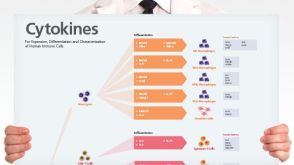 挂图Human Immune Cytokines Infographic of key cytokines for expansion, differentiation and characterization of major immune cell types

 沪公网安备31010102008431号