Mou H et al. (APR 2012)
Cell stem cell 10 4 385--397
Generation of multipotent lung and airway progenitors from mouse ESCs and patient-specific cystic fibrosis iPSCs
Deriving lung progenitors from patient-specific pluripotent cells is a key step in producing differentiated lung epithelium for disease modeling and transplantation. By mimicking the signaling events that occur during mouse lung development,we generated murine lung progenitors in a series of discrete steps. Definitive endoderm derived from mouse embryonic stem cells (ESCs) was converted into foregut endoderm,then into replicating Nkx2.1+ lung endoderm,and finally into multipotent embryonic lung progenitor and airway progenitor cells. We demonstrated that precisely-timed BMP,FGF,and WNT signaling are required for NKX2.1 induction. Mouse ESC-derived Nkx2.1+ progenitor cells formed respiratory epithelium (tracheospheres) when transplanted subcutaneously into mice. We then adapted this strategy to produce disease-specific lung progenitor cells from human Cystic Fibrosis induced pluripotent stem cells (iPSCs),creating a platform for dissecting human lung disease. These disease-specific human lung progenitors formed respiratory epithelium when subcutaneously engrafted into immunodeficient mice.
View Publication
产品号#:
05850
05857
05870
05875
85850
85857
85870
85875
产品名:
mTeSR™1
mTeSR™1
Shimada H et al. (JAN 2012)
Biochemical and Biophysical Research Communications 417 2 659--664
Accelerated generation of human induced pluripotent stem cells with retroviral transduction and chemical inhibitors under physiological hypoxia
Induced pluripotent stem (iPS) cells are generated from somatic cells by the forced expression of a defined set of pluripotency-associated transcription factors. Human iPS cells can be propagated indefinitely,while maintaining the capacity to differentiate into all cell types in the body except for extra-embryonic tissues. This technology not only represents a new way to use individual-specific stem cells for regenerative medicine but also constitutes a novel method to obtain large amounts of disease-specific cells for biomedical research. Despite their great potential,the long reprogramming process (up to 1. month) remains one of the most significant challenges facing standard virus-mediated methodology. In this study,we report the accelerated generation of human iPS cells from adipose-derived stem (ADS) cells,using a new combination of chemical inhibitors under a setting of physiological hypoxia in conjunction with retroviral transduction of Oct4,Sox2,Klf4,and L-Myc. Under optimized conditions,we observed human embryonic stem (ES)-like cells as early as 6. days after the initial retroviral transduction. This was followed by the emergence of fully reprogrammed cells bearing Tra-1-81-positive and DsRed transgene-silencing properties on day 10. The resulting cell lines resembled human ES cells in many respects including proliferation rate,morphology,pluripotency-associated markers,global gene expression patterns,genome-wide DNA methylation states,and the ability to differentiate into all three of the germ layers,both in vitro and in vivo. Our method,when combined with chemical inhibitors under conditions of physiological hypoxia,offers a powerful tool for rapidly generating bona fide human iPS cells and facilitates the application of iPS cell technology to biomedical research. textcopyright 2011 Elsevier Inc.
View Publication


 EasySep™小鼠TIL(CD45)正选试剂盒




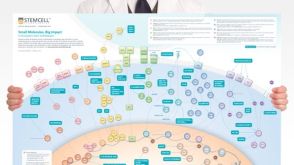 挂图Small Molecules, Big Impact in Pluripotent Stem Cell Research Overview of signaling pathways and small molecules in pluripotent stem cell research
 沪公网安备31010102008431号