Lambert AW et al. (JAN 2016)
Molecular cancer research : MCR 14 1 103--113
Tumor Cell-Derived Periostin Regulates Cytokines That Maintain Breast Cancer Stem Cells.
UNLABELLED Basal-like breast cancer (BLBC) is an aggressive subtype of breast cancer which is often enriched with cancer stem cells (CSC),but the underlying molecular basis for this connection remains elusive. We hypothesized that BLBC cells are able to establish a niche permissive to the maintenance of CSCs and found that tumor cell-derived periostin (POSTN),a component of the extracellular matrix,as well as a corresponding cognate receptor,integrin $$(v)$$(3),are highly expressed in a subset of BLBC cell lines as well as in CSC-enriched populations. Furthermore,we demonstrated that an intact periostin-integrin $$3 signaling axis is required for the maintenance of breast CSCs. POSTN activates the ERK signaling pathway and regulates NF-$$B-mediated transcription of key cytokines,namely IL6 and IL8,which in turn control downstream activation of STAT3. In summary,these findings suggest that BLBC cells have an innate ability to establish a microenvironmental niche supportive of CSCs. IMPLICATIONS The findings reported here indicate that POSTN produced by CSCs acts to reinforce the stem cell state through the activation of integrin receptors and the production of key cytokines.
View Publication
产品号#:
05620
产品名:
MammoCult™ 人源培养基套装
Brooks SE et al. ( 2015)
PloS one 10 10 e0140483
Application of the pMHC Array to Characterise Tumour Antigen Specific T Cell Populations in Leukaemia Patients at Disease Diagnosis.
Immunotherapy treatments for cancer are becoming increasingly successful,however to further improve our understanding of the T-cell recognition involved in effective responses and to encourage moves towards the development of personalised treatments for leukaemia immunotherapy,precise antigenic targets in individual patients have been identified. Cellular arrays using peptide-MHC (pMHC) tetramers allow the simultaneous detection of different antigen specific T-cell populations naturally circulating in patients and normal donors. We have developed the pMHC array to detect CD8+ T-cell populations in leukaemia patients that recognise epitopes within viral antigens (cytomegalovirus (CMV) and influenza (Flu)) and leukaemia antigens (including Per Arnt Sim domain 1 (PASD1),MelanA,Wilms' Tumour (WT1) and tyrosinase). We show that the pMHC array is at least as sensitive as flow cytometry and has the potential to rapidly identify more than 40 specific T-cell populations in a small sample of T-cells (0.8-1.4 x 10(6)). Fourteen of the twenty-six acute myeloid leukaemia (AML) patients analysed had T cells that recognised tumour antigen epitopes,and eight of these recognised PASD1 epitopes. Other tumour epitopes recognised were MelanA (n = 3),tyrosinase (n = 3) and WT1(126-134) (n = 1). One of the seven acute lymphocytic leukaemia (ALL) patients analysed had T cells that recognised the MUC1(950-958) epitope. In the future the pMHC array may be used provide point of care T-cell analyses,predict patient response to conventional therapy and direct personalised immunotherapy for patients.
View Publication
产品号#:
19053
19053RF
产品名:
EasySep™人CD8+ T细胞富集试剂盒
RoboSep™ 人CD8+ T细胞富集试剂盒含滤芯吸头
Lelaidier M et al. (OCT 2015)
Oncotarget 6 30 29440--55
TRAIL-mediated killing of acute lymphoblastic leukemia by plasmacytoid dendritic cell-activated natural killer cells.
Acute lymphoblastic leukemia (ALL) still frequently recurs after hematopoietic stem cell transplantation (HSCT),underscoring the need to improve the graft-versus-leukemia (GvL) effect. Natural killer (NK) cells reconstitute in the first months following HSCT when leukemia burden is at its lowest,but ALL cells have been shown to be resistant to NK cell-mediated killing. We show here that this resistance is overcome by NK cell stimulation with TLR-9-activated plasmacytoid dendritic cells (pDCs). NK cell priming with activated pDCs resulted in TRAIL and CD69 up-regulation on NK cells and IFN-γ production. NK cell activation was dependent on IFN-α produced by pDCs,but was not reproduced by IFN-α alone. ALL killing was further enhanced by inhibition of KIR engagement. We showed that ALL lysis was mainly mediated by TRAIL engagement,while the release of cytolytic granules was involved when ALL expressed NK cell activating receptor ligands. Finally,adoptive transfers of activated-pDCs in ALL-bearing humanized mice delayed the leukemia onset and cure 30% of mice. Our data therefore demonstrate that TLR-9 activated pDCs are a powerful tool to overcome ALL resistance to NK cell-mediated killing and to reinforce the GvL effect of HSCT. These results open new therapeutic avenues to prevent relapse in children with ALL.
View Publication
产品号#:
19062
19062RF
19055
19055RF
产品名:
EasySep™人浆细胞样DC富集试剂盒
RoboSep™ 人浆细胞样DC富集试剂盒含滤芯吸头
EasySep™人NK细胞富集试剂盒
RoboSep™ 人NK细胞富集试剂盒含滤芯吸头
Nijhof IS et al. (OCT 2015)
Leukemia 29 10 2039--49
Upregulation of CD38 expression on multiple myeloma cells by all-trans retinoic acid improves the efficacy of daratumumab.
Daratumumab is an anti-CD38 monoclonal antibody with lytic activity against multiple myeloma (MM) cells,including ADCC (antibody-dependent cellular cytotoxicity) and CDC (complement-dependent cytotoxicity). Owing to a marked heterogeneity of response to daratumumab therapy in MM,we investigated determinants of the sensitivity of MM cells toward daratumumab-mediated ADCC and CDC. In bone marrow samples from 144 MM patients,we observed no difference in daratumumab-mediated lysis between newly diagnosed or relapsed/refractory patients. However,we discovered,next to an expected effect of effector (natural killer cells/monocytes) to target (MM cells) ratio on ADCC,a significant association between CD38 expression and daratumumab-mediated ADCC (127 patients),as well as CDC (56 patients). Similarly,experiments with isogenic MM cell lines expressing different levels of CD38 revealed that the level of CD38 expression is an important determinant of daratumumab-mediated ADCC and CDC. Importantly,all-trans retinoic acid (ATRA) increased CD38 expression levels but also reduced expression of the complement-inhibitory proteins CD55 and CD59 in both cell lines and primary MM samples. This resulted in a significant enhancement of the activity of daratumumab in vitro and in a humanized MM mouse model as well. Our results provide the preclinical rationale for further evaluation of daratumumab combined with ATRA in MM patients.
View Publication
产品号#:
15621
15661
产品名:
RosetteSep™人CD3去除抗体混合物
RosetteSep™人CD3去除抗体混合物
Wang H-CC et al. (OCT 2014)
Cancer Informatics 13 Suppl 5 25--35
Profiling the microRNA Expression in Human iPS and iPS-derived Retinal Pigment Epithelium.
The purpose of this study is to characterize the microRNA (miRNA) expression profiles of induced pluripotent stem (iPS) cells and retinal pigment epithelium (RPE) derived from induced pluripotent stem cells (iPS-RPE). MiRNAs have been demonstrated to play critical roles in both maintaining pluripotency and facilitating differentiation. Gene expression networks accountable for maintenance and induction of pluripotency are linked and share components with those networks implicated in oncogenesis. Therefore,we hypothesize that miRNA expression profiling will distinguish iPS cells from their iPS-RPE progeny. To identify and analyze differentially expressed miRNAs,RPE was derived from iPS using a spontaneous differentiation method. MiRNA microarray analysis identified 155 probes that were statistically differentially expressed between iPS and iPS-RPE cells. Up-regulated miRNAs including miR-181c and miR-129-5p may play a role in promoting differentiation,while down-regulated miRNAs such as miR-367,miR-18b,and miR-20b are implicated in cell proliferation. Subsequent miRNA-target and network analysis revealed that these miRNAs are involved in cellular development,cell cycle progression,cell death,and survival. A systematic interrogation of temporal and spatial expression of iPS-RPE miRNAs and their associated target mRNAs will provide new insights into the molecular mechanisms of carcinogenesis,eye differentiation and development.
View Publication
产品号#:
05850
05857
05870
05875
85850
85857
85870
85875
产品名:
mTeSR™1
mTeSR™1
Beer PA et al. (JAN 2015)
Blood 125 3 504--15
Disruption of IKAROS activity in primitive chronic-phase CML cells mimics myeloid disease progression.
Without effective therapy,chronic-phase chronic myeloid leukemia (CP-CML) evolves into an acute leukemia (blast crisis [BC]) that displays either myeloid or B-lymphoid characteristics. This transition is often preceded by a clinically recognized,but biologically poorly characterized,accelerated phase (AP). Here,we report that IKAROS protein is absent or reduced in bone marrow blasts from most CML patients with advanced myeloid disease (AP or BC). This contrasts with primitive CP-CML cells and BCR-ABL1-negative acute myeloid leukemia blasts,which express readily detectable IKAROS. To investigate whether loss of IKAROS contributes to myeloid disease progression in CP-CML,we examined the effects of forced expression of a dominant-negative isoform of IKAROS (IK6) in CP-CML patients' CD34(+) cells. We confirmed that IK6 disrupts IKAROS activity in transduced CP-CML cells and showed that it confers on them features of AP-CML,including a prolonged increased output in vitro and in xenografted mice of primitive cells with an enhanced ability to differentiate into basophils. Expression of IK6 in CD34(+) CP-CML cells also led to activation of signal transducer and activator of transcription 5 and transcriptional repression of its negative regulators. These findings implicate loss of IKAROS as a frequent step and potential diagnostic harbinger of progressive myeloid disease in CML patients.
View Publication


 EasySep™小鼠TIL(CD45)正选试剂盒




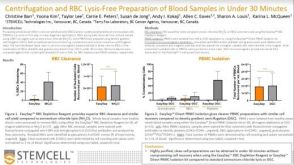 科学海报Centrifugation and RBC Lysis-Free Preparation of Blood Samples in Under 30 Minutes



 沪公网安备31010102008431号