Detection, isolation, and stimulation of quiescent primitive leukemic progenitor cells from patients with acute myeloid leukemia (AML).
Although many acute myeloid leukemia (AML) colony-forming cells (CFCs) and long-term culture-initiating cells (LTC-ICs) directly isolated from patients are actively cycling,quiescent progenitors are present in most samples. In the current study,(3)H-thymidine ((3)H-Tdr) suicide assays demonstrated that most NOD/SCID mouse leukemia-initiating cells (NOD/SL-ICs) are quiescent in 6 of 7 AML samples. AML cells in G(0),G(1),and S/G(2)+M were isolated from 4 of these samples using Hoechst 33342/pyroninY staining and cell sorting. The progenitor content of each subpopulation was consistent with the (3)H-Tdr suicide results,with NOD/SL-ICs found almost exclusively among G(0) cells while the cycling status of AML CFCs and LTC-ICs was more heterogeneous. Interestingly,after 72 hours in serum-free culture with or without Steel factor (SF),Flt-3 ligand (FL),and interleukin-3 (IL-3),most G(0) AML cells entered active cell cycle (percentage of AML cells remaining in G(0) at 72 hours,1.2% to 37%,and 0% to 7.6% in cultures without and with growth factors [GFs],respectively) while G(0) cells from normal lineage-depleted bone marrow remained quiescent in the absence of GF. All 4 AML samples showed evidence of autocrine production of 2 or more of SF,FL,IL-3,and granulocyte-macrophage colony-stimulating factor (GM-CSF). In addition,3 of 4 samples contained an internal tandem duplication of the FLT3 gene. In summary,quiescent leukemic cells,including NOD/SL-ICs,are present in most AML patients. Their spontaneous entry into active cell cycle in short-term culture might be explained by the deregulated GF signaling present in many AMLs.
View Publication
产品号#:
05150
09500
09600
09650
产品名:
MyeloCult™H5100
BIT 9500血清替代物
StemSpan™ SFEM
StemSpan™ SFEM
Smith KS et al. (NOV 2002)
Molecular and cellular biology 22 21 7678--87
Transformation of bone marrow B-cell progenitors by E2a-Hlf requires coexpression of Bcl-2.
The chimeric transcription factor E2a-Hlf is an oncoprotein associated with a subset of acute lymphoblastic leukemias of early B-lineage derivation. We employed a retroviral transduction-transplantation approach to evaluate the oncogenic effects of E2a-Hlf on murine B-cell progenitors harvested from adult bone marrow. Expression of E2a-Hlf induced short-lived clusters of primary hematopoietic cells but no long-term growth on preformed bone marrow stromal cell layers comprised of the AC6.21 cell line. Coexpression with Bcl-2,however,resulted in the sustained self-renewal of early preB-I cells that required stromal and interleukin-7 (IL-7) support for growth in vitro. Immortalized cells were unable to induce leukemias after transplantation into nonirradiated syngeneic hosts,unlike the leukemic properties and cytokine independence of preB-I cells transformed by p190(Bcr-Abl) under identical in vitro conditions. However,bone marrow cells expressing E2a-Hlf in combination with Bcl-2,but not E2a-Hlf alone,induced leukemias in irradiated recipients with long latencies,demonstrating both a requirement for suppression of apoptosis and the need for further secondary mutations in leukemia pathogenesis. Coexpression of IL-7 substituted for Bcl-2 to induce the in vitro growth of pre-B cells expressing E2a-Hlf,but leukemic conversion required additional abrogation of undefined stromal requirements and was associated with alterations in the Arf/Mdm2/p53 pathway. Thus,E2a-Hlf enhances the self-renewal of bone marrow B-cell progenitors without inciting a p53 tumor surveillance response or abrogating stromal and cytokine requirements for growth,which are nevertheless abrogated during progression to a leukemogenic phenotype.
View Publication
产品号#:
03134
产品名:
MethoCult™M3134
Nicolini FE et al. (AUG 2002)
Blood 100 4 1257--64
Expression of a human beta-globin transgene in erythroid cells derived from retrovirally transduced transplantable human fetal liver and cord blood cells.
Transfer of therapeutic genes to human hematopoietic stem cells (HSCs) using complex vectors at clinically relevant efficiencies remains a major challenge. Recently we described a stable retroviral vector that sustains long-term expression of green fluorescent protein (GFP) and a human beta-globin gene in the erythroid progeny of transduced murine HSCs. We now report the efficient transduction of primitive human CD34(+) fetal liver or cord blood cells with this vector and expression of the beta-globin transgene in the erythroid progeny of these human cells for at least 2 months. After growth factor prestimulation and then a 2- to 3-day exposure to the virus,35% to 55% GFP(+) progeny were seen in assays of transduced colony-forming cells,primitive erythroid precursors that generate large numbers of glycophorin A(+) cells in 3-week suspension cultures,and 6-week long-term culture-initiating cells. In immunodeficient mice injected with unselected infected cells,5% to 15% of the human cells regenerated in the marrow (including the erythroid cells) were GFP(+) 3 and 6 weeks after transplantation. Importantly,the numbers of GFP(+) human lymphoid and either granulopoietic or erythroid cells in individual mice 6 weeks after transplantation were significantly correlated,indicative of the initial transduction of human multipotent cells with in vivo repopulating activity. Expression of the transduced beta-globin gene in human cells obtained directly from the mice or after their differentiation into erythroid cells in vitro was demonstrated by reverse transcriptase-polymerase chain reaction using specific primers. These experiments represent a significant step toward the realization of a gene therapy approach for human beta-globin gene disorders.
View Publication
产品号#:
04330
产品名:
MethoCult™H4330
Rosé L et al. (JUL 2002)
Experimental hematology 30 7 729--37
In vitro studies of the combination of imatinib mesylate (Gleevec) and arsenic trioxide (Trisenox) in chronic myelogenous leukemia.
OBJECTIVE: The aim of this study was the preclinical evaluation of imatinib mesylate (Gleevec,formerly STI571) in conjunction with arsenic trioxide (As2O3,Trisenox) for the treatment of chronic myelogenous leukemia (CML). MATERIALS AND METHODS: Tetrazolium-based cell line proliferation assays (MTT assays) were performed to determine the cytotoxicity of As2O3 alone and in combination with imatinib. Cell lines tested in this study were Bcr-Abl-expressing cells (K562,MO7p210,32Dp210) and parental cells (MO7e,32D). Isobologram analysis was performed manually and using the median effect method. In vitro cytotoxicity also was determined in colony-forming assays using CML patient cells. Western blot analysis was performed to detect Bcr-Abl protein levels in K562 cells exposed to As2O3 at graded concentrations. Bcr-Abl protein level kinetics were correlated with cell viability (trypan blue count) and activated caspase-3 detected by flow cytometry. RESULTS: We show additive to synergistic cytotoxicity in Bcr-Abl+ cell lines depending on inhibitory concentrations and cell type. Results obtained by colony-forming assays confirmed the findings in cell line proliferation assays. Flow cytometric detection of activated caspase-3 revealed synergistic activity in K562 cells. Treatment of K562 cells with As2O3 alone led to down-regulation of Bcr-Abl protein within 24 hours,even at low doses. The decline of Bcr-Abl preceded activation of caspase-3 and the loss of viable cells. CONCLUSIONS: Favorable cytotoxicity and proapoptotic activity of imatinib in conjunction with As2O3 and specific down-regulation of Bcr-Abl protein levels by As2O3 in K562 cells indicate that As2O3 in combination with imatinib might be useful for circumventing resistance to imatinib monotherapy.
View Publication
产品号#:
04564
04534
04544
产品名:
入门套件MethoCult™H4534经典无EPO
MethoCult™H4534经典无EPO
MethoCult™H4534经典无EPO
Bruserud &O et al. (JUN 2002)
Haematologica 87 6 584--95
Leptin in human acute myelogenous leukemia: studies of in vivo levels and in vitro effects on native functional leukemia blasts.
BACKGROUND AND OBJECTIVES: Leptin receptors can be expressed by acute myelogenous leukemia (AML) cells,but the functional effects of leptin on native AML blasts have not been characterized in detail. We investigated systemic leptin levels in AML patients and in vitro effects of leptin on cultured AML blasts. DESIGN AND METHODS: Serum leptin levels were compared for patients with untreated AML and healthy controls. Native AML blasts were derived from a large group of consecutive patients,and effects of leptin on proliferation (suspension cultures and colony formation),constitutive cytokine secretion,differentiation and apoptosis regulation were assayed in vitro. RESULTS: Systemic leptin levels were decreased in patients with untreated AML,and leptin levels in acute leukemia patients were not altered during severe chemotherapy-induced cytopenia and complicating febrile neutropenia. In vitro studies demonstrated that leptin increased AML blast release of interleukin (IL) 1beta,IL6,tumor necrosis factor (TNF) alpha and granulocyte-macrophage colony-stimulating factor (GM-CSF). This enhancing effect showed no correlation with CD34 expression and was not dependent on the presence of serum,induction of differentiation or alteration of caspase 3 activity with decreased in vitro apoptosis. Leptin also increased spontaneous AML blast proliferation,whereas divergent effects on blast proliferation were observed in the presence of exogenous cytokines. The in vitro effects were usually observed at concentrations exceeding the systemic levels. INTERPRETATION AND CONCLUSIONS: Our results suggest that systemic leptin levels alone do not have a major influence on native AML blasts,but the systemic levels in combination with local leptin release in the bone marrow may affect the functional characteristics of these cells.
View Publication
Selective elimination of leukemic CD34(+) progenitor cells by cytotoxic T lymphocytes specific for WT1.
Hematologic malignancies such as acute and chronic myeloid leukemia are characterized by the malignant transformation of immature CD34(+) progenitor cells. Transformation is associated with elevated expression of the Wilm's tumor gene encoded transcription factor (WT1). Here we demonstrate that WT1 can serve as a target for cytotoxic T lymphocytes (CTL) with exquisite specificity for leukemic progenitor cells. HLA-A0201- restricted CTL specific for WT1 kill leukemia cell lines and inhibit colony formation by transformed CD34(+) progenitor cells isolated from patients with chronic myeloid leukemia (CML),whereas colony formation by normal CD34(+) progenitor cells is unaffected. Thus,the tissue-specific transcription factor WT1 is an ideal target for CTL-mediated purging of leukemic progenitor cells in vitro and for antigen-specific therapy of leukemia and other WT1-expressing malignancies in vivo.
View Publication
产品号#:
04535
04545
产品名:
MethoCult™H4535富集无EPO
MethoCult™ H4535 Enriched,不含EPO
Brandl M et al. (AUG 1999)
Experimental hematology 27 8 1264--70
Bispecific antibody fragments with CD20 X CD28 specificity allow effective autologous and allogeneic T-cell activation against malignant cells in peripheral blood and bone marrow cultures from patients with B-cell lineage leukemia and lymphoma.
Bispecific antibodies directed against tumor-associated target antigens and to surface receptors mediating T-cell activation,such as the TCR/CD3 complex and the costimulatory receptor CD28,are capable of mediating T-cell activation resulting in tumor cell killing. In this study,we used the B-cell-associated antigens CD19 and CD20 as target structures on human leukemic cells. We found that a combination of bispecific antibody fragments (bsFab2) with target x CD3 and target x CD28 specificity induces vigorous autologous T-cell activation and killing of malignant cells in peripheral blood and bone marrow cultures from patients with chronic lymphocytic leukemia and follicular lymphoma. The bsFab2 targeting CD20 were considerably more effective than those binding to CD19. The colony-forming capacity of treated bone marrow was impaired due to large amounts of tumor necrosis factor alpha produced during bsFab2-induced T-cell activation. Neutralizing tumor necrosis factor alpha antibodies were found to reverse this negative effect without affecting T-cell activation and tumor cell killing. CD20 x CD28 bsFab2,when used alone rather than in combination,markedly improved the recognition of leukemic cells by allogeneic T cells. Therefore,these reagents may be capable of enhancing the immunogenicity of leukemic cells in general and,in particular,of increasing the antileukemic activity of allogeneic donor buffy coat cells in relapsed bone marrow transplanted patients.
View Publication


 EasySep™小鼠TIL(CD45)正选试剂盒




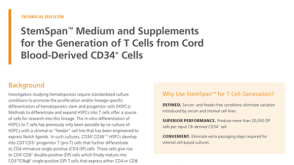 技术公告StemSpan™ Medium and Supplements for the Generation of T Cells from Cord Blood-Derived CD34+ Cells

 沪公网安备31010102008431号