Yamashita J et al. (NOV 2000)
Nature 408 6808 92--6
Flk1-positive cells derived from embryonic stem cells serve as vascular progenitors.
Interaction between endothelial cells and mural cells (pericytes and vascular smooth muscle) is essential for vascular development and maintenance. Endothelial cells arise from Flk1-expressing (Flk1+) mesoderm cells,whereas mural cells are believed to derive from mesoderm,neural crest or epicardial cells and migrate to form the vessel wall. Difficulty in preparing pure populations of these lineages has hampered dissection of the mechanisms underlying vascular formation. Here we show that Flk1+ cells derived from embryonic stem cells can differentiate into both endothelial and mural cells and can reproduce the vascular organization process. Vascular endothelial growth factor promotes endothelial cell differentiation,whereas mural cells are induced by platelet-derived growth factor-BB. Vascular cells derived from Flk1+ cells can organize into vessel-like structures consisting of endothelial tubes supported by mural cells in three-dimensional culture. Injection of Flk1+ cells into chick embryos showed that they can incorporate as endothelial and mural cells and contribute to the developing vasculature in vivo. Our findings indicate that Flk1+ cells can act as 'vascular progenitor cells' to form mature vessels and thus offer potential for tissue engineering of the vascular system.
View Publication
产品号#:
06902
06952
00321
00322
00323
00324
00325
产品名:
Wang Z et al. (JAN 2004)
Blood 103 1 100--9
Ephrin receptor, EphB4, regulates ES cell differentiation of primitive mammalian hemangioblasts, blood, cardiomyocytes, and blood vessels.
Differentiation of pluripotent embryonic stem (ES) cells is associated with expression of fate-specifying gene products. Coordinated development,however,must involve modifying factors that enable differentiation and growth to adjust in response to local microenvironmental determinants. We report here that the ephrin receptor,EphB4,known to be spatially restricted in expression and critical for organized vessel formation,modifies the rate and magnitude of ES cells acquiring genotypic and phenotypic characteristics of mesodermal tissues. Hemangioblast,blood cell,cardiomyocyte,and vascular differentiation was impaired in EphB4-/- ES cells in conjunction with decreased expression of mesoderm-associated,but not neuroectoderm-associated,genes. Therefore,EphB4 modulates the response to mesoderm induction signals. These data add differentiation kinetics to the known effects of ephrin receptors on mammalian cell migration and adhesion. We propose that modifying sensitivity to differentiation cues is a further means for ephrin receptors to contribute to tissue patterning and organization.
View Publication
Recurrent gain of chromosomes 17q and 12 in cultured human embryonic stem cells.
We have observed karyotypic changes involving the gain of chromosome 17q in three independent human embryonic stem (hES) cell lines on five independent occasions. A gain of chromosome 12 was seen occasionally. This implies that increased dosage of chromosome 17q and 12 gene(s) provides a selective advantage for the propagation of undifferentiated hES cells. These observations are instructive for the future application of hES cells in transplantation therapies in which the use of aneuploid cells could be detrimental.
View Publication
产品号#:
05859
05850
05857
05870
05875
85850
85857
85870
85875
77003
77004
200-0117
产品名:
FreSR™- S
mTeSR™1
mTeSR™1
CellAdhere™ Laminin-521
CellAdhere™ Laminin-521
Carotta S et al. (SEP 2004)
Blood 104 6 1873--80
Directed differentiation and mass cultivation of pure erythroid progenitors from mouse embryonic stem cells.
Differentiating embryonic stem (ES) cells are an increasingly important source of hematopoietic progenitors,useful for both basic research and clinical applications. Besides their characterization in colony assays,protocols exist for the cultivation of lymphoid,myeloid,and erythroid cells. With the possible exception of mast cells,however,long-term expansion of pure hematopoietic progenitors from ES cells has not been possible without immortalization caused by overexpression of exogenous genes. Here,we describe for the first time an efficient yet easy strategy to generate mass cultures of pure,immature erythroid progenitors from mouse ES cells (ES-EPs),using serum-free medium plus recombinant cytokines and hormones. ES-EPs represent long-lived,adult,definitive erythroid progenitors that resemble immature erythroid cells expanding in vivo during stress erythropoiesis. When exposed to terminal differentiation conditions,ES-EPs differentiated into mature,enucleated erythrocytes. Importantly,ES-EPs injected into mice did not exhibit tumorigenic potential but differentiated into normal erythrocytes. Both the virtually unlimited supply of cells and the defined culture conditions render our system a valuable tool for the analysis of factors influencing proliferation and maturation of erythroid progenitors. In addition,the system allows detailed characterization of processes during erythroid proliferation and differentiation using wild-type (wt) and genetically modified ES cells.
View Publication
产品号#:
03234
03434
03444
产品名:
MethoCult™ M3234
MethoCult™ GF M3434
MethoCult™ GF M3434
Li Q et al. (AUG 2005)
Proceedings of the National Academy of Sciences of the United States of America 102 35 12425--30
Enhanced NF-kappaB activation and cellular function in macrophages lacking IkappaB kinase 1 (IKK1).
IkappaB kinase (IKK) complex plays a key regulatory role in macrophages for NF-kappaB activation during both innate and adaptive immune responses. Because IKK1-/- mice died at birth,we differentiated functional macrophages from embryonic day 15.5 IKK1 mutant embryonic liver. The embryonic liver-derived macrophage (ELDM) showed enhanced phagocytotic clearance of bacteria,more efficient antigen-presenting capacity,elevated secretion of several key proinflammatory cytokines and chemokines,and known NFkappaB target genes. Increased NFkappaB activity in IKK1 mutant ELDM was the result of prolonged degradation of IkappaBalpha in response to infectious pathogens. The delayed restoration of IkappaBalpha in pathogen-activated IKK1-/- ELDM was a direct consequence of uncontrolled IKK2 kinase activity. We hypothesize that IKK1 plays a checkpoint role in the proper control of IkappaBalpha kinase activity in innate and adaptive immunity.
View Publication
产品号#:
02532
02832
09600
09650
产品名:
StemSpan™ SFEM
StemSpan™ SFEM
Hui Z et al. (OCT 2009)
Stem Cells 27 10 2435--2445
Lack of ABCG2 expression and side population properties in human pluripotent stem cells
The multidrug transporter ABCG2 in cell membranes enables various stem cells and cancer cells to efflux chemicals,including the fluorescent dye Hoechst 33342. The Hoechst(-) cells can be sorted out as a side population with stem cell properties. Abcg2 expression in mouse embryonic stem cells (ESCs) reduces accumulation of DNA-damaging metabolites in the cells,which helps prevent cell differentiation. Surprisingly,we found that human ESCs do not express ABCG2 and cannot efflux Hoechst. In contrast,trophoblasts and neural epithelial cells derived from human ESCs are ABCG2(+) and Hoechst(-). Human ESCs ectopically expressing ABCG2 become Hoechst(-),more tolerant of toxicity of mitoxantrone,a substrate of ABCG2,and more capable of self-renewal in basic fibroblast growth factor (bFGF)-free condition than control cells. However,Hoechst(low) cells sorted as a small subpopulation from human ESCs express lower levels of pluripotency markers than the Hoechst(high) cells. Similar results were observed with human induced pluripotent stem cells. Conversely,mouse ESCs are Abcg2(+) and mouse trophoblasts,Abcg2(-). Thus,absence of ABCG2 is a novel feature of human pluripotent stem cells,which distinguishes them from many other stem cells including mouse ESCs,and may be a reason why they are sensitive to suboptimal culture conditions.
View Publication
A novel role for ??-secretase in the formation of primitive streak-like intermediates from ES cells in culture
gamma-Secretase is a membrane-associated protease with multiple intracellular targets,a number of which have been shown to influence embryonic development and embryonic stem (ES) cell differentiation. This paper describes the use of the gamma-secretase inhibitor N-[N-(3,5-difluorophenacetyl)-L-alanyl]-S-phenylglycine t-butyl ester (DAPT) to evaluate the role of gamma-secretase in the differentiation of pluripotent stem cells to the germ lineages. The addition of DAPT did not prevent the formation of primitive ectoderm-like cells from ES cells in culture. In contrast,the addition of DAPT during primitive ectoderm-like cell differentiation interfered with the ability of both serum and BMP4 to induce a primitive streak-like intermediate and resulted in the preferential formation of neurectoderm. Similarly,DAPT reduced the formation of primitive streak-like intermediates from differentiating human ES cells; the culture conditions used resulted in a population enriched in human surface ectoderm. These data suggest that gamma-secretase may form part of the general pathway by which mesoderm is specified within the primitive streak. The addition of an E-cadherin neutralizing antibody was able to partially reverse the effect of DAPT,suggesting that DAPT may be preventing the formation of primitive streak-like intermediates and promoting neurectoderm differentiation by stabilizing E-cadherin and preventing its proteolysis.
View Publication
产品号#:
05850
05857
05870
05875
85850
85857
85870
85875
产品名:
mTeSR™1
mTeSR™1
Hockemeyer D et al. (SEP 2009)
Nature biotechnology 27 9 851--7
Efficient targeting of expressed and silent genes in human ESCs and iPSCs using zinc-finger nucleases.
Realizing the full potential of human embryonic stem cells (hESCs) and induced pluripotent stem cells (hiPSCs) requires efficient methods for genetic modification. However,techniques to generate cell type-specific lineage reporters,as well as reliable tools to disrupt,repair or overexpress genes by gene targeting,are inefficient at best and thus are not routinely used. Here we report the highly efficient targeting of three genes in human pluripotent cells using zinc-finger nuclease (ZFN)-mediated genome editing. First,using ZFNs specific for the OCT4 (POU5F1) locus,we generated OCT4-eGFP reporter cells to monitor the pluripotent state of hESCs. Second,we inserted a transgene into the AAVS1 locus to generate a robust drug-inducible overexpression system in hESCs. Finally,we targeted the PITX3 gene,demonstrating that ZFNs can be used to generate reporter cells by targeting non-expressed genes in hESCs and hiPSCs.
View Publication
产品号#:
05850
05857
05870
05875
85850
85857
85870
85875
产品名:
mTeSR™1
mTeSR™1
Eremeev AV et al. ( )
Doklady biological sciences : proceedings of the Academy of Sciences of the USSR,Biological sciences sections / translated from Russian 426 293--5
Derivation of a novel human embryonic stem cell line under serum-free and feeder-free conditions.
Kolle G et al. (OCT 2009)
Stem Cells 27 10 2446--56
Identification of human embryonic stem cell surface markers by combined membrane-polysome translation state array analysis and immunotranscriptional profiling.
Surface marker expression forms the basis for characterization and isolation of human embryonic stem cells (hESCs). Currently,there are few well-defined protein epitopes that definitively mark hESCs. Here we combine immunotranscriptional profiling of hESC lines with membrane-polysome translation state array analysis (TSAA) to determine the full set of genes encoding potential hESC surface marker proteins. Three independently isolated hESC lines (HES2,H9,and MEL1) grown under feeder and feeder-free conditions were sorted into subpopulations by fluorescence-activated cell sorting based on coimmunoreactivity to the hESC surface markers GCTM-2 and CD9. Colony-forming assays confirmed that cells displaying high coimmunoreactivity to GCTM-2 and CD9 constitute an enriched subpopulation displaying multiple stem cell properties. Following microarray profiling,820 genes were identified that were common to the GCTM-2(high)/CD9(high) stem cell-like subpopulation. Membrane-polysome TSAA analysis of hESCs identified 1,492 mRNAs encoding actively translated plasma membrane and secreted proteins. Combining these data sets,88 genes encode proteins that mark the pluripotent subpopulation,of which only four had been previously reported. Cell surface immunoreactivity was confirmed for two of these markers: TACSTD1/EPCAM and CDH3/P-Cadherin,with antibodies for EPCAM able to enrich for pluripotent hESCs. This comprehensive listing of both hESCs and spontaneous differentiation-associated transcripts and survey of translated membrane-bound and secreted proteins provides a valuable resource for future study into the role of the extracellular environment in both the maintenance of pluripotency and directed differentiation.
View Publication


 EasySep™小鼠TIL(CD45)正选试剂盒




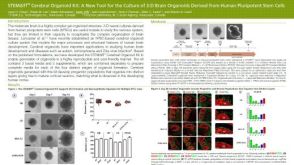 科学海报STEMdiff™ Cerebral Organoid Kit: A New Tool for the Culture of 3D Brain Organoids Derived from hPSCs
 沪公网安备31010102008431号