Zhu Z et al. (FEB 2017)
Cell stem cell 20 2 274--289.e7
PHB Associates with the HIRA Complex to Control an Epigenetic-Metabolic Circuit in Human ESCs.
The chromatin landscape and cellular metabolism both contribute to cell fate determination,but their interplay remains poorly understood. Using genome-wide siRNA screening,we have identified prohibitin (PHB) as an essential factor in self-renewal of human embryonic stem cells (hESCs). Mechanistically,PHB forms protein complexes with HIRA,a histone H3.3 chaperone,and stabilizes the protein levels of HIRA complex components. Like PHB,HIRA is required for hESC self-renewal. PHB and HIRA act together to control global deposition of histone H3.3 and gene expression in hESCs. Of particular note,PHB and HIRA regulate the chromatin architecture at the promoters of isocitrate dehydrogenase genes to promote transcription and,thus,production of α-ketoglutarate,a key metabolite in the regulation of ESC fate. Our study shows that PHB has an unexpected nuclear role in hESCs that is required for self-renewal and that it acts with HIRA in chromatin organization to link epigenetic organization to a metabolic circuit.
View Publication
Human Induced Pluripotent Stem Cell-Derived Macrophages Share Ontogeny with MYB-Independent Tissue-Resident Macrophages.
Tissue-resident macrophages,such as microglia,Kupffer cells,and Langerhans cells,derive from Myb-independent yolk sac (YS) progenitors generated before the emergence of hematopoietic stem cells (HSCs). Myb-independent YS-derived resident macrophages self-renew locally,independently of circulating monocytes and HSCs. In contrast,adult blood monocytes,as well as infiltrating,gut,and dermal macrophages,derive from Myb-dependent HSCs. These findings are derived from the mouse,using gene knockouts and lineage tracing,but their applicability to human development has not been formally demonstrated. Here,we use human induced pluripotent stem cells (iPSCs) as a tool to model human hematopoietic development. By using a CRISPR-Cas9 knockout strategy,we show that human iPSC-derived monocytes/macrophages develop in an MYB-independent,RUNX1-,and SPI1 (PU.1)-dependent fashion. This result makes human iPSC-derived macrophages developmentally related to and a good model for MYB-independent tissue-resident macrophages,such as alveolar and kidney macrophages,microglia,Kupffer cells,and Langerhans cells.
View Publication
产品号#:
85850
85857
85870
85875
产品名:
mTeSR™1
mTeSR™1
Kayama T et al. (JAN 2018)
Biochemical and Biophysical Research Communications 495 1 1028--1033
Temporally coordinated spiking activity of human induced pluripotent stem cell-derived neurons co-cultured with astrocytes
In culture conditions,human induced-pluripotent stem cells (hiPSC)-derived neurons form synaptic connections with other cells and establish neuronal networks,which are expected to be an in vitro model system for drug discovery screening and toxicity testing. While early studies demonstrated effects of co-culture of hiPSC-derived neurons with astroglial cells on survival and maturation of hiPSC-derived neurons,the population spiking patterns of such hiPSC-derived neurons have not been fully characterized. In this study,we analyzed temporal spiking patterns of hiPSC-derived neurons recorded by a multi-electrode array system. We discovered that specific sets of hiPSC-derived neurons co-cultured with astrocytes showed more frequent and highly coherent non-random synchronized spike trains and more dynamic changes in overall spike patterns over time. These temporally coordinated spiking patterns are physiological signs of organized circuits of hiPSC-derived neurons and suggest benefits of co-culture of hiPSC-derived neurons with astrocytes.
View Publication
On-demand optogenetic activation of human stem-cell-derived neurons
The widespread application of human stem-cell-derived neurons for functional studies is impeded by complicated differentiation protocols,immaturity,and deficient optogene expression as stem cells frequently lose transgene expression over time. Here we report a simple but precise Cre-loxP-based strategy for generating conditional,and thereby stable,optogenetic human stem-cell lines. These cells can be easily and efficiently differentiated into functional neurons,and optogene expression can be triggered by administering Cre protein to the cultures. This conditional expression system may be applied to stem-cell-derived neurons whenever timed transgene expression could help to overcome silencing at the stem-cell level.
View Publication
产品号#:
05711
05790
05792
05793
05794
05795
100-1281
产品名:
NeuroCult™ SM1 神经添加物
BrainPhys™神经元培养基
BrainPhys™神经元培养基和SM1试剂盒
BrainPhys™ 神经元培养基N2-A和SM1试剂盒
BrainPhys™原代神经元试剂盒
BrainPhys™ hPSC 神经元试剂盒
NeuroCult™ SM1 神经添加物
Lu J et al. (APR 2017)
Journal of biomedical materials research. Part A 105 4 1094--1104
Interactions of human embryonic stem cell-derived cardiovascular progenitor cells with immobilized extracellular matrix proteins.
Human embryonic stem cell-derived cardiovascular progenitor cells (hESC-CVPCs) hold great promise for cell-based therapies of heart diseases. However,little is known about their niche microenvironment and in particular the required extracellular matrix (ECM) components. Here we screened combinations of surface-immobilized ECM proteins to identify substrates that support the attachment and survival of hESC-CVPCs. Covalent immobilization of ECM proteins laminin (Lm),fibronectin (Fn),collagen I (CI),collagen III (CIII),and collagen IV (CIV) in multiple combinations and concentrations was achieved by reductive amination on transparent acetaldehyde plasma polymer (AAPP) interlayer coatings. We identified that CI,CIII,CIV,and Fn and their combinations were important for hESC-CVPC attachment and survival,while Lm was dispensable. Moreover,for coatings displaying single ECM proteins,CI and CIII performed better than CIV and Fn,while coatings displaying the combined ECM proteins CIII + CIV and Fn + CIII + CIV at 100 µg/mL were comparable to Matrigel in regard to supporting hESC-CVPC attachment and viability. Our results identify ECM proteins required for hESC-CVPCs and demonstrate that coatings displaying multiple immobilized ECM proteins offer a suitable microenvironment for the attachment and survival of hESC-CVPCs. This knowledge contributes to the development of approaches for maintaining hESC-CVPCs and therefore to advances in cardiovascular regeneration. textcopyright 2017 Wiley Periodicals,Inc. J Biomed Mater Res Part A: 105A: 1094-1104,2017.
View Publication
产品号#:
85850
85857
85870
85875
产品名:
mTeSR™1
mTeSR™1
Tan WL et al. (JAN 2017)
Cardiovascular Research 113 3 298--309
A landscape of circular RNA expression in the human heart
AIMS: Circular RNA (circRNA) is a newly validated class of single-stranded RNA,ubiquitously expressed in mammalian tissues and possessing key functions including acting as microRNA sponges and as transcriptional regulators by binding to RNA-binding proteins. While independent studies confirm the expression of circRNA in various tissue types,genome-wide circRNA expression in the heart has yet to be described in detail. METHODS AND RESULTS: We performed deep RNA-sequencing on ribosomal-depleted RNA isolated from 12 human hearts,25 mouse hearts and across a 28-day differentiation time-course of human embryonic stem cell-derived cardiomyocytes. Using purpose-designed bioinformatics tools,we uncovered a total of 15 318 and 3017 cardiac circRNA within human and mouse,respectively. Their abundance generally correlates with the abundance of their cognate linear RNA,but selected circRNAs exist at disproportionately higher abundance. Top highly expressed circRNA corresponded to key cardiac genes including Titin (TTN),RYR2,and DMD. The most abundant cardiac-expressed circRNA is a cytoplasmic localized single-exon circSLC8A1-1. The longest human transcript TTN alone generates up to 415 different exonic circRNA isoforms,the majority (83%) of which originates from the I-band domain. Finally,we confirmed the expression of selected cardiac circRNA by RT-PCR,Sanger sequencing and single molecule RNA-fluorescence in situ hybridization. CONCLUSIONS: Our data provide a detailed circRNA expression landscape in hearts. There is a high-abundance of specific cardiac-expressed circRNA. These findings open up a new avenue for future investigation into this emerging class of RNA.
View Publication
产品号#:
85850
85857
85870
85875
产品名:
mTeSR™1
mTeSR™1
Yokota M et al. (JAN 2017)
Cell death & disease 8 1 e2551
Mitochondrial respiratory dysfunction disturbs neuronal and cardiac lineage commitment of human iPSCs.
Mitochondrial diseases are genetically heterogeneous and present a broad clinical spectrum among patients; in most cases,genetic determinants of mitochondrial diseases are heteroplasmic mitochondrial DNA (mtDNA) mutations. However,it is uncertain whether and how heteroplasmic mtDNA mutations affect particular cellular fate-determination processes,which are closely associated with the cell-type-specific pathophysiology of mitochondrial diseases. In this study,we established two isogenic induced pluripotent stem cell (iPSC) lines each carrying different proportions of a heteroplasmic m.3243A>G mutation from the same patient; one exhibited apparently normal and the other showed most likely impaired mitochondrial respiratory function. Low proportions of m.3243A>G exhibited no apparent molecular pathogenic influence on directed differentiation into neurons and cardiomyocytes,whereas high proportions of m.3243A>G showed both induced neuronal cell death and inhibited cardiac lineage commitment. Such neuronal and cardiac maturation defects were also confirmed using another patient-derived iPSC line carrying quite high proportion of m.3243A>G. In conclusion,mitochondrial respiratory dysfunction strongly inhibits maturation and survival of iPSC-derived neurons and cardiomyocytes; our presenting data also suggest that appropriate mitochondrial maturation actually contributes to cellular fate-determination processes during development.
View Publication
产品号#:
85850
85857
85870
85875
产品名:
mTeSR™1
mTeSR™1
Zhou S et al. ( 2017)
PloS one 12 1 e0169899
Reprogramming Malignant Cancer Cells toward a Benign Phenotype following Exposure to Human Embryonic Stem Cell Microenvironment.
The embryonic microenvironment is well known to be non-permissive for tumor development because early developmental signals naturally suppress the expression of proto-oncogenes. In an analogous manner,mimicking an early embryonic environment during embryonic stem cell culture has been shown to suppress oncogenic phenotypes of cancer cells. Exosomes derived from human embryonic stem cells harbor substances that mirror the content of the cells of origin and have been reported to reprogram hematopoietic stem/progenitor cells via horizontal transfer of mRNA and proteins. However,the possibility that these embryonic stem cells-derived exosomes might be the main effectors of the anti-tumor effect mediated by the embryonic stem cells has not been explored yet. The present study aims to investigate whether exosomes derived from human embryonic stem cells can reprogram malignant cancer cells to a benign stage and reduce their tumorigenicity. We show that the embryonic stem cell-conditioned medium contains factors that inhibit cancer cell growth and tumorigenicity in vitro and in vivo. Moreover,we demonstrate that exosomes derived from human embryonic stem cells display anti-proliferation and pro-apoptotic effects,and decrease tumor size in a xenograft model. These exosomes are also able to transfer their cargo into target cancer cells,inducing a dose-dependent increase in SOX2,OCT4 and Nanog proteins,leading to a dose-dependent decrease of cancer cell growth and tumorigenicity. This study shows for the first time that human embryonic stem cell-derived exosomes play an important role in the tumor suppressive activity displayed by human embryonic stem cells.
View Publication
产品号#:
85850
85857
85870
85875
产品名:
mTeSR™1
mTeSR™1
Bershteyn M et al. (APR 2017)
Cell stem cell 20 4 435--449.e4
Human iPSC-Derived Cerebral Organoids Model Cellular Features of Lissencephaly and Reveal Prolonged Mitosis of Outer Radial Glia.
Classical lissencephaly is a genetic neurological disorder associated with mental retardation and intractable epilepsy,and Miller-Dieker syndrome (MDS) is the most severe form of the disease. In this study,to investigate the effects of MDS on human progenitor subtypes that control neuronal output and influence brain topology,we analyzed cerebral organoids derived from control and MDS-induced pluripotent stem cells (iPSCs) using time-lapse imaging,immunostaining,and single-cell RNA sequencing. We saw a cell migration defect that was rescued when we corrected the MDS causative chromosomal deletion and severe apoptosis of the founder neuroepithelial stem cells,accompanied by increased horizontal cell divisions. We also identified a mitotic defect in outer radial glia,a progenitor subtype that is largely absent from lissencephalic rodents but critical for human neocortical expansion. Our study,therefore,deepens our understanding of MDS cellular pathogenesis and highlights the broad utility of cerebral organoids for modeling human neurodevelopmental disorders.
View Publication
K. B. Langer et al. (APR 2018)
Stem cell reports 10 4 1282--1293
Retinal Ganglion Cell Diversity and Subtype Specification from Human Pluripotent Stem Cells.
Retinal ganglion cells (RGCs) are the projection neurons of the retina and transmit visual information to postsynaptic targets in the brain. While this function is shared among nearly all RGCs,this class of cell is remarkably diverse,comprised of multiple subtypes. Previous efforts have identified numerous RGC subtypes in animal models,but less attention has been paid to human RGCs. Thus,efforts of this study examined the diversity of RGCs differentiated from human pluripotent stem cells (hPSCs) and characterized defined subtypes through the expression of subtype-specific markers. Further investigation of these subtypes was achieved using single-cell transcriptomics,confirming the combinatorial expression of molecular markers associated with these subtypes,and also provided insight into more subtype-specific markers. Thus,the results of this study describe the derivation of RGC subtypes from hPSCs and will support the future exploration of phenotypic and functional diversity within human RGCs.
View Publication


 EasySep™小鼠TIL(CD45)正选试剂盒




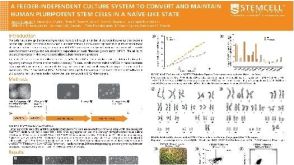 科学海报A Feeder-Independent Culture System to Convert and Maintain Human Pluripotent Stem Cells in a Naïve-Like State
 沪公网安备31010102008431号