c-myb supports erythropoiesis through the transactivation of KLF1 and LMO2 expression.
The c-myb transcription factor is highly expressed in immature hematopoietic cells and down-regulated during differentiation. To define its role during the hematopoietic lineage commitment,we silenced c-myb in human CD34(+) hematopoietic stem/progenitor cells. Noteworthy,c-myb silencing increased the commitment capacity toward the macrophage and megakaryocyte lineages,whereas erythroid differentiation was impaired,as demonstrated by clonogenic assay,morphologic and immunophenotypic data. Gene expression profiling and computational analysis of promoter regions of genes modulated in c-myb-silenced CD34(+) cells identified the transcription factors Kruppel-Like Factor 1 (KLF1) and LIM Domain Only 2 (LMO2) as putative targets,which can account for c-myb knockdown effects. Indeed,chromatin immunoprecipitation and luciferase reporter assay demonstrated that c-myb binds to KLF1 and LMO2 promoters and transactivates their expression. Consistently,the retroviral vector-mediated overexpression of either KLF1 or LMO2 partially rescued the defect in erythropoiesis caused by c-myb silencing,whereas only KLF1 was also able to repress the megakaryocyte differentiation enhanced in Myb-silenced CD34(+) cells. Our data collectively demonstrate that c-myb plays a pivotal role in human primary hematopoietic stem/progenitor cells lineage commitment,by enhancing erythropoiesis at the expense of megakaryocyte diffentiation. Indeed,we identified KLF1 and LMO2 transactivation as the molecular mechanism underlying Myb-driven erythroid versus megakaryocyte cell fate decision.
View Publication
产品号#:
18058
18058RF
18056
18056RF
产品名:
Cai S et al. (NOV 2010)
Journal of immunology (Baltimore,Md. : 1950) 185 10 6214--25
CXCL1 regulates pulmonary host defense to Klebsiella Infection via CXCL2, CXCL5, NF-kappaB, and MAPKs.
Pulmonary bacterial infections are a leading cause of death. Since the introduction of antibiotics,multidrug-resistant Klebsiella pneumoniae became an escalating threat. Therefore,development of methods to augment antibacterial defense is warranted. Neutrophil recruitment is critical to clear bacteria,and neutrophil migration in the lung requires the production of ELR(+) CXC chemokines. Although lung-specific CXCL1/keratinocyte cell-derived chemokine (KC) transgene expression causes neutrophil-mediated clearance of K. pneumoniae,the mechanisms underlying KC-mediated host defense against K. pneumoniae have not been explored. In this study,we delineated the host defense functions of KC during pulmonary K. pneumoniae infection using KC(-/-) mice. Our findings demonstrate that KC is important for expression of CXCL2/MIP-2 and CXCL5/LPS-induced CXC chemokine,and activation of NF-κB and MAPKs in the lung. Furthermore,KC derived from both hematopoietic and resident cells contributes to host defense against K. pneumoniae. Neutrophil depletion in mice before K. pneumoniae infection reveals no differences in the production of MIP-2 and LPS-induced CXC chemokine or activation of NF-κB and MAPKs in the lung. Using murine bone marrow-derived and alveolar macrophages,we confirmed KC-mediated upregulation of MIP-2 and activation of NF-κB and MAPKs on K. pneumoniae infection. Moreover,neutralizing KC in bone marrow-derived macrophages before K. pneumoniae challenge decreases bacteria-induced production of KC and MIP-2,and activation of NF-κB and MAPKs. These findings reveal the importance of KC produced by hematopoietic and resident cells in regulating pulmonary host defense against a bacterial pathogen via the activation of transcription factors and MAPKs,as well as the expression of cell adhesion molecules and other neutrophil chemoattractants.
View Publication
产品号#:
18770
18770RF
产品名:
Joseph J et al. ( 2016)
Nature communications 7 12748
Inhibition of ROS and upregulation of inflammatory cytokines by FoxO3a promotes survival against Salmonella typhimurium.
Virulent intracellular pathogens,such as the Salmonella species,engage numerous virulence factors to subvert host defence mechanisms to induce a chronic infection that leads to typhoid or exacerbation of other chronic inflammatory conditions. Here we show the role of the forkhead transcription factor FoxO3a during infection of mice with Salmonella typhimurium (ST). Although FoxO3a signalling does not affect the development of CD8(+) T cell responses to ST,FoxO3a has an important protective role,particularly during the chronic stage of infection,by limiting the persistence of oxidative stress. Furthermore,FoxO3a signalling regulates ERK signalling in macrophages,which results in the maintenance of a proinflammatory state. FoxO3a signalling does not affect cell proliferation or cell death. Thus,these results reveal mechanisms by which FoxO3a promotes host survival during infection with chronic,virulent intracellular bacteria.
View Publication
产品号#:
19761
19761RF
产品名:
挂图
Human Immune Cytokines
Infographic of key cytokines for expansion, differentiation and characterization of major immune cell types
Gilbert C et al. (JUL 2007)
Journal of virology 81 14 7672--82
Human immunodeficiency virus type 1 replication in dendritic cell-T-cell cocultures is increased upon incorporation of host LFA-1 due to higher levels of virus production in immature dendritic cells.
Dendritic cells (DCs) act as a portal for invasion by human immunodeficiency virus type-1 (HIV-1). Here,we investigated whether virion-incorporated host cell membrane proteins can affect virus replication in DC-T-cell cocultures. Using isogenic viruses either devoid of or bearing host-derived leukocyte function-associated antigen 1 (LFA-1),we showed that HIV-1 production is augmented when LFA-1-bearing virions are used compared to that for viral entities lacking this adhesion molecule. This phenomenon was observed in immature monocyte-derived DCs (IM-MDDCs) only and not in DCs displaying a mature phenotype. The increase is not due to higher virus production in responder CD4(+) T cells but rather is linked with a more important productive infection of IM-MDDCs. We provided evidence that virus-associated host LFA-1 molecules do not affect a late event in the HIV-1 life cycle but rather exert an effect on an early step in virus replication. We demonstrated that the enhancement of productive infection of IM-MDDCs that is conferred by virus-anchored host LFA-1 involves the protein kinase A (PKA) and PKC signal transduction pathways. The biological significance of this phenomenon was established by performing experiments with virus stocks produced in primary human cells and anti-LFA-1 antibodies. Together,our results indicate that the association between some virus-bound host proteins and their natural cognate ligands can modulate de novo HIV-1 production by IM-MDDCs. Therefore,the additional interactions between virus-bound host cell membrane constituents and counter receptors on the surfaces of DCs can influence HIV-1 replication in IM-MDDC-T-cell cocultures.
View Publication
产品号#:
18058
18058RF
19052
19052RF
产品名:
EasySep™人CD4+ T细胞富集试剂盒
RoboSep™ 人CD4+ T细胞富集试剂盒含滤芯吸头
Megjugorac NJ et al. (MAY 2010)
Blood 115 21 4185--90
IL-4 enhances IFN-lambda1 (IL-29) production by plasmacytoid DCs via monocyte secretion of IL-1Ra.
The type-III interferon (IFN) family is composed of 3 molecules in humans: IFN-lambda1 (interleukin-29 [IL-29]),IFN-lambda2 (IL-28A),and IFN-lambda3 (IL-28B),each of which signals through the same receptor complex. Plasmacytoid dendritic cells (pDCs) are major IFN-lambda producers among peripheral lymphocytes. Recently,it has been shown that IFN-lambda1 exerts a powerful inhibitory effect over the T-helper 2 (Th2) response by antagonizing the effect of IL-4 on CD4(+) T cells and inhibiting the production of Th2-associated cytokines. Here,we asked whether Th2 cytokines exert reciprocal control over IFN-lambda production. IL-4 treatment during stimulation of human peripheral lymphocytes significantly elevated IFN-lambda1 transcription and secretion. However,pDCs were not directly responsive to IL-4. Using depletion and reconstitution experiments,we showed that IL-4-responsive monocytes are an intermediary cell,responding to IL-4 by elevating their secretion of IL-1 receptor antagonist (IL-Ra); this IL-1Ra acts on pDCs to elevate their IFN-lambda1 output. Thus,our experiments revealed a novel mechanism for regulation of both IFN-lambda1 production and pDC function,and suggests an expanded immunomodulatory role for Th2-associated cytokines.
View Publication
产品号#:
18051
18051RF
18054
18054RF
18055
18055RF
18058
18058RF
19062
19062RF
19058
19058RF
18551
18551RF
18561
100-1525
产品名:
EasySep™人浆细胞样DC富集试剂盒
RoboSep™ 人浆细胞样DC富集试剂盒含滤芯吸头
EasySep™人单核细胞富集试剂盒(不去除CD16)
RoboSep™ 人单核细胞富集试剂盒(不去除CD16)含滤芯吸头
EasySep™人单核细胞富集试剂盒(不去除CD16)
Heinig M et al. (SEP 2010)
Nature 467 7314 460--4
A trans-acting locus regulates an anti-viral expression network and type 1 diabetes risk.
Combined analyses of gene networks and DNA sequence variation can provide new insights into the aetiology of common diseases that may not be apparent from genome-wide association studies alone. Recent advances in rat genomics are facilitating systems-genetics approaches. Here we report the use of integrated genome-wide approaches across seven rat tissues to identify gene networks and the loci underlying their regulation. We defined an interferon regulatory factor 7 (IRF7)-driven inflammatory network (IDIN) enriched for viral response genes,which represents a molecular biomarker for macrophages and which was regulated in multiple tissues by a locus on rat chromosome 15q25. We show that Epstein-Barr virus induced gene 2 (Ebi2,also known as Gpr183),which lies at this locus and controls B lymphocyte migration,is expressed in macrophages and regulates the IDIN. The human orthologous locus on chromosome 13q32 controlled the human equivalent of the IDIN,which was conserved in monocytes. IDIN genes were more likely to associate with susceptibility to type 1 diabetes (T1D)-a macrophage-associated autoimmune disease-than randomly selected immune response genes (P = 8.85 × 10(-6)). The human locus controlling the IDIN was associated with the risk of T1D at single nucleotide polymorphism rs9585056 (P = 7.0 × 10(-10); odds ratio,1.15),which was one of five single nucleotide polymorphisms in this region associated with EBI2 (GPR183) expression. These data implicate IRF7 network genes and their regulatory locus in the pathogenesis of T1D.
View Publication


 EasySep™小鼠TIL(CD45)正选试剂盒




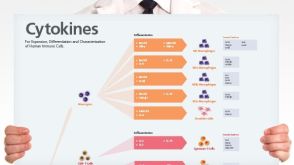 挂图Human Immune Cytokines Infographic of key cytokines for expansion, differentiation and characterization of major immune cell types




 沪公网安备31010102008431号