Bellemare-Pelletier A et al. (JUL 2005)
Journal of leukocyte biology 78 1 95--105
HLA-DO transduced in human monocyte-derived dendritic cells modulates MHC class II antigen processing.
Through the regulation of human leukocyte antigen (HLA)-DM (DM) in B cells,HLA-DO (DO) modulates positively or negatively the presentation of specific peptides. Transduction of DO into human blood monocyte-derived dendritic cells (MoDC) has been proposed as a mean of modifying the peptide repertoire of major histocompatibility complex class II molecules. However,maturation of DC induced by inflammatory stimuli or possibly the adenoviral vector itself triggers acidification of vesicles and shuts down transcription of the class II transactivator gene as well as de novo biosynthesis of class II-related molecules and DM activity. In these conditions,it is unclear that transduced DO could alter the peptide repertoire. Our Western blot and reverse transcriptase-polymerase chain reaction analyses revealed that human DC derived from blood monocytes express small amounts of DOalpha. Transduction of DObeta alone resulted in the accumulation of a small pool of DO in DM(+) CD63(+) vesicles and at the plasma membrane of mature DC. The cell-surface increase in class II-associated invariant chain peptide (CLIP)/class II complexes is in line with an inhibitory role of DO on DM. Cotransduction of DOalpha and DObeta only slightly increased CLIP and DO levels at the cell surface. Together with the fact that a large fraction of transduced DO remains in the endoplasmic reticulum,this suggests that DM is limiting in these conditions. DO expression did not affect a mixed lymphocyte reaction but reduced presentation of the exogenous gp100 antigen to a specific T cell clone. These results show that transduced DO modulates antigen presentation in human mature MoDC,evoking the possible use of this chaperone for immunotherapy.
View Publication
产品号#:
18058
18058RF
19052
19052RF
产品名:
EasySep™人CD4+ T细胞富集试剂盒
RoboSep™ 人CD4+ T细胞富集试剂盒含滤芯吸头
Heinonen KM et al. (FEB 2006)
Proceedings of the National Academy of Sciences of the United States of America 103 8 2776--81
Protein tyrosine phosphatase 1B negatively regulates macrophage development through CSF-1 signaling.
Protein tyrosine phosphatase 1B (PTP-1B) is a ubiquitously expressed cytosolic phosphatase with the ability to dephosphorylate JAK2 and TYK2,and thereby down-regulate cytokine receptor signaling. Furthermore,PTP-1B levels are up-regulated in certain chronic myelogenous leukemia patients,which points to a potential role for PTP-1B in myeloid development. The results presented here show that the absence of PTP-1B affects murine myelopoiesis by modifying the ratio of monocytes to granulocytes in vivo. This bias toward monocytic development is at least in part due to a decreased threshold of response to CSF-1,because the PTP-1B -/- bone marrow presents no abnormalities at the granulocyte-monocyte progenitor level but produces significantly more monocytic colonies in the presence of CSF-1. This phenomenon is not due to an increase in receptor levels but rather to enhanced phosphorylation of the activation loop tyrosine. PTP-1B -/- cells display increased inflammatory activity in vitro and in vivo through the constitutive up-regulation of activation markers as well as increased sensitivity to endotoxin. Collectively,our data indicate that PTP-1B is an important modulator of myeloid differentiation and macrophage activation in vivo and provide a demonstration of a physiological role for PTP-1B in immune regulation.
View Publication
产品号#:
03231
03434
03444
产品名:
MethoCult™ M3231
MethoCult™ GF M3434
MethoCult™ GF M3434
Su YR et al. (AUG 2008)
Arteriosclerosis,thrombosis,and vascular biology 28 8 1439--46
Lentiviral transduction of apoAI into hematopoietic progenitor cells and macrophages: applications to cell therapy of atherosclerosis.
OBJECTIVE: We used genetically engineered mouse hematopoietic progenitor cells (HPCs) to investigate the therapeutic effects of human apoAI on atherosclerosis in apoE(-/-) mice. METHODS AND RESULTS: Lentiviral constructs expressing either human apoAI (LV-apoAI) or green fluorescent protein (LV-GFP) cDNA under a macrophage specific promoter (CD68) were generated and used for ex vivo transduction of mouse HPCs and macrophages. The transduction efficiency was textgreater25% for HPCs and textgreater70% for macrophages. ApoAI was found in the macrophage culture media,mostly associated with the HDL fraction. Interestingly,a significant increase in mRNA and protein levels for ATP binding cassette A1 (ABCA1) and ABCG1 were found in apoAI-expressing macrophages after acLDL loading. Expression of apoAI significantly increased cholesterol efflux in wild-type and apoE(-/-) macrophages. HPCs transduced with LV-apoAI ex vivo and then transplanted into apoE(-/-) mice caused a 50% reduction in atherosclerotic lesion area compared to GFP controls,without influencing plasma HDL-C levels. CONCLUSIONS: Lentiviral transduction of apoAI into HPCs reduces atherosclerosis in apoE(-/-) mice. Expression of apoAI in macrophages improves cholesterol trafficking in wild-type apoE-producing macrophages and causes upregulation of ABCA1 and ABCG1. These novel observations set the stage for a cell therapy approach to atherosclerosis regression,exploiting the cooperation between apoE and apoAI to maximize cholesterol exit from the plaque.
View Publication
产品号#:
09600
09650
18756
18756RF
18757
18757RF
产品名:
StemSpan™ SFEM
StemSpan™ SFEM
EasySep™小鼠SCA1正选试剂盒
RoboSep™ 小鼠SCA1正选试剂盒含滤芯吸头
EasySep™小鼠CD117(cKIT)正选试剂盒
RoboSep™ 小鼠CD117(cKIT)正选试剂盒含滤芯吸头
Reddy K et al. (JUN 2008)
Molecular cancer research : MCR 6 6 929--36
Bone marrow subsets differentiate into endothelial cells and pericytes contributing to Ewing's tumor vessels.
Hematopoietic progenitor cells arising from bone marrow (BM) are known to contribute to the formation and expansion of tumor vasculature. However,whether different subsets of these cells have different roles in this process is unclear. To investigate the roles of BM-derived progenitor cell subpopulations in the formation of tumor vasculature in a Ewing's sarcoma model,we used a functional assay based on endothelial cell and pericyte differentiation in vivo. Fluorescence-activated cell sorting of human cord blood/BM or mouse BM from green fluorescent protein transgenic mice was used to isolate human CD34+/CD38(-),CD34+/CD45+,and CD34(-)/CD45+ cells and mouse Sca1+/Gr1+,Sca1(-)/Gr1+,VEGFR1+,and VEGFR2+ cells. Each of these progenitor subpopulations was separately injected intravenously into nude mice bearing Ewing's sarcoma tumors. Tumors were resected 1 week later and analyzed using immunohistochemistry and confocal microscopy for the presence of migrated progenitor cells expressing endothelial,pericyte,or inflammatory cell surface markers. We showed two distinct patterns of stem cell infiltration. Human CD34+/CD45+ and CD34+/CD38(-) and murine VEGFR2+ and Sca1+/Gr1+ cells migrated to Ewing's tumors,colocalized with the tumor vascular network,and differentiated into cells expressing either endothelial markers (mouse CD31 or human vascular endothelial cadherin) or the pericyte markers desmin and alpha-smooth muscle actin. By contrast,human CD34(-)/CD45+ and mouse Sca1(-)/Gr1+ cells migrated predominantly to sites outside of the tumor vasculature and differentiated into monocytes/macrophages expressing F4/80 or CD14. Our data indicate that only specific BM stem/progenitor subpopulations participate in Ewing's sarcoma tumor vasculogenesis.
View Publication
产品号#:
02690
09600
09650
产品名:
StemSpan™ CC100
StemSpan™ SFEM
StemSpan™ SFEM
Smalls-Mantey A et al. ( 2013)
PloS one 8 9 e74858
Comparative efficiency of HIV-1-infected T cell killing by NK cells, monocytes and neutrophils.
HIV-1 infected cells are eliminated in infected individuals by a variety of cellular mechanisms,the best characterized of which are cytotoxic T cell and NK cell-mediated killing. An additional antiviral mechanism is antibody-dependent cellular cytotoxicity. Here we use primary CD4(+) T cells infected with the BaL clone of HIV-1 as target cells and autologous NK cells,monocytes,and neutrophils as effector cells,to quantify the cytotoxicity mediated by the different effectors. This was carried out in the presence or absence of HIV-1-specific antiserum to assess antibody-dependent cellular cytotoxicity. We show that at the same effector to target ratio,NK cells and monocytes mediate similar levels of both antibody-dependent and antibody-independent killing of HIV-1-infected T cells. Neutrophils mediated significant antibody-dependent killing of targets,but were less effective than monocytes or NK cells. These data have implications for acquisition and control of HIV-1 in natural infection and in the context of vaccination.
View Publication
产品号#:
19257
19257RF
19055
19055RF
19059
19059RF
产品名:
EasySep™人NK细胞富集试剂盒
RoboSep™ 人NK细胞富集试剂盒含滤芯吸头
EasySep™人单核细胞富集试剂盒
RoboSep™ 人单核细胞富集试剂盒含滤芯吸头
Martí et al. (OCT 2014)
Blood 124 15 2411--20
Human blood BDCA-1 dendritic cells differentiate into Langerhans-like cells with thymic stromal lymphopoietin and TGF-β.
The ontogeny of human Langerhans cells (LCs) remains poorly characterized,in particular the nature of LC precursors and the factors that may drive LC differentiation. Here we report that thymic stromal lymphopoietin (TSLP),a keratinocyte-derived cytokine involved in epithelial inflammation,cooperates with transforming growth factor (TGF)-β for the generation of LCs. We show that primary human blood BDCA-1(+),but not BDCA-3(+),dendritic cells (DCs) stimulated with TSLP and TGF-β harbor a typical CD1a(+)Langerin(+) LC phenotype. Electron microscopy established the presence of Birbeck granules,an intracellular organelle specific to LCs. LC differentiation was not observed from tonsil BDCA-1(+) and BDCA-3(+) subsets. TSLP + TGF-β LCs had a mature phenotype with high surface levels of CD80,CD86,and CD40. They induced a potent CD4(+) T-helper (Th) cell expansion and differentiation into Th2 cells with increased production of tumor necrosis factor-α and interleukin-6 compared with CD34-derived LCs. Our findings establish a novel LC differentiation pathway from BDCA-1(+) blood DCs with potential implications in epithelial inflammation. Therapeutic targeting of TSLP may interfere with tissue LC repopulation from circulating precursors.
View Publication
产品号#:
19251
19251RF
产品名:
EasySep™人Pan-DC预富集试剂盒
RoboSep™ 人Pan-DC预富集试剂盒含滤芯吸头
Nanua S et al. (MAR 2011)
Blood 117 13 3539--47
Activation of the unfolded protein response is associated with impaired granulopoiesis in transgenic mice expressing mutant Elane.
Severe congenital neutropenia (SCN) is an inborn disorder of granulopoiesis that in many cases is caused by mutations of the ELANE gene,which encodes neutrophil elastase (NE). Recent data suggest a model in which ELANE mutations result in NE protein misfolding,induction of endoplasmic reticulum (ER) stress,activation of the unfolded protein response (UPR),and ultimately a block in granulocytic differentiation. To test this model,we generated transgenic mice carrying a targeted mutation of Elane (G193X) reproducing a mutation found in SCN. The G193X Elane allele produces a truncated NE protein that is rapidly degraded. Granulocytic precursors from G193X Elane mice,though without significant basal UPR activation,are sensitive to chemical induction of ER stress. Basal and stress granulopoiesis after myeloablative therapy are normal in these mice. Moreover,inaction of protein kinase RNA-like ER kinase (Perk),one of the major sensors of ER stress,either alone or in combination with G193X Elane,had no effect on basal granulopoiesis. However,inhibition of the ER-associated degradation (ERAD) pathway using a proteosome inhibitor resulted in marked neutropenia in G193X Elane. The selective sensitivity of G913X Elane granulocytic cells to ER stress provides new and strong support for the UPR model of disease patho-genesis in SCN.
View Publication


 EasySep™小鼠TIL(CD45)正选试剂盒




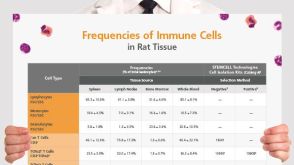 挂图Frequencies of Immune Cells in Rat Tissue Lists the estimated frequencies of more than 15 immune cell types in Sprague Dawley rats



 沪公网安备31010102008431号