Ginestier C et al. (NOV 2007)
Cell stem cell 1 5 555--67
ALDH1 is a marker of normal and malignant human mammary stem cells and a predictor of poor clinical outcome.
Application of stem cell biology to breast cancer research has been limited by the lack of simple methods for identification and isolation of normal and malignant stem cells. Utilizing in vitro and in vivo experimental systems,we show that normal and cancer human mammary epithelial cells with increased aldehyde dehydrogenase activity (ALDH) have stem/progenitor properties. These cells contain the subpopulation of normal breast epithelium with the broadest lineage differentiation potential and greatest growth capacity in a xenotransplant model. In breast carcinomas,high ALDH activity identifies the tumorigenic cell fraction,capable of self-renewal and of generating tumors that recapitulate the heterogeneity of the parental tumor. In a series of 577 breast carcinomas,expression of ALDH1 detected by immunostaining correlated with poor prognosis. These findings offer an important new tool for the study of normal and malignant breast stem cells and facilitate the clinical application of stem cell concepts.
View Publication
产品号#:
01700
01705
01702
产品名:
ALDEFLUOR™ 试剂盒
ALDEFLUOR™ DEAB试剂, 1.5 mM, 1 mL
ALDEFLUOR™检测缓冲液
Shafee N et al. (MAY 2008)
Cancer research 68 9 3243--50
Cancer stem cells contribute to cisplatin resistance in Brca1/p53-mediated mouse mammary tumors.
The majority of BRCA1-associated breast cancers are basal cell-like,which is associated with a poor outcome. Using a spontaneous mouse mammary tumor model,we show that platinum compounds,which generate DNA breaks during the repair process,are more effective than doxorubicin in Brca1/p53-mutated tumors. At 0.5 mg/kg of daily cisplatin treatment,80% primary tumors (n = 8) show complete pathologic response. At greater dosages,100% show complete response (n = 19). However,after 2 to 3 months of complete remission following platinum treatment,tumors relapse and become refractory to successive rounds of treatment. Approximately 3.8% to 8.0% (mean,5.9%) of tumor cells express the normal mammary stem cell markers,CD29(hi)24(med),and these cells are tumorigenic,whereas CD29(med)24(-/lo) and CD29(med)24(hi) cells have diminished tumorigenicity or are nontumorigenic,respectively. In partially platinum-responsive primary transplants,6.6% to 11.0% (mean,8.8%) tumor cells are CD29(hi)24(med); these populations significantly increase to 16.5% to 29.2% (mean,22.8%; P textless 0.05) in platinum-refractory secondary tumor transplants. Further,refractory tumor cells have greater colony-forming ability than the primary transplant-derived cells in the presence of cisplatin. Expression of a normal stem cell marker,Nanog,is decreased in the CD29(hi)24(med) populations in the secondary transplants. Top2A expression is also down-regulated in secondary drug-resistant tumor populations and,in one case,was accompanied by genomic deletion of Top2A. These studies identify distinct cancer cell populations for therapeutic targeting in breast cancer and implicate clonal evolution and expansion of cancer stem-like cells as a potential cause of chemoresistance.
View Publication
Purification and unique properties of mammary epithelial stem cells.
Elucidation of the cellular and molecular mechanisms that maintain mammary epithelial tissue integrity is of broad interest and paramount to the design of more effective treatments for breast cancer. Evidence from both in vitro and in vivo experiments suggests that mammary cell differentiation is a hierarchical process originating in an uncommitted stem cell with self-renewal potential. However,analysis of the properties and regulation of mammary stem cells has been limited by a lack of methods for their prospective isolation. Here we report the use of multi-parameter cell sorting and limiting dilution transplant analysis to demonstrate the purification of a rare subset of adult mouse mammary cells that are able individually to regenerate an entire mammary gland within 6 weeks in vivo while simultaneously executing up to ten symmetrical self-renewal divisions. These mammary stem cells are phenotypically distinct from and give rise to mammary epithelial progenitor cells that produce adherent colonies in vitro. The mammary stem cells are also a rapidly cycling population in the normal adult and have molecular features indicative of a basal position in the mammary epithelium.
View Publication
产品号#:
19757
产品名:
Luo M et al. (JAN 2009)
Cancer research 69 2 466--74
Mammary epithelial-specific ablation of the focal adhesion kinase suppresses mammary tumorigenesis by affecting mammary cancer stem/progenitor cells.
Focal adhesion kinase (FAK) has been implicated in the development of cancers,including those of the breast. Nevertheless,the molecular and cellular mechanisms by which FAK promotes mammary tumorigenesis in vivo are not well understood. Here,we show that targeted deletion of FAK in mouse mammary epithelium significantly suppresses mammary tumorigenesis in a well-characterized breast cancer model. Ablation of FAK leads to the depletion of a subset of bipotent cells in the tumor that express both luminal marker keratin 8/18 and basal marker keratin 5. Using mammary stem/progenitor markers,including aldehyde dehydrogenase,CD24,CD29,and CD61,we further revealed that ablation of FAK reduced the pool of cancer stem/progenitor cells in primary tumors of FAK-targeted mice and impaired their self-renewal and migration in vitro. Finally,through transplantation in NOD-SCID mice,we found that cancer stem/progenitor cells isolated from FAK-targeted mice have compromised tumorigenicity and impaired maintenance in vivo. Together,these results show a novel function of FAK in maintaining the mammary cancer stem/progenitor cell population and provide a novel mechanism by which FAK may promote breast cancer development and progression.
View Publication
Jeselsohn R et al. (JAN 2010)
Cancer cell 17 1 65--76
Cyclin D1 kinase activity is required for the self-renewal of mammary stem and progenitor cells that are targets of MMTV-ErbB2 tumorigenesis.
Transplantation studies have demonstrated the existence of mammary progenitor cells with the ability to self-renew and regenerate a functional mammary gland. Although these progenitors are the likely targets for oncogenic transformation,correlating progenitor populations with certain oncogenic stimuli has been difficult. Cyclin D1 is required for lobuloalveolar development during pregnancy and lactation as well as MMTV-ErbB2- but not MMTV-Wnt1-mediated tumorigenesis. Using a kinase-deficient cyclin D1 mouse,we identified two functional mammary progenitor cell populations,one of which is the target of MMTV-ErbB2. Moreover,cyclin D1 activity is required for the self-renewal and differentiation of mammary progenitors because its abrogation leads to a failure to maintain the mammary epithelial regenerative potential and also results in defects in luminal lineage differentiation.
View Publication
产品号#:
19757
产品名:
Jiao X et al. (MAR 2010)
The Journal of biological chemistry 285 11 8218--26
c-Jun induces mammary epithelial cellular invasion and breast cancer stem cell expansion.
The molecular mechanisms governing breast tumor cellular self-renewal contribute to breast cancer progression and therapeutic resistance. The ErbB2 oncogene is overexpressed in approximately 30% of human breast cancers. c-Jun,the first cellular proto-oncogene,is overexpressed in human breast cancer. However,the role of endogenous c-Jun in mammary tumor progression is unknown. Herein,transgenic mice expressing the mammary gland-targeted ErbB2 oncogene were crossed with c-jun(f/f) transgenic mice to determine the role of endogenous c-Jun in mammary tumor invasion and stem cell function. The excision of c-jun by Cre recombinase reduced cellular migration,invasion,and mammosphere formation of ErbB2-induced mammary tumors. Proteomic analysis identified a subset of secreted proteins (stem cell factor (SCF) and CCL5) induced by ErbB2 expression that were dependent upon endogenous c-Jun expression. SCF and CCL5 were identified as transcriptionally induced by c-Jun. CCL5 rescued the c-Jun-deficient breast tumor cellular invasion phenotype. SCF rescued the c-Jun-deficient mammosphere production. Endogenous c-Jun thus contributes to ErbB2-induced mammary tumor cell invasion and self-renewal.
View Publication
Yamaji D et al. (OCT 2009)
Genes & development 23 20 2382--7
Development of mammary luminal progenitor cells is controlled by the transcription factor STAT5A.
Mammary alveologenesis is abrogated in the absence of the transcription factors STAT5A/5B,which mediate cytokine signaling. To reveal the underlying causes for this developmental block,we studied mammary stem and progenitor cells. While loss of STAT5A/5B did not affect the stem cell population and its ability to form mammary ducts,luminal progenitors were greatly reduced and unable to form alveoli during pregnancy. Temporally controlled expression of transgenic STAT5A in mammary epithelium lacking STAT5A/5B restored the luminal progenitor population and rescued alveologenesis in a reversible fashion in vivo. Thus,STAT5A is necessary and sufficient for the establishment of luminal progenitor cells.
View Publication
产品号#:
05610
产品名:
EpiCult™-B 小鼠培养基
Shimono Y et al. (AUG 2009)
Cell 138 3 592--603
Downregulation of miRNA-200c links breast cancer stem cells with normal stem cells.
Human breast tumors contain a breast cancer stem cell (BCSC) population with properties reminiscent of normal stem cells. We found 37 microRNAs that were differentially expressed between human BCSCs and nontumorigenic cancer cells. Three clusters,miR-200c-141,miR-200b-200a-429,and miR-183-96-182 were downregulated in human BCSCs,normal human and murine mammary stem/progenitor cells,and embryonal carcinoma cells. Expression of BMI1,a known regulator of stem cell self-renewal,was modulated by miR-200c. miR-200c inhibited the clonal expansion of breast cancer cells and suppressed the growth of embryonal carcinoma cells in vitro. Most importantly,miR-200c strongly suppressed the ability of normal mammary stem cells to form mammary ducts and tumor formation driven by human BCSCs in vivo. The coordinated downregulation of three microRNA clusters and the similar functional regulation of clonal expansion by miR-200c provide a molecular link that connects BCSCs with normal stem cells.
View Publication


 EasySep™小鼠TIL(CD45)正选试剂盒




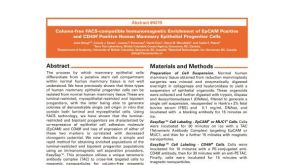 科学海报Column-Free Enrichment of EPCAM Positive and CD49F Positive Human Mammary Epithelial Progenitor Cells
 技术窍门组织解离方法指南

 沪公网安备31010102008431号