Crow J et al. (JUL 2010)
The Journal of molecular diagnostics : JMD 12 4 530--7
Donor cell leukemia in umbilical cord blood transplant patients: a case study and literature review highlighting the importance of molecular engraftment analysis.
Donor cell neoplasms are rare complications of treatment regimens that involve stem cell transplantation for hematological malignancies,myelodysplastic processes,or certain genetic or metabolic disorders. We report a case of donor cell leukemia in a pediatric patient with a history of acute myeloid leukemia that manifested as recurrent AML FAB type M5 fourteen months after umbilical cord blood transplantation. Although there was some immunophenotypic drift from the patient's original AML and their posttransplant presentation,the initial pathological impression was of recurrent disease. Bone marrow engraftment analysis by multiplex PCR of short tandem repeat markers performed on the patient's diagnostic specimen showed complete engraftment by donor cells,with a loss of heterozygosity in the donor alleles on chromosome 7. This led to the reinterpretation of this patient's disease as donor-derived leukemia. This interpretation was supported by a routine karyotype and fluorescence in situ hybridization analysis showing loss of chromosome 7 and a male (donor) chromosome complement in this female patient. Also noted was a loss of the patient's presenting chromosomal abnormality,t(11;19)(q23;p13). This case highlights the need for close coordination between all aspects of clinical testing for the transplant patient,including molecular engraftment studies,when distinguishing the very common complication of recurrent disease from the exceedingly rare complication of donor cell leukemia.
View Publication
Kang L et al. ( 2013)
Frontiers in immunology 4 MAY 101
Characterization and ex vivo Expansion of Human Placenta-Derived Natural Killer Cells for Cancer Immunotherapy.
Recent clinical studies suggest that adoptive transfer of donor-derived natural killer (NK) cells may improve clinical outcome in hematological malignancies and some solid tumors by direct anti-tumor effects as well as by reduction of graft versus host disease (GVHD). NK cells have also been shown to enhance transplant engraftment during allogeneic hematopoietic stem cell transplantation (HSCT) for hematological malignancies. The limited ex vivo expansion potential of NK cells from peripheral blood (PB) or umbilical cord blood (UCB) has however restricted their therapeutic potential. Here we define methods to efficiently generate NK cells from donor-matched,full-term human placenta perfusate (termed Human Placenta-Derived Stem Cell,HPDSC) and UCB. Following isolation from cryopreserved donor-matched HPDSC and UCB units,CD56+CD3- placenta-derived NK cells,termed pNK cells,were expanded in culture for up to 3 weeks to yield an average of 1.2 billion cells per donor that were textgreater80% CD56+CD3-,comparable to doses previously utilized in clinical applications. Ex vivo-expanded pNK cells exhibited a marked increase in anti-tumor cytolytic activity coinciding with the significantly increased expression of NKG2D,NKp46,and NKp44 (p textless 0.001,p textless 0.001,and p textless 0.05,respectively). Strong cytolytic activity was observed against a wide range of tumor cell lines in vitro. pNK cells display a distinct microRNA (miRNA) expression profile,immunophenotype,and greater anti-tumor capacity in vitro compared to PB NK cells used in recent clinical trials. With further development,pNK may represent a novel and effective cellular immunotherapy for patients with high clinical needs and few other therapeutic options.
View Publication


 EasySep™小鼠TIL(CD45)正选试剂盒




 技术公告通过流式细胞仪进行纯度检测,以进行谱系特异性嵌合分析
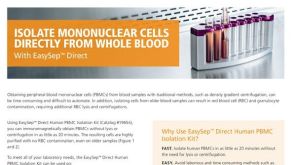 产品手册从全血中直接分离单个核细胞

 沪公网安备31010102008431号