Kim et al. (May 2024)
Journal of Tissue Engineering 15
Modeling of solar UV-induced photodamage on the hair follicles in human skin organoids
Solar ultraviolet (sUV) exposure is known to cause skin damage. However,the pathological mechanisms of sUV on hair follicles have not been extensively explored. Here,we established a model of sUV-exposed skin and its appendages using human induced pluripotent stem cell-derived skin organoids with planar morphology containing hair follicles. Our model closely recapitulated several symptoms of photodamage,including skin barrier disruption,extracellular matrix degradation,and inflammatory response. Specifically,sUV induced structural damage and catagenic transition in hair follicles. As a potential therapeutic agent for hair follicles,we applied exosomes isolated from human umbilical cord blood-derived mesenchymal stem cells to sUV-exposed organoids. As a result,exosomes effectively alleviated inflammatory responses by inhibiting NF-κB activation,thereby suppressing structural damage and promoting hair follicle regeneration. Ultimately,our model provided a valuable platform to mimic skin diseases,particularly those involving hair follicles,and to evaluate the efficacy and underlying mechanisms of potential therapeutics.
View Publication
产品类型:
产品号#:
100-0483
100-0484
产品名:
Hausser Scientificᵀᴹ 明线血球计数板
ReLeSR™
L. Tian et al. (nov 2020)
Wiley interdisciplinary reviews. Developmental biology e399
Human pluripotent stem cell-derived lung organoids: Potential applications in development and disease modeling.
The pulmonary system is comprised of two main compartments,airways and alveolar space. Their tissue and cellular complexity ensure lung function and protection from external agents,for example,virus. Two-dimensional (2D) in vitro systems and animal models have been largely employed to elucidate the molecular mechanisms underlying human lung development,physiology,and pathogenesis. However,neither of these models accurately recapitulate the human lung environment and cellular crosstalk. More recently,human-derived three-dimensional (3D) models have been generated allowing for a deeper understanding of cell-to-cell communication. However,the availability and accessibility of primary human cell sources from which generate the 2D and 3D models may be limited. In the past few years,protocols have been developed to successfully employ human pluripotent stem cells (hPSCs) and differentiate them toward pulmonary fate in vitro. In the present review,we discuss the advantages and pitfalls of hPSC-derived lung 2D and 3D models,including the main characteristics and potentials for these models and their current and future applications for modeling development and diseases. Lung organoids currently represent the closest model to the human pulmonary system. We further focus on the applications of lung organoids for the study of human diseases such as pulmonary fibrosis,infectious diseases,and lung cancer. Finally,we discuss the present limitations and potential future applications of 3D lung organoids. This article is categorized under: Adult Stem Cells,Tissue Renewal,and Regeneration {\textgreater} Stem Cells and Disease Adult Stem Cells,Tissue Renewal,and Regeneration {\textgreater} Stem Cell Differentiation and Reversion.
View Publication
Smith MS et al. (SEP 2010)
Cell host & microbe 8 3 284--91
Granulocyte-colony stimulating factor reactivates human cytomegalovirus in a latently infected humanized mouse model.
Human cytomegalovirus (HCMV) is a significant cause of morbidity and mortality in organ transplant recipients. The use of granulocyte-colony stimulating factor (G-CSF)-mobilized stem cells from HCMV seropositive donors is suggested to double the risk of late-onset HCMV disease and chronic graft-versus-host disease in recipients when compared to conventional bone marrow transplantation with HCMV seropositive donors,although the etiology of the increased risk is unknown. To understand mechanisms of HCMV transmission in patients receiving G-CSF-mobilized blood products,we generated a NOD-scid IL2Rγ(c)(null)-humanized mouse model in which HCMV establishes latent infection in human hematopoietic cells. In this model,G-CSF induces the reactivation of latent HCMV in monocytes/macrophages that have migrated into organ tissues. In addition to establishing a humanized mouse model for systemic and latent HCMV infection,these results suggest that the use of G-CSF mobilized blood products from seropositive donors pose an elevated risk for HCMV transmission to recipients.
View Publication
产品类型:
产品号#:
200-0000
200-0001
200-0002
70008
70008.1
70008.2
70008.3
70008.4
70008.5
产品名:
冻存的人脐带血CD34+细胞
冻存的人脐带血CD34+细胞
冻存的人脐带血CD34+细胞
冻存的人脐带血CD34+细胞
冻存的人脐带血CD34+细胞
冻存的人脐带血CD34+细胞
冻存的人脐带血CD34+细胞
冻存的人脐带血CD34+细胞
冻存的人脐带血CD34+细胞
Task K et al. (JAN 2012)
PLoS ONE 7 3 e32975
Population based model of human embryonic stem cell (hESC) differentiation during endoderm induction
The mechanisms by which human embryonic stem cells (hESC) differentiate to endodermal lineage have not been extensively studied. Mathematical models can aid in the identification of mechanistic information. In this work we use a population-based modeling approach to understand the mechanism of endoderm induction in hESC,performed experimentally with exposure to Activin A and Activin A supplemented with growth factors (basic fibroblast growth factor (FGF2) and bone morphogenetic protein 4 (BMP4)). The differentiating cell population is analyzed daily for cellular growth,cell death,and expression of the endoderm proteins Sox17 and CXCR4. The stochastic model starts with a population of undifferentiated cells,wherefrom it evolves in time by assigning each cell a propensity to proliferate,die and differentiate using certain user defined rules. Twelve alternate mechanisms which might describe the observed dynamics were simulated,and an ensemble parameter estimation was performed on each mechanism. A comparison of the quality of agreement of experimental data with simulations for several competing mechanisms led to the identification of one which adequately describes the observed dynamics under both induction conditions. The results indicate that hESC commitment to endoderm occurs through an intermediate mesendoderm germ layer which further differentiates into mesoderm and endoderm,and that during induction proliferation of the endoderm germ layer is promoted. Furthermore,our model suggests that CXCR4 is expressed in mesendoderm and endoderm,but is not expressed in mesoderm. Comparison between the two induction conditions indicates that supplementing FGF2 and BMP4 to Activin A enhances the kinetics of differentiation than Activin A alone. This mechanistic information can aid in the derivation of functional,mature cells from their progenitors. While applied to initial endoderm commitment of hESC,the model is general enough to be applicable either to a system of adult stem cells or later stages of ESC differentiation.
View Publication
产品类型:
产品号#:
85850
85857
产品名:
mTeSR™1
mTeSR™1
Peltz L et al. (JAN 2012)
PloS one 7 5 e37162
Resveratrol exerts dosage and duration dependent effect on human mesenchymal stem cell development.
Studies in the past have illuminated the potential benefit of resveratrol as an anticancer (pro-apoptosis) and life-extending (pro-survival) compound. However,these two different effects were observed at different concentration ranges. Studies of resveratrol in a wide range of concentrations on the same cell type are lacking,which is necessary to comprehend its diverse and sometimes contradictory cellular effects. In this study,we examined the effects of resveratrol on cell self-renewal and differentiation of human mesenchymal stem cells (hMSCs),a type of adult stem cells that reside in a number of tissues,at concentrations ranging from 0.1 to 10 µM after both short- and long-term exposure. Our results reveal that at 0.1 µM,resveratrol promotes cell self-renewal by inhibiting cellular senescence,whereas at 5 µM or above,resveratrol inhibits cell self-renewal by increasing senescence rate,cell doubling time and S-phase cell cycle arrest. At 1 µM,its effect on cell self-renewal is minimal but after long-term exposure it exerts an inhibitory effect,accompanied with increased senescence rate. At all concentrations,resveratrol promotes osteogenic differentiation in a dosage dependent manner,which is offset by its inhibitory effect on cell self-renewal at high concentrations. On the contrary,resveratrol suppresses adipogenic differentiation during short-term exposure but promotes this process after long-term exposure. Our study implicates that resveratrol is the most beneficial to stem cell development at 0.1 µM and caution should be taken in applying resveratrol as an anticancer therapeutic agent or nutraceutical supplement due to its dosage dependent effect on hMSCs.
View Publication
产品类型:
产品号#:
72862
72864
产品名:
白藜芦醇(Resveratrol)
白藜芦醇(Resveratrol)
Wu J and Tzanakakis ES ( 2012)
PLoS ONE 7 11 e50715
Contribution of stochastic partitioning at human embryonic stem cell division to NANOG heterogeneity.
Heterogeneity is an often unappreciated characteristic of stem cell populations yet its importance in fate determination is becoming increasingly evident. Although gene expression noise has received greater attention as a source of non-genetic heterogeneity,the effects of stochastic partitioning of cellular material during mitosis on population variability have not been researched to date. We examined self-renewing human embryonic stem cells (hESCs),which typically exhibit a dispersed distribution of the pluripotency marker NANOG. In conjunction with our experiments,a multiscale cell population balance equation (PBE) model was constructed accounting for transcriptional noise and stochastic partitioning at division as sources of population heterogeneity. Cultured hESCs maintained time-invariant profiles of size and NANOG expression and the data were utilized for parameter estimation. Contributions from both sources considered in this study were significant on the NANOG profile,although elimination of the gene expression noise resulted in greater changes in the dispersion of the NANOG distribution. Moreover,blocking of division by treating hESCs with nocodazole or colcemid led to a 39% increase in the average NANOG content and over 68% of the cells had higher NANOG level than the mean NANOG expression of untreated cells. Model predictions,which were in excellent agreement with these findings,revealed that stochastic partitioning accounted for 17% of the total noise in the NANOG profile of self-renewing hESCs. The computational framework developed in this study will aid in gaining a deeper understanding of how pluripotent stem/progenitor cells orchestrate processes such as gene expression and proliferation for maintaining their pluripotency or differentiating along particular lineages. Such models will be essential in designing and optimizing efficient differentiation strategies and bioprocesses for the production of therapeutically suitable stem cell progeny.
View Publication
产品类型:
产品号#:
85850
85857
产品名:
mTeSR™1
mTeSR™1
Hansel MC et al. (JAN 2014)
Cell Transplantation 23 1 27--38
Increased reprogramming of human fetal hepatocytes compared with adult hepatocytes in feeder-free conditions
Hepatocyte transplantation has been used to treat liver disease. The availability of cells for these procedures is quite limited. Human embryonic stem cells (hESCs) and induced pluripotent stem cells (hiPSCs) may be a useful source of hepatocytes for basic research and transplantation if efficient and effective differentiation protocols were developed and problems with tumorigenicity could be overcome. Recent evidence suggests that the cell of origin may affect hiPSC differentiation. Thus,hiPSCs generated from hepatocytes may differentiate back to hepatocytes more efficiently than hiPSCs from other cell types. We examined the efficiency of reprogramming adult and fetal human hepatocytes. The present studies report the generation of 40 hiPSC lines from primary human hepatocytes under feeder-free conditions. Of these,37 hiPSC lines were generated from fetal hepatocytes,2 hiPSC lines from normal hepatocytes,and 1 hiPSC line from hepatocytes of a patient with Crigler-Najjar syndrome,type 1. All lines were confirmed reprogrammed and expressed markers of pluripotency by gene expression,flow cytometry,immunocytochemistry,and teratoma formation. Fetal hepatocytes were reprogrammed at a frequency over 50-fold higher than adult hepatocytes. Adult hepatocytes were only reprogrammed with six factors,while fetal hepatocytes could be reprogrammed with three (OCT4,SOX2,NANOG) or four factors (OCT4,SOX2,NANOG,LIN28 or OCT4,SOX2,KLF4,C-MYC). The increased reprogramming efficiency of fetal cells was not due to increased transduction efficiency or vector toxicity. These studies confirm that hiPSCs can be generated from adult and fetal hepatocytes including those with genetic diseases. Fetal hepatocytes reprogram much more efficiently than adult hepatocytes,although both could serve as useful sources of hiPSC-derived hepatocytes for basic research or transplantation.
View Publication
产品类型:
产品号#:
85850
85857
产品名:
mTeSR™1
mTeSR™1
Betts BC et al. (FEB 2014)
Journal of leukocyte biology 95 2 205--13
STAT5 polarization promotes iTregs and suppresses human T-cell alloresponses while preserving CTL capacity.
Alloreactivity negatively influences outcomes of organ transplantation or HCT from allogeneic donors. Standard pharmacologic immune suppression impairs T-cell function and jeopardizes the beneficial reconstitution of Tregs. Murine transplantation models have shown that STAT3 is highly expressed in alloreactive T cells and may be therapeutically targeted. The influence and effects of STAT3 neutralization in human alloreactivity,however,remain to be elucidated. In this study,S3I-201,a selective small-molecule inhibitor of STAT3,suppressed human DC-allosensitized T-cell proliferation and abrogated Th17 responses. STAT3 blockade significantly enhanced the expansion of potent iTregs and permitted CD8(+) cytolytic effector function. Mechanistically,S3I-201 polarized the ratio of STAT phosphorylation in favor of STAT5 over STAT3 and also achieved a significant degree of Foxp3 demethylation among the iTregs. Conversely,selective impairment of STAT5 phosphorylation with CAS 285986-31-4 markedly reduced iTregs. STAT3 represents a relevant target for achieving control over human alloresponses,where its suppression facilitates STAT5-mediated iTreg growth and function.
View Publication
B. G. Wiggins et al. (jul 2022)
Gut 71 7 1399--1411
The human liver microenvironment shapes the homing and function of CD4+ T-cell populations.
OBJECTIVE Tissue-resident memory T cells (TRM) are vital immune sentinels that provide protective immunity. While hepatic CD8+ TRM have been well described,little is known about the location,phenotype and function of CD4+ TRM. DESIGN We used multiparametric flow cytometry,histological assessment and novel human tissue coculture systems to interrogate the ex vivo phenotype,function and generation of the intrahepatic CD4+ T-cell compartment. We also used leukocytes isolated from human leukocyte antigen (HLA)-disparate liver allografts to assess long-term retention. RESULTS Hepatic CD4+ T cells were delineated into three distinct populations based on CD69 expression: CD69-,CD69INT and CD69HI. CD69HICD4+ cells were identified as tissue-resident CD4+ T cells on the basis of their exclusion from the circulation,phenotypical profile (CXCR6+CD49a+S1PR1-PD-1+) and long-term persistence within the pool of donor-derived leukcoocytes in HLA-disparate liver allografts. CD69HICD4+ T cells produced robust type 1 polyfunctional cytokine responses on stimulation. Conversely,CD69INTCD4+ T cells represented a more heterogenous population containing cells with a more activated phenotype,a distinct chemokine receptor profile (CX3CR1+CXCR3+CXCR1+) and a bias towards interleukin-4 production. While CD69INTCD4+ T cells could be found in the circulation and lymph nodes,these cells also formed part of the long-term resident pool,persisting in HLA-mismatched allografts. Notably,frequencies of CD69INTCD4+ T cells correlated with necroinflammatory scores in chronic hepatitis B infection. Finally,we demonstrated that interaction with hepatic epithelia was sufficient to generate CD69INTCD4+ T cells,while additional signals from the liver microenvironment were required to generate liver-resident CD69HICD4+ T cells. CONCLUSIONS High and intermediate CD69 expressions mark human hepatic CD4+ TRM and a novel functionally distinct recirculating population,respectively,both shaped by the liver microenvironment to achieve diverse immunosurveillance.
View Publication


 EasySep™小鼠TIL(CD45)正选试剂盒




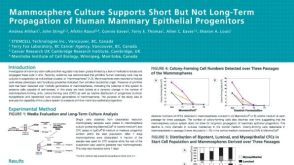 科学海报Mammosphere Culture Supports Short But Not Long-Term Propagation of Human Mammary Epithelial Progenitors

 沪公网安备31010102008431号