J. U. Hermansen et al. (dec 2018)
Scientific reports 8 1 17651
Cryopreservation of primary B cells minimally influences their signaling responses.
Phospho flow is a powerful approach to detect cell signaling aberrations,identify biomarkers and assess pharmacodynamics,and can be performed using cryopreserved samples. The effects of cryopreservation on signaling responses and the reproducibility of phospho flow measurements are however unknown in many cell systems. Here,B lymphocytes were isolated from healthy donors and patients with the B cell malignancy chronic lymphocytic leukemia and analyzed by phospho flow using phospho-specific antibodies targeting 20 different protein epitopes. Cells were analyzed both at basal conditions and after activation of cluster of differentiation 40 (CD40) or the B cell receptor. Pharmacodynamics of the novel pathway inhibitor ibrutinib was also assessed. At all conditions,fresh cells were compared to cryopreserved cells. Minimal variation between fresh and frozen samples was detected. Reproducibility was tested by running samples from the same donors in different experiments. The results demonstrate reproducibility across different phospho flow runs and support the use of cryopreserved samples in future phospho flow studies of B lymphocytes.
View Publication
产品类型:
产品号#:
15024
15064
产品名:
RosetteSep™ 人B细胞富集抗体混合物
RosetteSep™人B细胞富集抗体混合物
Pieters T et al. (SEP 2012)
Stem cell reviews 8 3 768--78
Efficient and user-friendly pluripotin-based derivation of mouse embryonic stem cells.
Classic derivation of mouse embryonic stem (ES) cells from blastocysts is inefficient,strain-dependent,and requires expert skills. Over recent years,several major improvements have greatly increased the success rate for deriving mouse ES cell lines. The first improvement was the establishment of a user-friendly and reproducible medium-alternating protocol that allows isolation of ES cells from C57BL/6 transgenic mice with efficiencies of up to 75%. A recent report describes the use of this protocol in combination with leukemia inhibitory factor and pluripotin treatment,which made it possible to obtain ES cells from F1 strains with high efficiency. We report modifications of these protocols for user-friendly and reproducible derivation of mouse ES cells with efficiencies of up to 100%. Our protocol involves a long initial incubation of primary outgrowths from blastocysts with pluripotin,which results in the formation of large spherical outgrowths. These outgrowths are morphologically distinct from classical inner cell mass (ICM) outgrowths and can be easily picked and trypsinized. Pluripotin was omitted after the first trypsinization because we found that it blocks attachment of ES cells to the feeder layer and its removal facilitated formation of ES cell colonies. The newly established ES cells exhibited normal karyotypes and generated chimeras. In summary,our user-friendly modified protocol allows formation of large spherical ICM outgrowths in a robust and reliable manner. These outgrowths gave rise to ES cell lines with success rates of up to 100%.
View Publication
产品类型:
产品号#:
72812
72814
产品名:
Pluripotin
Pluripotin
Koshkin V et al. (JAN 2016)
Journal of cellular biochemistry 117 1 59--65
Metabolic Suppression of a Drug-Resistant Subpopulation in Cancer Spheroid Cells.
Inhibition of metabolic features which distinguish cancer cells from their non-malignant counterparts is a promising approach to cancer treatment. Energy support for drug extrusion in multidrug resistance (MDR) is a potential target for metabolic inhibition. Two major sources of ATP-based metabolic energy are partial (glycolysis) and complete (mitochondrial oxidative phosphorylation) oxidation of metabolic fuels. In cancer cells,the balance between them tends to be shifted toward glycolysis; this shift is considered to be characteristic of the cancer metabolic phenotype. Numerous earlier studies,conducted with cells cultured in a monolayer (2-D model),suggested inhibition of glycolytic ATP production as an efficient tool to suppress MDR in cancer cells. Yet,more recent work challenged the appropriateness of the 2-D model for such studies and suggested that a more clinically relevant approach would utilize a more advanced cellular model such as a 3-D model. Here,we show that the transition from the 2-D model (cultured monolayer) to a 3-D model (cultured spheroids) introduces essential changes into the concept of energetic suppression of MDR. The 3-D cell organization leads to the formation of a discrete cell subpopulation (not formed in the 2-D model) with elevated MDR transport capacity. This subpopulation has a specific metabolic phenotype (mixed glycolytic/oxidative MDR support) different from that of cells cultured in the 2-D model. Finally,the shift to the oxidative phenotype becomes greater when the spheroids are grown under conditions of lactic acidosis that are typical for solid tumors. The potential clinical significance of these findings is discussed.
View Publication
产品类型:
产品号#:
05620
产品名:
MammoCult™人培养基试剂盒
Han S et al. (JAN 2016)
Biochemical and biophysical research communications 469 4 1153--1158
Evodiamine selectively targets cancer stem-like cells through the p53-p21-Rb pathway.
In spite of the recent improvements,the resistance to chemotherapy/radiotherapy followed by relapse is the main hurdle for the successful treatment of breast cancer,a leading cause of death in women. A small population of breast cancer cells that have stem-like characteristics (cancer stem-like cells; CSLC) may contribute to this resistance and relapse. Here,we report on a component of a traditional Chinese medicine,evodiamine,which selectively targets CSLC of breast cancer cell lines MCF7 and MDAMB 231 at a concentration that does show a little or no cytotoxic effect on bulk cancer cells. While evodiamine caused the accumulation of bulk cancer cells at the G2/M phase,it did not hold CSLC in a specific cell cycle phase but instead,selectively killed CSLC. This was not due to the culture of CSLC in suspension or without FBS. A proteomic analysis and western blotting revealed that evodiamine changed the expression of cell cycle regulating molecules more efficiently in CSLC cells than in bulk cancer cells. Surprisingly,evodiamine selectively activated p53 and p21 and decreased inactive Rb,the master molecules in G1/S checkpoint. These data collectively suggest a novel mechanism involving CSLC-specific targeting by evodiamine and its possible use to the therapy of breast cancer.
View Publication
产品类型:
产品号#:
05620
产品名:
MammoCult™人培养基试剂盒
Ito N et al. (APR 2016)
Disease models & mechanisms 9 4 451--462
Decreased N-TAF1 expression in X-linked dystonia-parkinsonism patient-specific neural stem cells.
X-linked dystonia-parkinsonism (XDP) is a hereditary neurodegenerative disorder involving a progressive loss of striatal medium spiny neurons. The mechanisms underlying neurodegeneration are not known,in part because there have been few cellular models available for studying the disease. The XDP haplotype consists of multiple sequence variations in a region of the X chromosome containingTAF1,a large gene with at least 38 exons,and a multiple transcript system (MTS) composed of five unconventional exons. A previous study identified an XDP-specific insertion of a SINE-VNTR-Alu (SVA)-type retrotransposon in intron 32 ofTAF1,as well as a neural-specific TAF1 isoform,N-TAF1,which showed decreased expression in post-mortem XDP brain compared with control tissue. Here,we generated XDP patient and control fibroblasts and induced pluripotent stem cells (iPSCs) in order to further probe cellular defects associated with this disease. As initial validation of the model,we compared expression ofTAF1and MTS transcripts in XDP versus control fibroblasts and iPSC-derived neural stem cells (NSCs). Compared with control cells,XDP fibroblasts exhibited decreased expression ofTAF1transcript fragments derived from exons 32-36,a region spanning the SVA insertion site. N-TAF1,which incorporates an alternative exon (exon 34'),was not expressed in fibroblasts,but was detectable in iPSC-differentiated NSCs at levels that were ∼threefold lower in XDP cells than in controls. These results support the previous findings that N-TAF1 expression is impaired in XDP,but additionally indicate that this aberrant transcription might occur in neural cells at relatively early stages of development that precede neurodegeneration.
View Publication
Elabd C et al. (OCT 2013)
The Journal of Cell Biology 203 1 73--85
DNA methyltransferase-3–dependent nonrandom template segregation in differentiating embryonic stem cells
Asymmetry of cell fate is one fundamental property of stem cells,in which one daughter cell self-renews,whereas the other differentiates. Evidence of nonrandom template segregation (NRTS) of chromosomes during asymmetric cell divisions in phylogenetically divergent organisms,such as plants,fungi,and mammals,has already been shown. However,before this current work,asymmetric inheritance of chromatids has never been demonstrated in differentiating embryonic stem cells (ESCs),and its molecular mechanism has remained unknown. Our results unambiguously demonstrate NRTS in asymmetrically dividing,differentiating human and mouse ESCs. Moreover,we show that NRTS is dependent on DNA methylation and on Dnmt3 (DNA methyltransferase-3),indicating a molecular mechanism that regulates this phenomenon. Furthermore,our data support the hypothesis that retention of chromatids with the old" template DNA preserves the epigenetic memory of cell fate�
View Publication
Telomerase protects werner syndrome lineage-specific stem cells from premature aging.
Werner syndrome (WS) patients exhibit premature aging predominantly in mesenchyme-derived tissues,but not in neural lineages,a consequence of telomere dysfunction and accelerated senescence. The cause of this lineage-specific aging remains unknown. Here,we document that reprogramming of WS fibroblasts to pluripotency elongated telomere length and prevented telomere dysfunction. To obtain mechanistic insight into the origin of tissue-specific aging,we differentiated iPSCs to mesenchymal stem cells (MSCs) and neural stem/progenitor cells (NPCs). We observed recurrence of premature senescence associated with accelerated telomere attrition and defective synthesis of the lagging strand telomeres in MSCs,but not in NPCs. We postulate this aging" discrepancy is regulated by telomerase. Expression of hTERT or p53 knockdown ameliorated the accelerated aging phenotypein MSC�
View Publication
产品类型:
产品号#:
85850
85857
产品名:
mTeSR™1
mTeSR™1
Kendellen MF et al. (MAR 2014)
Oncogene 33 10 1297--1305
Canonical and non-canonical NF-$$B signaling promotes breast cancer tumor-initiating cells.
Tumor-initiating cells (TICs) are a sub-population of cells that exhibit a robust ability to self-renew and contribute to the formation of primary tumors,the relapse of previously treated tumors and the development of metastases. TICs have been identified in various tumors including those of the breast,and are particularly enriched in the basal-like and claudin-low subtypes of breast cancer. The signaling pathways that contribute to the function and maintenance of TICs are under intense study. We explored the potential involvement of the nuclear factor-$$B (NF-$$B) family of transcription factors in TICs in cell lines that are representative of basal-like and claudin-low breast cancer. NF-$$B was found to be activated in breast cancer cells that form tumorspheres efficiently. Moreover,both canonical and non-canonical NF-$$B signaling is required for these cells to self-renew in vitro and to form xenograft tumors efficiently in vivo using limiting dilutions of cells. Consistent with this fact,canonical and non-canonical NF-$$B signaling is activated in TICs isolated from breast cancer cell lines. Experimental results indicate that NF-$$B promotes the function of TICs by stimulating epithelial-to-mesenchymal transition and by upregulating the expression of the inflammatory cytokines interleukin-1$$ and interleukin-6. The results suggest the use of NF-$$B inhibitors for clinical therapy of certain breast cancers.
View Publication
产品类型:
产品号#:
05620
产品名:
MammoCult™人培养基试剂盒
K. A. Davis et al. (jun 2020)
Journal of biomedical materials research. Part A
Increased yield of gelatin coated therapeutic cells through cholesterol insertion.
Gelatin coatings are effective in increasing the retention of MSCs injected into the heart and minimizing the damage from acute myocardial infarction (AMI),but early studies suffered from low fractions of the MSCs coated with gelatin. Biotinylation of the MSC surface is a critical first step in the gelatin coating process,and in this study,we evaluated the use of biotinylated cholesterol lipid insertion" anchors as a substitute for the covalent NHS-biotin anchors to the cell surface. Streptavidin-eosin molecules where eosin is our photoinitiator can then be bound to the cell surface through biotin-streptavidin affinity. The use of cholesterol anchors increased streptavidin density on the surface of MSCs further driving polymerization and allowing for an increased fraction of MSCs coated with gelatin (83{\%}) when compared to NHS-biotin (52{\%}). Additionally the cholesterol anchors increased the uniformity of the coating on the MSC surface and supported greater numbers of coated MSCs even when the streptavidin density was slightly lower than that of an NHS-biotin anchoring strategy. Critically this improvement in gelatin coating efficiency did not impact cytokine secretion and other critical MSC functions. Proper selection of the cholesterol anchor and the biotinylation conditions supports cellular function and densities of streptavidin on the MSC surface of up to {\~{}}105 streptavidin molecules/$\mu$m2 . In all these cholesterol anchors offer an effective path towards the formation of conformal coatings on the majority of MSCs to improve the retention of MSCs in the heart following AMI."
View Publication
产品类型:
产品号#:
05513
产品名:
MesenCult™ 扩增试剂盒 (小鼠)
S. H. Choi et al. (oct 2020)
Genes 11 10 1169
Detargeting Lentiviral-Mediated CFTR Expression in Airway Basal Cells Using miR-106b.
Lentiviral-mediated integration of a CFTR transgene cassette into airway basal cells is a strategy being considered for cystic fibrosis (CF) cell-based therapies. However,CFTR expression is highly regulated in differentiated airway cell types and a subset of intermediate basal cells destined to differentiate. Since basal stem cells typically do not express CFTR,suppressing the CFTR expression from the lentiviral vector in airway basal cells may be beneficial for maintaining their proliferative capacity and multipotency. We identified miR-106b as highly expressed in proliferating airway basal cells and extinguished in differentiated columnar cells. Herein,we developed lentiviral vectors with the miR-106b-target sequence (miRT) to both study miR-106b regulation during basal cell differentiation and detarget CFTR expression in basal cells. Given that miR-106b is expressed in the 293T cells used for viral production,obstacles of viral genome integrity and titers were overcome by creating a 293T-B2 cell line that inducibly expresses the RNAi suppressor B2 protein from flock house virus. While miR-106b vectors effectively detargeted reporter gene expression in proliferating basal cells and following differentiation in the air-liquid interface and organoid cultures,the CFTR-miRT vector produced significantly less CFTR-mediated current than the non-miR-targeted CFTR vector following transduction and differentiation of CF basal cells. These findings suggest that miR-106b is expressed in certain airway cell types that contribute to the majority of CFTR anion transport in airway epithelium.
View Publication


 EasySep™小鼠TIL(CD45)正选试剂盒




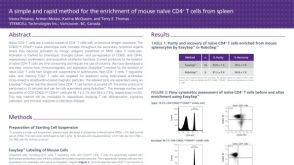 科学海报Cell Enrichment of Mouse Naïve CD4+ T Cells from Spleen

 沪公网安备31010102008431号