

 EasySep™小鼠TIL(CD45)正选试剂盒




Cryopreserving Hepatic Organoids Expanded in HepatiCult™ Organoid Growth Medium (Human)
Cryopreserving Hepatic Organoids Expanded in HepatiCult™ Organoid Growth Medium (Human)
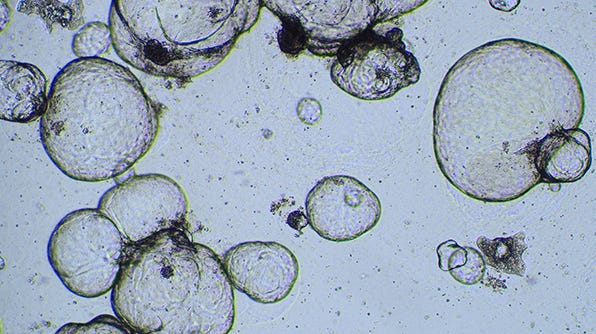
Cryopreserving hepatic organoids can be a key point in your experimental workflow as it offers a pausing point before further differentiation, or to preserve samples for future experiments.
This protocol is for cryopreserving established hepatic organoids in dome cultures grown using the HepatiCult™ Organoid Kit (Human).
Materials
- Healthy hepatic organoid cultures expanded in HepatiCult™ Organoid Growth Medium (Human)
- CryoStor® CS10 (Catalog #07930)
- Advanced DMEM/F-12 (Thermo Fisher 12634028)
- 25% bovine serum albumin (BSA) solution in water
- Sterile 2 mL cryogenic vials
- Sterile 15 mL conical tubes (Catalog #38009)
- Sterile 6-well tissue culture-treated plate (Catalog #38015)
- Sterile 200 µL and 1000 µL pipette tips
- Styrofoam box with ice
- Biohazard safety cabinet
- Controlled-rate cell freezing container (e.g. Corning® CoolCell® (Catalog #200-0642), Mr. Frosty™ etc.)
- Incubator at 5% CO2 and 37°C
Preparation
- Prepare 50 mL of serum-supplemented Advanced DMEM/F-12 (AdvDMEM + BSA):
- 2 mL of 25% BSA
- 48 mL of Advanced DMEM/F-12
- Mix thoroughly and store on ice. Use cold.
Note: This volume is sufficient to cryopreserve one full 24-well plate. If not used immediately, store AdvDMEM + BSA at 2 - 8°C for up to 4 weeks.
- Place CryoStor® CS10 and labeled 2 mL cryogenic vials on ice in the biosafety cabinet.
Protocol
- Check that the Matrigel® domes containing the organoids being cryopreserved are intact. If the dome is intact, proceed to step 2. If the dome is loose, add cold AdvDMEM + BSA to top-up the total volume in the well to 1mL and let sit for 1 minute, then proceed to step 4.
- Without touching the Matrigel® dome, aspirate and discard the medium in each well being processed.
- Using a 1 mL pipettor, forcefully add 1 mL cold AdvDMEM + BSA to the center of each Matrigel® dome and let sit for 1 minute.
- Set the 1 mL pipettor to 1000 µL and vigorously pipette the volume up and down 45 times, taking care not to generate bubbles. This results in mechanical breakdown of hepatic organoids and Matrigel® into smaller fragments of 30 - 100 µm.
Note: Check the sizes of the fragments generated in the well using a light microscope before proceeding to step 5. If most fragments are larger than 100 µm, triturate until they are 30 - 100 µm.
Note: If organoid density is low, or if cryopreserving fragments from multiple wells with the same sample or treatment, the contents of multiple wells can be pooled into a 15 mL conical tube at this stage.
- Vortex the plate containing the organoid fragments in individual wells or the tube containing the pooled organoid fragments gently at medium speed for 5 seconds. To quantify the organoid fragment density in these volumes, immediately transfer 3 x 10 µL from the individual wells or the tube into an empty 6-well plate, creating three separate droplets.
- Using a light microscope, quantify the number of hepatic organoid fragments in each 10 µL droplet, only counting fragments that are 30 - 100 µm. It is recommended to cryopreserve 1000 - 3000 fragments in each cryogenic vial.
Note: If the fragment density is too high to count, dilute the fragment suspension with AdvDMEM + BSA and repeat the count.
- Transfer the desired number of fragments to new 15 mL conical tubes containing 1 mL Advanced DMEM/F-12. Prepare a separate conical tube for each cryogenic vial that will be frozen.
Example:
- Three 10 µL fragment counts: 35, 40, 42
- Average count per 10 µL: 39
- Volume to transfer 1000 fragments to subsequent passage: 256 µL
- Desired number of cryovials containing 1000 fragments: 4
- Prepare 4 x 15 mL conical tubes, each containing 1 mL Advanced DMEM/F-12. Add 256 µL of fragment suspension to each of the four tubes.
- Centrifuge the tubes at 290 x g for 5 minutes.
- Without disturbing the pellets, carefully aspirate and discard as much of the supernatant as possible, leaving 5 - 10 µL in the tube. The pellet is often not visible.
- Place tubes containing pellets on ice. Working with one tube at a time, add 1 mL CryoStor® CS10 and pipette up and down 5 - 8 times to resuspend. Transfer the entire volume into one labeled and cooled cryogenic vial.
- Working quickly, repeat step 10 for all remaining tubes. Transfer all prepared cryogenic vials into a controlled-rate cell freezing container.
- Place cell freezing container at -80ºC for 24 - 48 hours, then transfer cryogenic vials to liquid nitrogen storage.
Note: It is recommended to thaw at least one cryogenic vial within 1 - 2 weeks of cryopreservation to verify viability and density of cryopreserved hepatic organoid fragments.

 沪公网安备31010102008431号