Neutrophil development and function critically depend on Bruton tyrosine kinase in a mouse model of X-linked agammaglobulinemia.
Bruton tyrosine kinase (Btk) is essential for B cell development and function and also appears to be important for myeloid cells. The bone marrow of Btk-deficient mice shows enhanced granulopoiesis compared with that of wild-type mice. In purified granulocyte-monocyte-progenitors (GMP) from Btk-deficient mice,the development of granulocytes is favored at the expense of monocytes. However,Btk-deficient neutrophils are impaired in maturation and function. Using bone marrow chimeras,we show that this defect is cell-intrinsic to neutrophils. In GMP and neutrophils,Btk plays a role in GM-CSF- and Toll-like receptor-induced differentiation. Molecular analyses revealed that expression of the lineage-determining transcription factors C/EBPα,C/EBPβ,and PU.1,depends on Btk. In addition,expression of several granule proteins,including myeloperoxidase,neutrophilic granule protein,gelatinase and neutrophil elastase,is Btk-dependent. In the Arthus reaction,an acute inflammatory response,neutrophil migration into tissues,edema formation,and hemorrhage are significantly reduced in Btk-deficient animals. Together,our findings implicate Btk as an important regulator of neutrophilic granulocyte maturation and function in vivo.
View Publication
Let-7 Suppresses B Cell Activation through Restricting the Availability of Necessary Nutrients.
The control of uptake and utilization of necessary extracellular nutrients-glucose and glutamine-is an important aspect of B cell activation. Let-7 is a family of microRNAs known to be involved in metabolic control. Here,we employed several engineered mouse models,including B cell-specific overexpression of Lin28a or the let-7a-1/let-7d/let-7f-1 cluster (let-7adf) and knockout of individual let-7 clusters to show that let-7adf specifically inhibits T cell-independent (TI) antigen-induced immunoglobulin (Ig)M antibody production. Both overexpression and deletion of let-7 in this cluster leads to altered TI-IgM production. Mechanistically,let-7adf suppresses the acquisition and utilization of key nutrients,including glucose and glutamine,through directly targeting hexokinase 2 (Hk2) and by repressing a glutamine transporter Slc1a5 and a key degradation enzyme,glutaminase (Gls),a mechanism mediated by regulation of c-Myc. Our results suggest a novel role of let-7adf as a metabolic brake" on B cell antibody production."
View Publication
BiHC, a T-Cell-Engaging Bispecific Recombinant Antibody, Has Potent Cytotoxic Activity Against Her2 Tumor Cells.
Among different cancer immunotherapy approaches,bispecific antibodies (BsAbs) are of great interest due to their ability to recruit immune cells to kill tumor cells directly. Various BsAbs against Her2 tumor cells have been proposed with potent cytotoxic activities. However,most of these formats require extensive processing to obtain heterodimeric bispecific antibodies. In this study,we describe a bispecific antibody,BiHC (bispecific Her2-CD3 antibody),constructed with a single-domain anti-Her2 and a single-chain Fv (variable fragment) of anti-CD3 in an IgG-like format. In contrast to most IgG-like BsAbs,the two arms in BiHC have different molecular weights,making it easier to separate hetero- or homodimers. BiHC can be expressed in Escherichia coli and purified via Protein A affinity chromatography. The purified BiHC can recruit T cells and induce specific cytotoxicity of Her2-expressing tumor cells in vitro. The BiHC can also efficiently inhibit the tumor growth in vivo. Thus,BiHC is a promising candidate for the treatment of Her2-positive cancers.
View Publication
产品号#:
17851
17851RF
100-0692
产品名:
EasySep™人CD3正选试剂盒II
RoboSep™ 人CD3正选试剂盒II
EasySep™人CD3正选试剂盒II
Dewhurst JA et al. (AUG 2017)
Scientific reports 7 1 7143
Characterisation of lung macrophage subpopulations in COPD patients and controls.
Lung macrophage subpopulations have been identified based on size. We investigated characteristics of small and large macrophages in the alveolar spaces and lung interstitium of COPD patients and controls. Alveolar and interstitial cells were isolated from lung resection tissue from 88 patients. Macrophage subpopulation cell-surface expression of immunological markers and phagocytic ability were assessed by flow cytometry. Inflammatory related gene expression was measured. Alveolar and interstitial macrophages had subpopulations of small and large macrophages based on size and granularity. Alveolar macrophages had similar numbers of small and large cells; interstitial macrophages were mainly small. Small macrophages expressed significantly higher cell surface HLA-DR,CD14,CD38 and CD36 and lower CD206 compared to large macrophages. Large alveolar macrophages showed lower marker expression in COPD current compared to ex-smokers. Small interstitial macrophages had the highest pro-inflammatory gene expression levels,while large alveolar macrophages had the lowest. Small alveolar macrophages had the highest phagocytic ability. Small alveolar macrophage CD206 expression was lower in COPD patients compared to smokers. COPD lung macrophages include distinct subpopulations; Small interstitial and small alveolar macrophages with more pro-inflammatory and phagocytic function respectively,and large alveolar macrophages with low pro-inflammatory and phagocytic ability.
View Publication
Direct interaction of whole-inactivated influenza A and pneumococcal vaccines enhances influenza-specific immunity.
The upper respiratory tract is continuously exposed to a vast array of potentially pathogenic viruses and bacteria. Influenza A virus (IAV) has particular synergism with the commensal bacterium Streptococcus pneumoniae in this niche,and co-infection exacerbates pathogenicity and causes significant mortality. However,it is not known whether this synergism is associated with a direct interaction between the two pathogens. We have previously reported that co-administration of a whole-inactivated IAV vaccine (gamma-Flu) with a whole-inactivated pneumococcal vaccine (gamma-PN) enhances pneumococcal-specific responses. In this study,we show that mucosal co-administration of gamma-Flu and gamma-PN similarly augments IAV-specific immunity,particularly tissue-resident memory cell responses in the lung. In addition,our in vitro analysis revealed that S. pneumoniae directly interacts with both gamma-Flu and with live IAV,facilitating increased uptake by macrophages as well as increased infection of epithelial cells by IAV. These observations provide an additional explanation for the synergistic pathogenicity of IAV and S. pneumoniae,as well as heralding the prospect of exploiting the phenomenon to develop better vaccine strategies for both pathogens.
View Publication


 EasySep™小鼠TIL(CD45)正选试剂盒





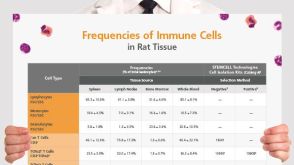 挂图Frequencies of Immune Cells in Rat Tissue Lists the estimated frequencies of more than 15 immune cell types in Sprague Dawley rats

 沪公网安备31010102008431号