Human Immune Cytokines
Infographic of key cytokines for expansion, differentiation and characterization of major immune cell types
Zimmermann M et al. (JAN 2016)
Scientific Reports 6 19674
IFNα enhances the production of IL-6 by human neutrophils activated via TLR8.
Recently,we reported that human neutrophils produce biologically active amounts of IL-6 when incubated with agonists activating TLR8,a receptor recognizing viral single strand RNA. In this study,we demonstrate that IFNα,a cytokine that modulates the early innate immune responses toward viral and bacterial infections,potently enhances the production of IL-6 in neutrophils stimulated with R848,a TLR8 agonist. We also show that such an effect is not caused by an IFNα-dependent induction of TLR7 and its consequent co-activation with TLR8 in response to R848,but,rather,it is substantially mediated by an increased production and release of endogenous TNFα. The latter cytokine,in an autocrine manner,leads to an augmented synthesis of the IkBζ co-activator and an enhanced recruitment of the C/EBPβ transcription factor to the IL-6 promoter. Moreover,we show that neutrophils from SLE patients with active disease state,hence displaying an IFN-induced gene expression signature,produce increased amounts of both IL-6 and TNFα in response to R848 as compared to healthy donors. Altogether,data uncover novel effects that type I IFN exerts in TLR8-activated neutrophils,which therefore enlarge our knowledge on the various biological actions which type I IFN orchestrates during infectious and autoimmune diseases.
View Publication
Brode S et al. (DEC 2010)
Thorax 65 12 1116--7
Interleukin-5 inhibits glucocorticoid-mediated apoptosis in human eosinophils.
Fan Y et al. (JAN 2018)
The Biochemical journal 475 1 23--44
Interrogating Parkinson's disease LRRK2 kinase pathway activity by assessing Rab10 phosphorylation in human neutrophils.
There is compelling evidence for the role of the leucine-rich repeat kinase 2 (LRRK2) and in particular its kinase function in Parkinson's disease. Orally bioavailable,brain penetrant and potent LRRK2 kinase inhibitors are in the later stages of clinical development. Here,we describe a facile and robust assay to quantify LRRK2 kinase pathway activity by measuring LRRK2-mediated phosphorylation of Rab10 in human peripheral blood neutrophils. We use the selective MJFF-pRab10 monoclonal antibody recognising the Rab10 Thr73 phospho-epitope that is phosphorylated by LRRK2. We highlight the feasibility and practicability of using our assay in the clinical setting by studying a few patients with G2019S LRRK2 associated and sporadic Parkinson's as well as healthy controls. We suggest that peripheral blood neutrophils are a valuable resource for LRRK2 research and should be considered for inclusion in Parkinson's bio-repository collections as they are abundant,homogenous and express relatively high levels of LRRK2 as well as Rab10. In contrast,the widely used peripheral blood mononuclear cells are heterogeneous and only a minority of cells (monocytes and contaminating neutrophils) express LRRK2. While our LRRK2 kinase pathway assay could assist in patient stratification based on LRRK2 kinase activity,we envision that it may find greater utility in pharmacodynamic and target engagement studies in future LRRK2 inhibitor trials.
View Publication
Joulia R et al. (JAN 2015)
Nature communications 6 6174
Mast cells form antibody-dependent degranulatory synapse for dedicated secretion and defence.
Mast cells are tissue-resident immune cells that play a key role in inflammation and allergy. Here we show that interaction of mast cells with antibody-targeted cells induces the polarized exocytosis of their granules resulting in a sustained exposure of effector enzymes,such as tryptase and chymase,at the cell-cell contact site. This previously unidentified mast cell effector mechanism,which we name the antibody-dependent degranulatory synapse (ADDS),is triggered by both IgE- and IgG-targeted cells. ADDSs take place within an area of cortical actin cytoskeleton clearance in the absence of microtubule organizing centre and Golgi apparatus repositioning towards the stimulating cell. Remarkably,IgG-mediated degranulatory synapses also occur upon contact with opsonized Toxoplasma gondii tachyzoites resulting in tryptase-dependent parasite death. Our results broaden current views of mast cell degranulation by revealing that human mast cells form degranulatory synapses with antibody-targeted cells and pathogens for dedicated secretion and defence.
View Publication
Hiyoshi H et al. (FEB 2018)
Cell reports 22 7 1787--1797
Mechanisms to Evade the Phagocyte Respiratory Burst Arose by Convergent Evolution in Typhoidal Salmonella Serovars.
Typhoid fever caused by Salmonella enterica serovar (S.) Typhi differs in its clinical presentation from gastroenteritis caused by S. Typhimurium and other non-typhoidal Salmonella serovars. The different clinical presentations are attributed in part to the virulence-associated capsular polysaccharide (Vi antigen) of S. Typhi,which prevents phagocytes from triggering a respiratory burst by preventing antibody-mediated complement activation. Paradoxically,the Vi antigen is absent from S. Paratyphi A,which causes a disease that is indistinguishable from typhoid fever. Here,we show that evasion of the phagocyte respiratory burst by S. Paratyphi A required very long O antigen chains containing the O2 antigen to inhibit antibody binding. We conclude that the ability to avoid the phagocyte respiratory burst is a property distinguishing typhoidal from non-typhoidal Salmonella serovars that was acquired by S. Typhi and S. Paratyphi A independently through convergent evolution.
View Publication
Yang K et al. (JAN 2018)
Biosensors & bioelectronics 99 259--267
Mkit: A cell migration assay based on microfluidic device and smartphone.
Mobile sensing based on the integration of microfluidic device and smartphone,so-called MS2 technology,has enabled many applications over recent years,and continues to stimulate growing interest in both research communities and industries. In particular,it has been envisioned that MS2 technology can be developed for various cell functional assays to enable basic research and clinical applications. Toward this direction,in this paper,we describe the development of a MS2-based cell functional assay for testing cell migration (the Mkit). The system is constructed as an integrated test kit,which includes microfluidic chips,a smartphone-based imaging platform,the phone apps for image capturing and data analysis,and a set of reagent and accessories for performing the cell migration assay. We demonstrated that the Mkit can effectively measure purified neutrophil and cancer cell chemotaxis. Furthermore,neutrophil chemotaxis can be tested from a drop of whole blood using the Mkit with red blood cell (RBC) lysis. The effects of chemoattractant dose and gradient profile on neutrophil chemotaxis were also tested using the Mkit. In addition to research applications,we demonstrated the effective use of the Mkit for on-site test at the hospital and for testing clinical samples from chronic obstructive pulmonary disease patient. Thus,this developed Mkit provides an easy and integrated experimental platform for cell migration related research and potential medical diagnostic applications.
View Publication


 EasySep™小鼠TIL(CD45)正选试剂盒




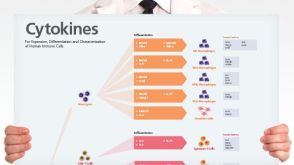 挂图Human Immune Cytokines Infographic of key cytokines for expansion, differentiation and characterization of major immune cell types






 沪公网安备31010102008431号