Kawatsu K et al. (APR 2008)
Journal of clinical microbiology 46 4 1226--31
Development and evaluation of immunochromatographic assay for simple and rapid detection of Campylobacter jejuni and Campylobacter coli in human stool specimens.
An immunochromatographic assay (Campy-ICA) using a newly generated single monoclonal antibody against a 15-kDa cell surface protein of Campylobacter jejuni was developed. When cell suspensions of 86 C. jejuni strains and 27 Campylobacter coli strains were treated with a commercially available bacterial protein extraction reagent and the resulting extracts were tested with the Campy-ICA,they all yielded positive results. The minimum detectable limits for the C. jejuni strains ranged from 1.8 x 10(4) to 8.2 x 10(5) CFU/ml of cell suspension,and those for the C. coli strains ranged from 1.4 x 10(5) to 4.6 x 10(6) CFU/ml of cell suspension. All 26 non-Campylobacter species tested yielded negative results with the Campy-ICA. To evaluate the ability of the Campy-ICA to detect C. jejuni and C. coli in human stool specimens,suspensions of 222 stool specimens from patients with acute gastroenteritis were treated with the bacterial protein extraction reagent,and the resulting extracts were tested with the Campy-ICA. The Campy-ICA results showed a sensitivity of 84.8% (28 of 33 specimens) and a specificity of 100% (189 of 189 specimens) compared to the results of isolation of C. jejuni and C. coli from the stool specimens by a bacterial culture test. The Campy-ICA was simple to perform and was able to detect Campylobacter antigen in a fecal extract within 15 min. These results suggest that Campy-ICA testing of fecal extracts may be useful as a simple and rapid adjunct to stool culture for detecting C. jejuni and C. coli in human stool specimens.
View Publication
Grimaldi JC et al. (JUN 1999)
Journal of Leukocyte Biology 65 6 846--53
Depletion of eosinophils in mice through the use of antibodies specific for C-C chemokine receptor 3 (CCR3).
We have generated rat monoclonal antibodies specific for the mouse eotaxin receptor,C-C chemokine receptor 3 (CCR3). Several anti-CCR3 mAbs proved to be useful for in vivo depletion of CCR3-expressing cells and immunofluorescent staining. In vivo CCR3 mAbs of the IgG2b isotype substantially depleted blood eosinophil levels in Nippostrongyus brasiliensis-infected mice. Repeated anti-CCR3 mAb treatment in these mice significantly reduced tissue eosinophilia in the lung tissue and bronchoalveolar lavage fluid. Flow cytometry revealed that mCCR3 was expressed on eosinophils but not on stem cells,dendritic cells,or cells from the thymus,lymph node,or spleen of normal mice. Unlike human Th2 cells,mouse Th2 cells did not express detectable levels of CCR3 nor did they give a measurable response to eotaxin. None of the mAbs were antagonists or agonists of CCR3 calcium mobilization. To our knowledge,the antibodies described here are the first mAbs reported to be specific for mouse eosinophils and to be readily applicable for the detection,isolation,and in vivo depletion of eosinophils.
View Publication
产品号#:
03800
03801
03802
03803
03804
03805
03806
产品名:
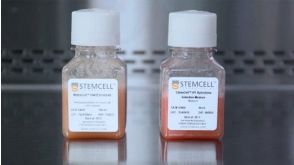
ClonaCell™-HY杂交瘤试剂盒
ClonaCell™-HY培养基A
ClonaCell™-HY 培养基 B
ClonaCell™-HY 培养基 C
ClonaCell™-HY 培养基 D
ClonaCell™-HY 培养基 E
ClonaCell™-HY PEG
Weidanz Ja et al. (OCT 2006)
Journal of Immunology (Baltimore,Md. : 1950) 177 8 5088--97
Levels of specific peptide-HLA class I complex predicts tumor cell susceptibility to CTL killing.
Recognition of tumor-associated Ags (TAAs) on tumor cells by CTLs and the subsequent tumor cell death are assumed to be dependent on TAA protein expression and to correlate directly with the level of peptide displayed in the binding site of the HLA class I molecule. In this study we evaluated whether the levels of Her-2/neu protein expression on human tumor cell lines directly correlate with HLA-A*0201/Her2/neu peptide presentation and CTL recognition. We developed a TCR mimic (TCRm) mAb designated 1B8 that specifically recognizes the HLA-A2.1/Her2/neu peptide (369-377) (Her2(369)-A2) complex. TCRm mAb staining intensity varied for the five human tumor cell lines analyzed,suggesting quantitative differences in levels of the Her2(369)-A2 complex on these cells. Analysis of tumor cell lines pretreated with IFN-gamma and TNF-alpha for Her2/neu protein and HLA-A2 molecule expression did not reveal a direct correlation between the levels of Her2/neu Ag,HLA-A2 molecule,and Her2(369)-A2 complex expression. However,compared with untreated cells,cytokine-treated cell lines showed an increase in Her2(369)-A2 epitope density that directly correlated with enhanced tumor cell death (p = 0.05). Although a trend was observed between tumor cell lysis and the level of the Her2(369)-A2 complex for untreated cells,the association was not significant. These findings suggest that tumor cell susceptibility to CTL-mediated lysis may be predicted based on the level of specific peptide-MHC class I expression rather than on the total level of TAA expression. Further,these studies demonstrate the potential of the TCRm mAb for validation of endogenous HLA-peptide epitopes on tumor cells.
View Publication


 EasySep™小鼠TIL(CD45)正选试剂盒







 沪公网安备31010102008431号