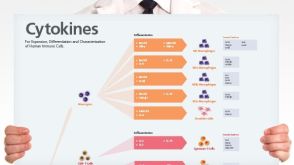
Human Immune Cytokines
Infographic of key cytokines for expansion, differentiation and characterization of major immune cell types
Collins SM et al. (DEC 2013)
Cancer immunology,immunotherapy : CII 62 12 1841--9
Elotuzumab directly enhances NK cell cytotoxicity against myeloma via CS1 ligation: evidence for augmented NK cell function complementing ADCC.
Elotuzumab is a monoclonal antibody in development for multiple myeloma (MM) that targets CS1,a cell surface glycoprotein expressed on MM cells. In preclinical models,elotuzumab exerts anti-MM efficacy via natural killer (NK)-cell-mediated antibody-dependent cellular cytotoxicity (ADCC). CS1 is also expressed at lower levels on NK cells where it acts as an activating receptor. We hypothesized that elotuzumab may have additional mechanisms of action via ligation of CS1 on NK cells that complement ADCC activity. Herein,we show that elotuzumab appears to induce activation of NK cells by binding to NK cell CS1 which promotes cytotoxicity against CS1(+) MM cells but not against autologous CS1(+) NK cells. Elotuzumab may also promote CS1-CS1 interactions between NK cells and CS1(+) target cells to enhance cytotoxicity in a manner independent of ADCC. NK cell activation appears dependent on differential expression of the signaling intermediary EAT-2 which is present in NK cells but absent in primary,human MM cells. Taken together,these data suggest elotuzumab may enhance NK cell function directly and confer anti-MM efficacy by means beyond ADCC alone.
View Publication
产品号#:
18387
18387RF
产品名:
Norman JM et al. (OCT 2011)
Nature immunology 12 10 975--83
The antiviral factor APOBEC3G enhances the recognition of HIV-infected primary T cells by natural killer cells.
APOBEC3G (A3G) is an intrinsic antiviral factor that inhibits the replication of human immunodeficiency virus (HIV) by deaminating cytidine residues to uridine. This causes guanosine-to-adenosine hypermutation in the opposite strand and results in inactivation of the virus. HIV counteracts A3G through the activity of viral infectivity factor (Vif),which promotes degradation of A3G. We report that viral protein R (Vpr),which interacts with a uracil glycosylase,also counteracted A3G by diminishing the incorporation of uridine. However,this process resulted in activation of the DNA-damage–response pathway and the expression of natural killer (NK) cell–activating ligands. Our results show that pathogen-induced deamination of cytidine and the DNA-damage response to virus-mediated repair of the incorporation of uridine enhance the recognition of HIV-infected cells by NK cells.
View Publication
产品号#:
17755
产品名:
Bouchentouf M et al. (DEC 2010)
Journal of immunology (Baltimore,Md. : 1950) 185 11 7014--25
Induction of cardiac angiogenesis requires killer cell lectin-like receptor 1 and α4β7 integrin expression by NK cells.
Recent findings indicate that NK cells are involved in cardiac repair following myocardial infarction. The aim of this study is to investigate the role NK cells in infarct angiogenesis and cardiac remodeling. In normal C57BL/6 mice,myelomonocytic inflammatory cells invaded infarcted heart within 24 h followed by a lymphoid/NK cell infiltrate by day 6,accompanied by substantial expression of IL-2,TNF-α,and CCL2. In contrast,NOD SCID mice had virtually no lymphoid cells infiltrating the heart and did not upregulate IL-2 levels. In vitro and in vivo,IL-2-activated NK cells promoted TNF-α-stimulated endothelial cell proliferation,enhanced angiogenesis and reduced fibrosis within the infarcted myocardium. Adoptive transfer of IL-2-activated NK cells to NOD SCID mice improved post-myocardial infarction angiogenesis. RNA silencing technology and neutralizing Abs demonstrated that this process involved α4β7 integrin/VCAM-1 and killer cell lectin-like receptor 1/N-cadherin-specific binding. In this study,we show that IL-2-activated NK cells reduce myocardial collagen deposition along with an increase in neovascularization following acute cardiac ischemia through specific interaction with endothelial cells. These data define a potential role of activated NK cells in cardiac angiogenesis and open new perspectives for the treatment of ischemic diseases.
View Publication
产品号#:
19755
产品名:
Akatsuka A et al. (SEP 2010)
International immunology 22 9 783--90
Tumor cells of non-hematopoietic and hematopoietic origins express activation-induced C-type lectin, the ligand for killer cell lectin-like receptor F1.
Killer cell lectin-like receptor F1 (KLRF1) is an activating C-type lectin-like receptor expressed on human NK cells and subsets of T cells. In this study,we show that activation-induced C-type lectin (AICL) is a unique KLRF1 ligand expressed on tumor cell lines of hematopoietic and non-hematopoietic origins. We screened a panel of human tumor cell lines using the KLRF1 reporter cells and found that several tumor lines expressed KLRF1 ligands. We characterized a putative KLRF1 ligand expressed on the U937 cell line. The molecular mass for the deglycosylated ligand was 28 kDa under non-reducing condition and 17 kDa under reducing condition,suggesting that the KLRF1 ligand is a homodimer. By expression cloning from a U937 cDNA library,we identified AICL as a KLRF1 ligand. We generated mAbs against AICL to identify the KLRF1 ligands on non-hematopoietic tumor lines. The anti-AICL mAbs stained the tumor lines that express the KLRF1 ligands and importantly the interaction of KLRF1 with the KLRF1 ligand on non-hematopoietic tumors was completely blocked by the two anti-AICL mAbs. Moreover,NK cell degranulation triggered by AICL-expressing targets was partially inhibited by the anti-AICL mAb. Finally,we demonstrate that AICL is expressed in human primary liver cancers. These results suggest that AICL is expressed on tumor cells of non-hematopoietic origins and raise the possibility that AICL may contribute to NK cell surveillance of tumor cells.
View Publication
产品号#:
18554
18554RF
18564
18564RF
产品名:
Kawakami Y et al. (JUN 2009)
The Journal of experimental medicine 206 6 1219--25
Inhibition of NK cell activity by IL-17 allows vaccinia virus to induce severe skin lesions in a mouse model of eczema vaccinatum.
Threats of bioterrorism have renewed efforts to better understand poxvirus pathogenesis and to develop a safer vaccine against smallpox. Individuals with atopic dermatitis are excluded from smallpox vaccination because of their propensity to develop eczema vaccinatum,a disseminated vaccinia virus (VACV) infection. To study the underlying mechanism of the vulnerability of atopic dermatitis patients to VACV infection,we developed a mouse model of eczema vaccinatum. Virus infection of eczematous skin induced severe primary erosive skin lesions,but not in the skin of healthy mice. Eczematous mice exhibited lower natural killer (NK) cell activity but similar cytotoxic T lymphocyte activity and humoral immune responses. The role of NK cells in controlling VACV-induced skin lesions was demonstrated by experiments depleting or transferring NK cells. The proinflammatory cytokine interleukin (IL)-17 reduced NK cell activity in mice with preexisting dermatitis. Given low NK cell activities and increased IL-17 expression in atopic dermatitis patients,these results can explain the increased susceptibility of atopic dermatitis patients to eczema vaccinatum.
View Publication
产品号#:
19755
产品名:
S. L. Rogers et al. (JUL 2006)
Journal of immunology (Baltimore,Md. : 1950) 177 1 414--21
A role for DNA hypomethylation and histone acetylation in maintaining allele-specific expression of mouse NKG2A in developing and mature NK cells.
The repertoire of receptors that is expressed by NK cells is critical for their ability to kill virally infected or transformed cells. However,the molecular mechanisms that determine whether and when NK receptor genes are transcribed during hemopoiesis remain unclear. In this study,we show that hypomethylation of a CpG-rich region in the mouse NKG2A gene is associated with transcription of NKG2A in ex vivo NK cells and NK cell lines. This observation was extended to various developmental stages of NK cells sorted from bone marrow,in which we demonstrate that the CpGs are methylated in the NKG2A-negative stages (hemopoietic stem cells,NK progenitors,and NKG2A-negative NK cells),and hypomethylated specifically in the NKG2A-positive NK cells. Furthermore,we provide evidence that DNA methylation is important in maintaining the allele-specific expression of NKG2A. Finally,we show that acetylated histones are associated with the CpG-rich region in NKG2A positive,but not negative,cell lines,and that treatment with the histone deacetylase inhibitor trichostatin A alone is sufficient to induce NKG2A expression. Treatment with the methyltransferase inhibitor 5-azacytidine only is insufficient to induce transcription,but cotreatment with both drugs resulted in a significantly greater induction,suggesting a cooperative role for DNA methylation and histone acetylation status in regulating gene expression. These results enhance our understanding of the formation and maintenance of NK receptor repertoires in developing and mature NK cells.
View Publication
Huang Y et al. (DEC 2016)
Journal of immunology (Baltimore,Md. : 1950) 197 12 4603--4612
Diversity of Antiviral IgG Effector Activities Observed in HIV-Infected and Vaccinated Subjects.
Diverse Ab effector functions mediated by the Fc domain have been commonly associated with reduced risk of infection in a growing number of nonhuman primate and human clinical studies. This study evaluated the anti-HIV Ab effector activities in polyclonal serum samples from HIV-infected donors,VAX004 vaccine recipients,and healthy HIV-negative subjects using a variety of primary and cell line-based assays,including Ab-dependent cellular cytotoxicity (ADCC),Ab-dependent cell-mediated viral inhibition,and Ab-dependent cellular phagocytosis. Additional assay characterization was performed with a panel of Fc-engineered variants of mAb b12. The goal of this study was to characterize different effector functions in the study samples and identify assays that might most comprehensively and dependably capture Fc-mediated Ab functions mediated by different effector cell types and against different viral targets. Deployment of such assays may facilitate assessment of functionally unique humoral responses and contribute to identification of correlates of protection with potential mechanistic significance in future HIV vaccine studies. Multivariate and correlative comparisons identified a set of Ab-dependent cell-mediated viral inhibition and phagocytosis assays that captured different Ab activities and were distinct from a group of ADCC assays that showed a more similar response profile across polyclonal serum samples. The activities of a panel of b12 monoclonal Fc variants further identified distinctions among the ADCC assays. These results reveal the natural diversity of Fc-mediated Ab effector responses among vaccine recipients in the VAX004 trial and in HIV-infected subjects,and they point to the potential importance of polyfunctional Ab responses.
View Publication
产品号#:
15025
15065
产品名:
RosetteSep™人NK细胞富集抗体混合物
RosetteSep™人NK细胞富集抗体混合物
Mace EM et al. (NOV 2016)
The Journal of clinical investigation
Biallelic mutations in IRF8 impair human NK cell maturation and function.
Human NK cell deficiencies are rare yet result in severe and often fatal disease,particularly as a result of viral susceptibility. NK cells develop from hematopoietic stem cells,and few monogenic errors that specifically interrupt NK cell development have been reported. Here we have described biallelic mutations in IRF8,which encodes an interferon regulatory factor,as a cause of familial NK cell deficiency that results in fatal and severe viral disease. Compound heterozygous or homozygous mutations in IRF8 in 3 unrelated families resulted in a paucity of mature CD56dim NK cells and an increase in the frequency of the immature CD56bright NK cells,and this impairment in terminal maturation was also observed in Irf8-/-,but not Irf8+/-,mice. We then determined that impaired maturation was NK cell intrinsic,and gene expression analysis of human NK cell developmental subsets showed that multiple genes were dysregulated by IRF8 mutation. The phenotype was accompanied by deficient NK cell function and was stable over time. Together,these data indicate that human NK cells require IRF8 for development and functional maturation and that dysregulation of this function results in severe human disease,thereby emphasizing a critical role for NK cells in human antiviral defense.
View Publication
产品号#:
15025
15065
产品名:
RosetteSep™人NK细胞富集抗体混合物
RosetteSep™人NK细胞富集抗体混合物
Cavalli RC et al. ( 2016)
PloS one 11 10 e0164353
Induced Human Decidual NK-Like Cells Improve Utero-Placental Perfusion in Mice.
Decidual NK (dNK) cells,a distinct type of NK cell,are thought to regulate uterine spiral artery remodeling,a process that allows for increased blood delivery to the fetal-placental unit. Impairment of uterine spiral artery remodeling is associated with decreased placental perfusion,increased uterine artery resistance,and obstetric complications such as preeclampsia and intrauterine growth restriction. Ex vivo manipulation of human peripheral blood NK (pNK) cells by a combination of hypoxia,TGFß-1 and 5-aza-2'-deoxycytidine yields cells with phenotypic and in vitro functional similarities to dNK cells,called idNK cells. Here,gene expression profiling shows that CD56Bright idNK cells derived ex vivo from human pNK cells,and to a lesser extent CD56Dim idNK cells,are enriched in the gene expression signature that distinguishes dNK cells from pNK cells. When injected into immunocompromised pregnant mice with elevated uterine artery resistance,idNK cells homed to the uterus and reduced the uterine artery resistance index,suggesting improved placental perfusion.
View Publication


 EasySep™小鼠TIL(CD45)正选试剂盒




 挂图Human Immune Cytokines Infographic of key cytokines for expansion, differentiation and characterization of major immune cell types
 科学海报Cell Enrichment to Obtain Mouse NK Cell Populations By Negative Selection

 沪公网安备31010102008431号