Chronic Hepatitis C Virus Infection Impairs M1 Macrophage Differentiation and Contributes to CD8+ T-Cell Dysfunction.
Chronic hepatitis C virus (HCV) infection causes generalized CD8+ T cell impairment,not limited to HCV-specific CD8+ T-cells. Liver-infiltrating monocyte-derived macrophages (MDMs) contribute to the local micro-environment and can interact with and influence cells routinely trafficking through the liver,including CD8+ T-cells. MDMs can be polarized into M1 (classically activated) and M2a,M2b,and M2c (alternatively activated) phenotypes that perform pro- and anti-inflammatory functions,respectively. The impact of chronic HCV infection on MDM subset functions is not known. Our results show that M1 cells generated from chronic HCV patients acquire M2 characteristics,such as increased CD86 expression and IL-10 secretion,compared to uninfected controls. In contrast,M2 subsets from HCV-infected individuals acquired M1-like features by secreting more IL-12 and IFN-gamma. The severity of liver disease was also associated with altered macrophage subset differentiation. In co-cultures with autologous CD8+ T-cells from controls,M1 macrophages alone significantly increased CD8+ T cell IFN-gamma expression in a cytokine-independent and cell-contact-dependent manner. However,M1 macrophages from HCV-infected individuals significantly decreased IFN-gamma expression in CD8+ T-cells. Therefore,altered M1 macrophage differentiation in chronic HCV infection may contribute to observed CD8+ T-cell dysfunction. Understanding the immunological perturbations in chronic HCV infection will lead to the identification of therapeutic targets to restore immune function in HCV+ individuals,and aid in the mitigation of associated negative clinical outcomes.
View Publication
He W et al. (NOV 2017)
Cancer research 77 22 6375--6388
CD155T/TIGIT Signaling Regulates CD8+ T-cell Metabolism and Promotes Tumor Progression in Human Gastric Cancer.
The T-cell surface molecule TIGIT is an immune checkpoint molecule that inhibits T-cell responses,but its roles in cancer are little understood. In this study,we evaluated the role TIGIT checkpoint plays in the development and progression of gastric cancer. We show that the percentage of CD8 T cells that are TIGIT+ was increased in gastric cancer patients compared with healthy individuals. These cells showed functional exhaustion with impaired activation,proliferation,cytokine production,and metabolism,all of which were rescued by glucose. In addition,gastric cancer tissue and cell lines expressed CD155,which bound TIGIT receptors and inactivated CD8 T cells. In a T cell-gastric cancer cell coculture system,gastric cancer cells deprived CD8 T cells of glucose and impaired CD8 T-cell effector functions; these effects were neutralized by the additional glucose or by TIGIT blockade. In gastric cancer tumor cells,CD155 silencing increased T-cell metabolism and IFNγ production,whereas CD155 overexpression inhibited T-cell metabolism and IFNγ production; this inhibition was neutralized by TIGIT blockade. Targeting CD155/TIGIT enhanced CD8 T-cell reaction and improved survival in tumor-bearing mice. Combined targeting of TIGIT and PD-1 further enhanced CD8 T-cell activation and improved survival in tumor-bearing mice. Our results suggest that gastric cancer cells inhibit CD8 T-cell metabolism through CD155/TIGIT signaling,which inhibits CD8 T-cell effector functions,resulting in hyporesponsive antitumor immunity. These findings support the candidacy of CD155/TIGIT as a potential therapeutic target in gastric cancer. Cancer Res; 77(22); 6375-88. textcopyright2017 AACR.
View Publication
产品号#:
19158
19158RF
19053
19053RF
产品名:
EasySep™人CD8+ T细胞富集试剂盒
RoboSep™ 人CD8+ T细胞富集试剂盒含滤芯吸头
Chen Z et al. (SEP 2017)
Cell reports 20 11 2584--2597
miR-150 Regulates Memory CD8 T Cell Differentiation via c-Myb.
MicroRNAs play an important role in T cell responses. However,how microRNAs regulate CD8 T cell memory remains poorly defined. Here,we found that miR-150 negatively regulates CD8 T cell memory in vivo. Genetic deletion of miR-150 disrupted the balance between memory precursor and terminal effector CD8 T cells following acute viral infection. Moreover,miR-150-deficient memory CD8 T cells were more protective upon rechallenge. A key circuit whereby miR-150 repressed memory CD8 T cell development through the transcription factor c-Myb was identified. Without miR-150,c-Myb was upregulated and anti-apoptotic targets of c-Myb,such as Bcl-2 and Bcl-xL,were also increased,suggesting a miR-150-c-Myb survival circuit during memory CD8 T cell development. Indeed,overexpression of non-repressible c-Myb rescued the memory CD8 T cell defects caused by overexpression of miR-150. Overall,these results identify a key role for miR-150 in memory CD8 T cells through a c-Myb-controlled enhanced survival circuit.
View Publication
产品号#:
19853
19853RF
产品名:
EasySep™小鼠CD8+ T细胞分选试剂盒
RoboSep™ 小鼠CD8+ T细胞分选试剂盒
Xu MM et al. (AUG 2017)
Immunity 47 2 363--373.e5
Dendritic Cells but Not Macrophages Sense Tumor Mitochondrial DNA for Cross-priming through Signal Regulatory Protein α Signaling.
Inhibition of cytosolic DNA sensing represents a strategy that tumor cells use for immune evasion,but the underlying mechanisms are unclear. Here we have shown that CD47-signal regulatory protein α (SIRPα) axis dictates the fate of ingested DNA in DCs for immune evasion. Although macrophages were more potent in uptaking tumor DNA,increase of DNA sensing by blocking the interaction of SIRPα with CD47 preferentially occurred in dendritic cells (DCs) but not in macrophages. Mechanistically,CD47 blockade enabled the activation of NADPH oxidase NOX2 in DCs,which in turn inhibited phagosomal acidification and reduced the degradation of tumor mitochondrial DNA (mtDNA) in DCs. mtDNA was recognized by cyclic-GMP-AMP synthase (cGAS) in the DC cytosol,contributing to type I interferon (IFN) production and antitumor adaptive immunity. Thus,our findings have demonstrated how tumor cells inhibit innate sensing in DCs and suggested that the CD47-SIRPα axis is critical for DC-driven antitumor immunity.
View Publication
产品号#:
18780
18780RF
18781
18781RF
19853
19853RF
70025
70025.1
70025.2
70025.3
产品名:
EasySep™小鼠CD11c正选试剂盒II
RoboSep™ 小鼠CD11c正选试剂盒II
EasySep™小鼠CD11c正选试剂盒II及脾脏解离液
RoboSep™ 小鼠CD11c正选试剂盒II及脾脏解离液
EasySep™小鼠CD8+ T细胞分选试剂盒
RoboSep™ 小鼠CD8+ T细胞分选试剂盒
冻存的人外周血单个核细胞
冻存的人外周血单个核细胞
冻存的人外周血单个核细胞
冻存的人外周血单个核细胞
Wang X et al. ( 2012)
Journal of immunotherapy (Hagerstown,Md. : 1997) 35 9 689--701
Phenotypic and functional attributes of lentivirus-modified CD19-specific human CD8+ central memory T cells manufactured at clinical scale.
A key determinant of the therapeutic potency of adoptive T-cell transfer is the extent to which infused cells can persist and expand in vivo. Ex vivo propagated virus-specific and chimeric antigen receptor (CAR)-redirected antitumor CD8 effector T cells derived from CD45RA(-) CD62L(+) central memory (TCM) precursors engraft long-term and reconstitute functional memory after adoptive transfer. Here,we describe a clinical scale,closed system,immunomagnetic selection method to isolate CD8(+) T(CM) from peripheral blood mononuclear cells (PBMC). This method uses the CliniMACS device to first deplete CD14(+),CD45RA(+),and CD4(+) cells from PBMC,and then to positively select CD62L(+) cells. The average purity and yield of CD8(+) CD45RA(-) CD62L TCM obtained in full-scale qualification runs were 70% and 0.4% (of input PBMC),respectively. These CD8(+) T(CM) are responsive to anti-CD3/CD28 bead stimulation,and can be efficiently transduced with CAR encoding lentiviral vectors,and undergo sustained expansion in interleukin (IL)-2/IL-15 over 3-6 weeks. The resulting CD8(+) T(CM)-derived effectors are polyclonal,retain expression of CD62L and CD28,exhibit CAR-redirected antitumor effector function,and are capable of huIL-15-dependent in vivo homeostatic engraftment after transfer to immunodeficient NOD/Scid IL-2RgCnull mice. Adoptive therapy using purified T(CM) cells is now the subject of a Food and Drug Administration-authorized clinical trial for the treatment of CD19(+) B-cell malignancies,and 3 clinical cell products expressing a CD19-specific CAR for IND 14645 have already been successfully generated from lymphoma patients using this manufacturing platform.
View Publication


 EasySep™小鼠TIL(CD45)正选试剂盒





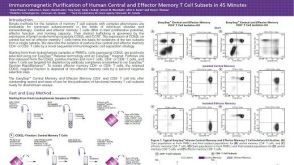 科学海报Immunomagnetic Purification of Human Central and Effector Memory T Cell Subsets in 45 Minutes

 沪公网安备31010102008431号