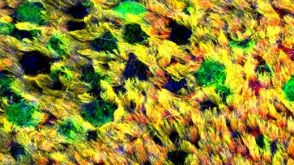
F. Cadamuro et al. (Feb 2023)
Carbohydrate polymers 302 120395
3D bioprinted colorectal cancer models based on hyaluronic acid and signalling glycans.
In cancer microenvironment,aberrant glycosylation events of ECM proteins and cell surface receptors occur. We developed a protocol to generate 3D bioprinted models of colorectal cancer (CRC) crosslinking hyaluronic acid and gelatin functionalized with three signalling glycans characterized in CRC,3'-Sialylgalactose,6'-Sialylgalactose and 2'-Fucosylgalactose. The crosslinking,performed exploiting azide functionalized gelatin and hyaluronic acid and 4arm-PEG-dibenzocyclooctyne,resulted in biocompatible hydrogels that were 3D bioprinted with commercial CRC cells HT-29 and patient derived CRC tumoroids. The glycosylated hydrogels showed good 3D printability,biocompatibility and stability over the time. SEM and synchrotron radiation SAXS/WAXS analysis revealed the influence of glycosylation in the construct morphology,whereas MALDI-MS imaging showed that protein profiles of tumoroid cells vary with glycosylation,indicating that sialylation and fucosylation of ECM proteins induce diverse alterations to the proteome of the tumoroid and surrounding cells.
View Publication
Ishikawa S et al. ( 2017)
Respiratory Research 18 1 1--11
A 3D epithelial-mesenchymal co-culture model of human bronchial tissue recapitulates multiple features of airway tissue remodeling by TGF-β1 treatment
BACKGROUND: The collagen gel contraction assay measures gel size to assess the contraction of cells embedded in collagen gel matrices. Using the assay with lung fibroblasts is useful in studying the lung tissue remodeling process in wound healing and disease development. However,the involvement of bronchial epithelial cells in this process should also be investigated. METHODS: We applied a layer of mucociliary differentiated bronchial epithelial cells onto collagen gel matrices with lung fibroblasts. This co-culture model enables direct contact between epithelial and mesenchymal cells. We stimulated the culture with transforming growth factor (TGF) beta1 as an inducer of tissue remodeling for 21 days,and measured gel size,histological changes,and expression of factors related to extracellular matrix homeostasis. RESULTS: TGF-beta1 exerted a concentration-dependent effect on collagen gel contraction and on contractile myofibroblasts in the mesenchymal collagen layer. TGF-beta1 also induced expression of the mesenchymal marker vimentin in the basal layer of the epithelium,suggesting the induction of epithelial-mesenchymal transition. In addition,the expression of various genes encoding extracellular matrix proteins was upregulated. Fibrotic tenascin-C accumulated in the sub-epithelial region of the co-culture model. CONCLUSION: Our findings indicate that TGF-beta1 can affect both epithelial and mesenchymal cells,and induce gel contraction and structural changes. Our novel in vitro co-culture model will be a useful tool for investigating the roles of epithelial cells,fibroblasts,and their interactions in the airway remodeling process.
View Publication
Shikotra A et al. ( 2017)
Journal of immunology (Baltimore,Md. : 1950) 198 8 3307--3317
A CEACAM6-High Airway Neutrophil Phenotype and CEACAM6-High Epithelial Cells Are Features of Severe Asthma.
Severe asthma represents a major unmet clinical need; understanding the pathophysiology is essential for the development of new therapies. Using microarray analysis,we previously found three immunological clusters in asthma: Th2-high,Th17-high,and Th2/17-low. Although new therapies are emerging for Th2-high disease,identifying molecular pathways in Th2-low disease remains an important goal. Further interrogation of our previously described microarray dataset revealed upregulation of gene expression for carcinoembryonic Ag cell adhesion molecule (CEACAM) family members in the bronchi of patients with severe asthma. Our aim was therefore to explore the distribution and cellular localization of CEACAM6 using immunohistochemistry on bronchial biopsy tissue obtained from patients with mild-to-severe asthma and healthy control subjects. Human bronchial epithelial cells were used to investigate cytokine and corticosteroid in vitro regulation of CEACAM6 gene expression. CEACAM6 protein expression in bronchial biopsies was increased in airway epithelial cells and lamina propria inflammatory cells in severe asthma compared with healthy control subjects. CEACAM6 in the lamina propria was localized to neutrophils predominantly. Neutrophil density in the bronchial mucosa was similar across health and the spectrum of asthma severity,but the percentage of neutrophils expressing CEACAM6 was significantly increased in severe asthma,suggesting the presence of an altered neutrophil phenotype. CEACAM6 gene expression in cultured epithelial cells was upregulated by wounding and neutrophil elastase. In summary,CEACAM6 expression is increased in severe asthma and primarily associated with airway epithelial cells and tissue neutrophils. CEACAM6 may contribute to the pathology of treatment-resistant asthma via neutrophil and airway epithelial cell-dependent pathways.
View Publication
D. R. McHugh et al. ( 2018)
PloS one 13 6 e0199573
A G542X cystic fibrosis mouse model for examining nonsense mutation directed therapies.
Nonsense mutations are present in 10{\%} of patients with CF,produce a premature termination codon in CFTR mRNA causing early termination of translation,and lead to lack of CFTR function. There are no currently available animal models which contain a nonsense mutation in the endogenous Cftr locus that can be utilized to test nonsense mutation therapies. In this study,we create a CF mouse model carrying the G542X nonsense mutation in Cftr using CRISPR/Cas9 gene editing. The G542X mouse model has reduced Cftr mRNA levels,demonstrates absence of CFTR function,and displays characteristic manifestations of CF mice such as reduced growth and intestinal obstruction. Importantly,CFTR restoration is observed in G542X intestinal organoids treated with G418,an aminoglycoside with translational readthrough capabilities. The G542X mouse model provides an invaluable resource for the identification of potential therapies of CF nonsense mutations as well as the assessment of in vivo effectiveness of these potential therapies targeting nonsense mutations.
View Publication
Eirew P et al. (DEC 2008)
Nature medicine 14 12 1384--9
A method for quantifying normal human mammary epithelial stem cells with in vivo regenerative ability.
Previous studies have demonstrated that normal mouse mammary tissue contains a rare subset of mammary stem cells. We now describe a method for detecting an analogous subpopulation in normal human mammary tissue. Dissociated cells are suspended with fibroblasts in collagen gels,which are then implanted under the kidney capsule of hormone-treated immunodeficient mice. After 2-8 weeks,the gels contain bilayered mammary epithelial structures,including luminal and myoepithelial cells,their in vitro clonogenic progenitors and cells that produce similar structures in secondary transplants. The regenerated clonogenic progenitors provide an objective indicator of input mammary stem cell activity and allow the frequency and phenotype of these human mammary stem cells to be determined by limiting-dilution analysis. This new assay procedure sets the stage for investigations of mechanisms regulating normal human mammary stem cells (and possibly stem cells in other tissues) and their relationship to human cancer stem cell populations.
View Publication
N. K. Lytle et al. ( 2019)
Cell 177 3 572--586.e22
A Multiscale Map of the Stem Cell State in Pancreatic Adenocarcinoma.
Drug resistance and relapse remain key challenges in pancreatic cancer. Here,we have used RNA sequencing (RNA-seq),chromatin immunoprecipitation (ChIP)-seq,and genome-wide CRISPR analysis to map the molecular dependencies of pancreatic cancer stem cells,highly therapy-resistant cells that preferentially drive tumorigenesis and progression. This integrated genomic approach revealed an unexpected utilization of immuno-regulatory signals by pancreatic cancer epithelial cells. In particular,the nuclear hormone receptor retinoic-acid-receptor-related orphan receptor gamma (ROR$\gamma$),known to drive inflammation and T cell differentiation,was upregulated during pancreatic cancer progression,and its genetic or pharmacologic inhibition led to a striking defect in pancreatic cancer growth and a marked improvement in survival. Further,a large-scale retrospective analysis in patients revealed that ROR$\gamma$ expression may predict pancreatic cancer aggressiveness,as it positively correlated with advanced disease and metastasis. Collectively,these data identify an orthogonal co-option of immuno-regulatory signals by pancreatic cancer stem cells,suggesting that autoimmune drugs should be evaluated as novel treatment strategies for pancreatic cancer patients.
View Publication
A triple co-culture model of the human respiratory tract to study immune-modulatory effects of liposomes and virosomes
The respiratory tract with its ease of access,vast surface area and dense network of antigen-presenting cells (APCs) represents an ideal target for immune-modulation. Bio-mimetic nanocarriers such as virosomes may provide immunomodulatory properties to treat diseases such as allergic asthma. In our study we employed a triple co-culture model of epithelial cells,macrophages and dendritic cells to simulate the human airway barrier. The epithelial cell line 16HBE was grown on inserts and supplemented with human blood monocyte-derived macrophages (MDMs) and dendritic cells (MDDCs) for exposure to influenza virosomes and liposomes. Additionally,primary human nasal epithelial cells (PHNEC) and EpCAM+ epithelial progenitor cell mono-cultures were utilized to simulate epithelium from large and smaller airways,respectively. To assess particle uptake and phenotype change,cell cultures were analyzed by flow cytometry and pro-inflammatory cytokine concentrations were measured by ELISA. All cell types internalized virosomes more efficiently than liposomes in both mono- and co-cultures. APCs like MDMs and MDDCs showed the highest uptake capacity. Virosome and liposome treatment caused a moderate degree of activation in MDDCs from mono-cultures and induced an increased cytokine production in co-cultures. In epithelial cells,virosome uptake was increased compared to liposomes in both mono- and co-cultures with EpCAM+ epithelial progenitor cells showing highest uptake capacity. In conclusion,all cell types successfully internalized both nanocarriers with virosomes being taken up by a higher proportion of cells and at a higher rate inducing limited activation of MDDCs. Thus virosomes may represent ideal carrier antigen systems to modulate mucosal immune responses in the respiratory tract without causing excessive inflammatory changes.
View Publication
Saxena A et al. (JUL 2017)
American journal of physiology. Gastrointestinal and liver physiology 313 1 G26--G38
Absence of the NOD2 protein renders epithelia more susceptible to barrier dysfunction due to mitochondrial dysfunction.
Irregular mitochondria structure and reduced ATP in some patients with IBD suggest that metabolic stress contributes to disease. Loss-of-function mutation in the nucleotide-binding oligomerization domain (NOD)-2 gene is a major susceptibility trait for IBD. Hence,we assessed if loss of NOD2 further impairs the epithelial barrier function instigated by disruption of mitochondrial ATP synthesis via the hydrogen ionophore dinitrophenol (DNP). NOD2 protein (virtually undetectable in epithelia under basal conditions) was increased in T84 (human colon cell line) cells treated with noninvasive Escherichia coli + DNP (16 h). Increased intracellular bacteria in wild-type (WT) and NOD2 knockdown (KD) cells and colonoids from NOD2(-/-) mice were mediated by reactive oxygen species (ROS) and the MAPK ERK1/2 pathways as determined by cotreatment with the antioxidant mitoTEMPO and the ERK inhibitor U0126: ROS was upstream of ERK1/2 activation. Despite increased E. coli in DNP-treated NOD2 KD compared with WT cells,there were no differences in the internalization of fluorescent inert beads or dead E. coli particles. This suggests that lack of killing in the NOD2 KD cells was responsible for the increased numbers of viable intracellular bacteria; a conclusion supported by evidence of reduced autophagy in NOD2 KD T84 epithelia. Thus,in a two-hit hypothesis,decreased barrier function due to dysfunctional mitochondrial is amplified by lack of NOD2 in transporting enterocytes: subsequently,greater numbers of bacteria entering the mucosa would be a significant inflammatory threat especially since individuals with NOD2 mutations have compromised macrophage and Paneth cell responses to bacteria.NEW & NOTEWORTHY Increased internalization of bacteria by epithelia with dysfunctional mitochondria (reduced ATP) is potentiated if the cells lack nucleotide-binding oligomerization domain 2 (NOD2),mutations in which are inflammatory bowel disease-susceptibility traits. Uptake of bacteria was dependent on reactive oxygen species and MAP-kinase activity,and the increased viable intracellular bacteria in NOD2(-/-) cells likely reflect a reduced ability to recognize and kill bacteria. Thus a significant barrier defect occurs with NOD2 deficiency in conjunction with metabolic stress that could contribute to inflammation.
View Publication
Korkaya H et al. (AUG 2012)
Molecular cell 47 4 570--84
Activation of an IL6 inflammatory loop mediates trastuzumab resistance in HER2+ breast cancer by expanding the cancer stem cell population.
Although inactivation of the PTEN gene has been implicated in the development of resistance to the HER2 targeting antibody trastuzumab,the mechanisms mediating this resistance remain elusive. We generated trastuzumab resistant cells by knocking down PTEN expression in HER2 overexpressing breast cancer cell lines and demonstrate that development of trastuzumab resistance in these cells is mediated by activation of an IL6 inflammatory feedback loop leading to expansion of the cancer stem cell (CSC) population. Long term trastuzumab treatment generates highly enriched CSCs which display an EMT phenotype secreting over 100-fold more IL6 than parental cells. An IL6 receptor antibody interrupted this inflammatory feedback loop reducing the cancer stem cell population resulting in decreased tumor growth and metastasis in mouse xenographs. These studies demonstrate that trastuzumab resistance may be mediated by an IL6 inflammatory loop and suggest that blocking this loop may provide alternative strategy to overcome trastuzumab resistance.
View Publication