Human Immune Cytokines
Infographic of key cytokines for expansion, differentiation and characterization of major immune cell types
Ols ML et al. (OCT 2016)
Immunity
Dendritic Cells Regulate Extrafollicular Autoreactive B Cells via T Cells Expressing Fas and Fas Ligand.
The extrafollicular (EF) plasmablast response to self-antigens that contain Toll-like receptor (TLR) ligands is prominent in murine lupus models and some bacterial infections,but the inhibitors and activators involved have not been fully delineated. Here,we used two conventional dendritic cell (cDC) depletion systems to investigate the role of cDCs on a classical TLR-dependent autoreactive EF response elicited in rheumatoid-factor B cells by DNA-containing immune complexes. Contrary to our hypothesis,cDC depletion amplified rather than dampened the EF response in Fas-intact but not Fas-deficient mice. Further,we demonstrated that cDC-dependent regulation requires Fas and Fas ligand (FasL) expression by T cells,but not Fas expression by B cells. Thus,cDCs activate FasL-expressing T cells that regulate Fas-expressing extrafollicular helper T (Tefh) cells. These studies reveal a regulatory role for cDCs in B cell plasmablast responses and provide a mechanistic explanation for the excess autoantibody production observed in Fas deficiency.
View Publication
产品号#:
19754
19754RF
产品名:
Chorny A et al. (SEP 2016)
The Journal of experimental medicine
The soluble pattern recognition receptor PTX3 links humoral innate and adaptive immune responses by helping marginal zone B cells.
Pentraxin 3 (PTX3) is a fluid-phase pattern recognition receptor of the humoral innate immune system with ancestral antibody-like properties but unknown antibody-inducing function. In this study,we found binding of PTX3 to splenic marginal zone (MZ) B cells,an innate-like subset of antibody-producing lymphocytes strategically positioned at the interface between the circulation and the adaptive immune system. PTX3 was released by a subset of neutrophils that surrounded the splenic MZ and expressed an immune activation-related gene signature distinct from that of circulating neutrophils. Binding of PTX3 promoted homeostatic production of IgM and class-switched IgG antibodies to microbial capsular polysaccharides,which decreased in PTX3-deficient mice and humans. In addition,PTX3 increased IgM and IgG production after infection with blood-borne encapsulated bacteria or immunization with bacterial carbohydrates. This immunogenic effect stemmed from the activation of MZ B cells through a neutrophil-regulated pathway that elicited class switching and plasmablast expansion via a combination of T cell-independent and T cell-dependent signals. Thus,PTX3 may bridge the humoral arms of the innate and adaptive immune systems by serving as an endogenous adjuvant for MZ B cells. This property could be harnessed to develop more effective vaccines against encapsulated pathogens.
View Publication
产品号#:
19754
19754RF
产品名:
Drake LY et al. (JUL 2016)
Journal of immunology (Baltimore,Md. : 1950)
Group 2 Innate Lymphoid Cells Promote an Early Antibody Response to a Respiratory Antigen in Mice.
Innate lymphoid cells (ILCs) are a new family of immune cells that play important roles in innate immunity in mucosal tissues,and in the maintenance of tissue and metabolic homeostasis. Recently,group 2 ILCs (ILC2s) were found to promote the development and effector functions of Th2-type CD4(+) T cells by interacting directly with T cells or by activating dendritic cells,suggesting a role for ILC2s in regulating adaptive immunity. However,our current knowledge on the role of ILCs in humoral immunity is limited. In this study,we found that ILC2s isolated from the lungs of naive BALB/c mice enhanced the proliferation of B1- as well as B2-type B cells and promoted the production of IgM,IgG1,IgA,and IgE by these cells in vitro. Soluble factors secreted by ILC2s were sufficient to enhance B cell Ig production. By using blocking Abs and ILC2s isolated from IL-5-deficient mice,we found that ILC2-derived IL-5 is critically involved in the enhanced production of IgM. Furthermore,when adoptively transferred to Il7r(-/-) mice,which lack ILC2s and mature T cells,lung ILC2s promoted the production of IgM Abs to a polysaccharide Ag,4-hydroxy-3-nitrophenylacetyl Ficoll,within 7 d of airway exposure in vivo. These findings add to the growing body of literature regarding the regulatory functions of ILCs in adaptive immunity,and suggest that lung ILC2s promote B cell production of early Abs to a respiratory Ag even in the absence of T cells.
View Publication
产品号#:
19754
19754RF
18554
18554RF
18564
18564RF
产品名:
Hauer J et al. (JUL 2011)
Blood 118 3 544--53
Loss of p19Arf in a Rag1(-/-) B-cell precursor population initiates acute B-lymphoblastic leukemia.
In human B-acute lymphoblastic leukemia (B-ALL),RAG1-induced genomic alterations are important for disease progression. However,given that biallelic loss of the RAG1 locus is observed in a subset of cases,RAG1's role in the development of B-ALL remains unclear. We chose a p19Arf(-/-)Rag1(-/-) mouse model to confirm the previously published results concerning the contribution of CDKN2A (p19ARF /INK4a) and RAG1 copy number alterations in precursor B cells to the initiation and/or progression to B-acute lymphoblastic leukemia (B-ALL). In this murine model,we identified a new,Rag1-independent leukemia-initiating mechanism originating from a Sca1(+)CD19(+) precursor cell population and showed that Notch1 expression accelerates the cells' self-renewal capacity in vitro. In human RAG1-deficient BM,a similar CD34(+)CD19(+) population expressed p19ARF. These findings suggest that combined loss of p19Arf and Rag1 results in B-cell precursor leukemia in mice and may contribute to the progression of precursor B-ALL in humans.
View Publication


 EasySep™小鼠TIL(CD45)正选试剂盒







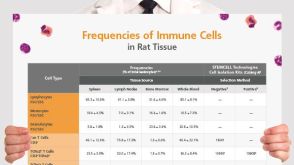 挂图Frequencies of Immune Cells in Rat Tissue Lists the estimated frequencies of more than 15 immune cell types in Sprague Dawley rats
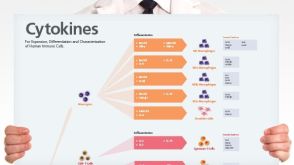 挂图Human Immune Cytokines Infographic of key cytokines for expansion, differentiation and characterization of major immune cell types


 沪公网安备31010102008431号